MBABANE – The ongoing anti-migrant campaign in South Africa could significantly disrupt Eswatini’s economy.
This is unless the country moves quickly to diversify its trade and investment base, the Southern African Regional Financial and Economic Development (SARFED) has warned.
In a policy brief released this week, SARFED said Eswatini’s heavy dependence on South Africa for trade, employment and investment leaves it highly vulnerable to the economic fallout from growing hostility towards foreign nationals in the neighbouring country.
The report follows recent anti-migrant protests and calls for undocumented foreign nationals working in South Africa’s informal sector to leave the country.
According to SARFED, the developments have already displaced thousands of foreign workers, including emaSwati, raising concerns over the wider economic implications for Southern Africa.
SARFED noted that more than 70 per cent of Eswatini’s imports originate from South Africa, while around 60 per cent of the country’s exports are destined for the South African market.
This level of dependence means any slowdown in South Africa’s economy is likely to have immediate consequences for Eswatini.
The organisation warned that violence and uncertainty in South Africa could discourage foreign direct investment across the region, affecting countries linked through the Southern African Customs Union (SACU), including Eswatini, Lesotho and Namibia.
According to the report, the shrinking of South Africa’s informal sector could weaken both supply and demand, disrupting trade flows, reducing business opportunities and slowing economic activity across neighbouring countries.
SARFED further cautioned that Eswatini could experience increased unemployment if returning migrant workers struggle to find jobs locally. The report notes that the country’s unemployment rate exceeds 30 per cent, while youth unemployment is estimated at more than 50 per cent, making the economy particularly vulnerable to a sudden influx of returning workers.
However, the organisation believes the situation also presents an opportunity for Eswatini to strengthen its economic resilience.
It urged government to diversify the economy, attract more foreign investment and reform policies to position Eswatini as a competitive investment destination within the region.
SARFED also recommended that government strengthen domestic economic policies and review investment frameworks to improve competitiveness while expanding trade opportunities beyond South Africa.
*Full article available on Pressreader*
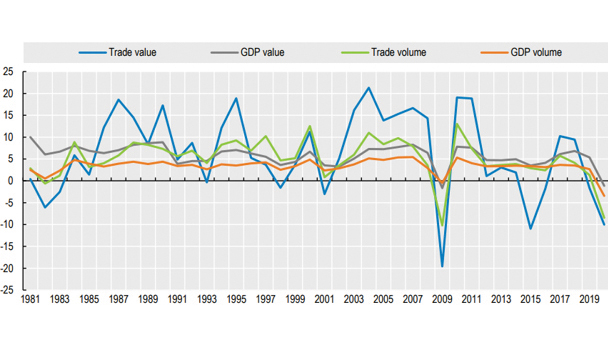
Global Trade values are declining by 2019.