MBABANE – Eswatini has begun 2026 on a remarkably strong footing after recording its fastest quarterly economic expansion in more than a year.
This is despite persistent global economic uncertainty characterised by slowing international trade, geopolitical tensions, elevated borrowing costs and weakening consumer demand in many parts of the world.
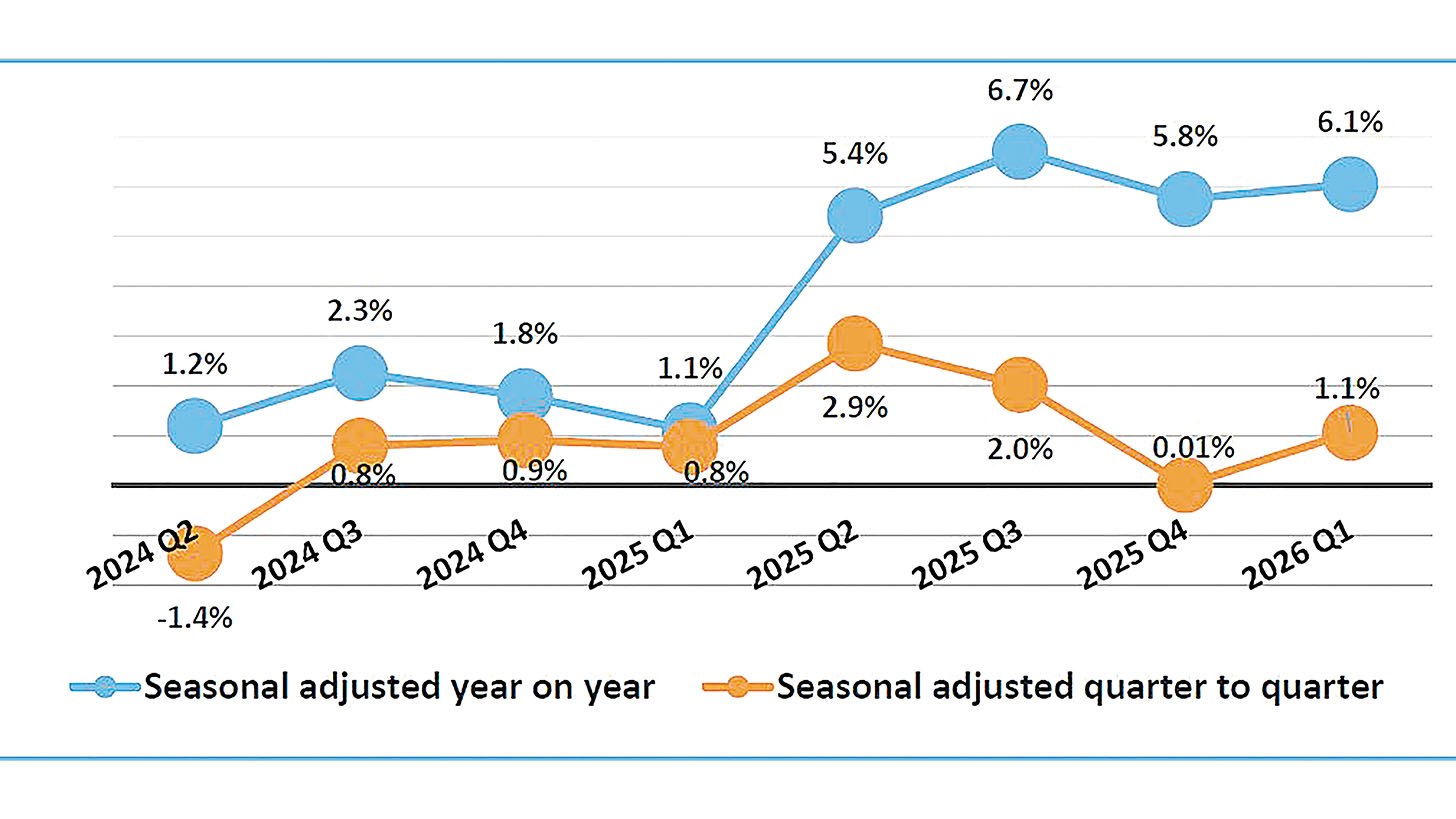
The country’s real gross domestic product (GDP) expanded by 6.1 per cent during the first quarter of 2026 compared with the corresponding quarter of 2025.
This, according to the stats, shows broad-based economic resilience that was underpinned by manufacturing, construction, mining, information and communication technologies, tourism-related activities and professional services.
The latest Quarterly GDP Bulletin released by the Central Statistical Office (CSO) shows that the performance represents an improvement from the 1.1 per cent year-on-year growth recorded during the first quarter of 2025, illustrating the pace at which economic activity has accelerated over the past 12 months.
While many economies continue grappling with subdued investment and slowing industrial production following years of global economic disruptions, Eswatini’s latest figures suggest that domestic production, infrastructure investment and private sector activity continue to provide important buffers against external shocks.
The figures are particularly encouraging because they reflect real GDP, meaning the growth has been adjusted for inflation and, therefore, represents an increase in actual economic output rather than simply higher prices.
According to the CSO, the quarterly estimates are seasonally adjusted to remove normal seasonal fluctuations, providing a clearer picture of underlying economic trends.
The seasonally adjusted GDP also rose to E24.1 billion at current prices during the first quarter, while real GDP measured at constant prices stood at E18.4 billion, reflecting higher overall economic activity across the country.
Secondary sector grows by 13.9%
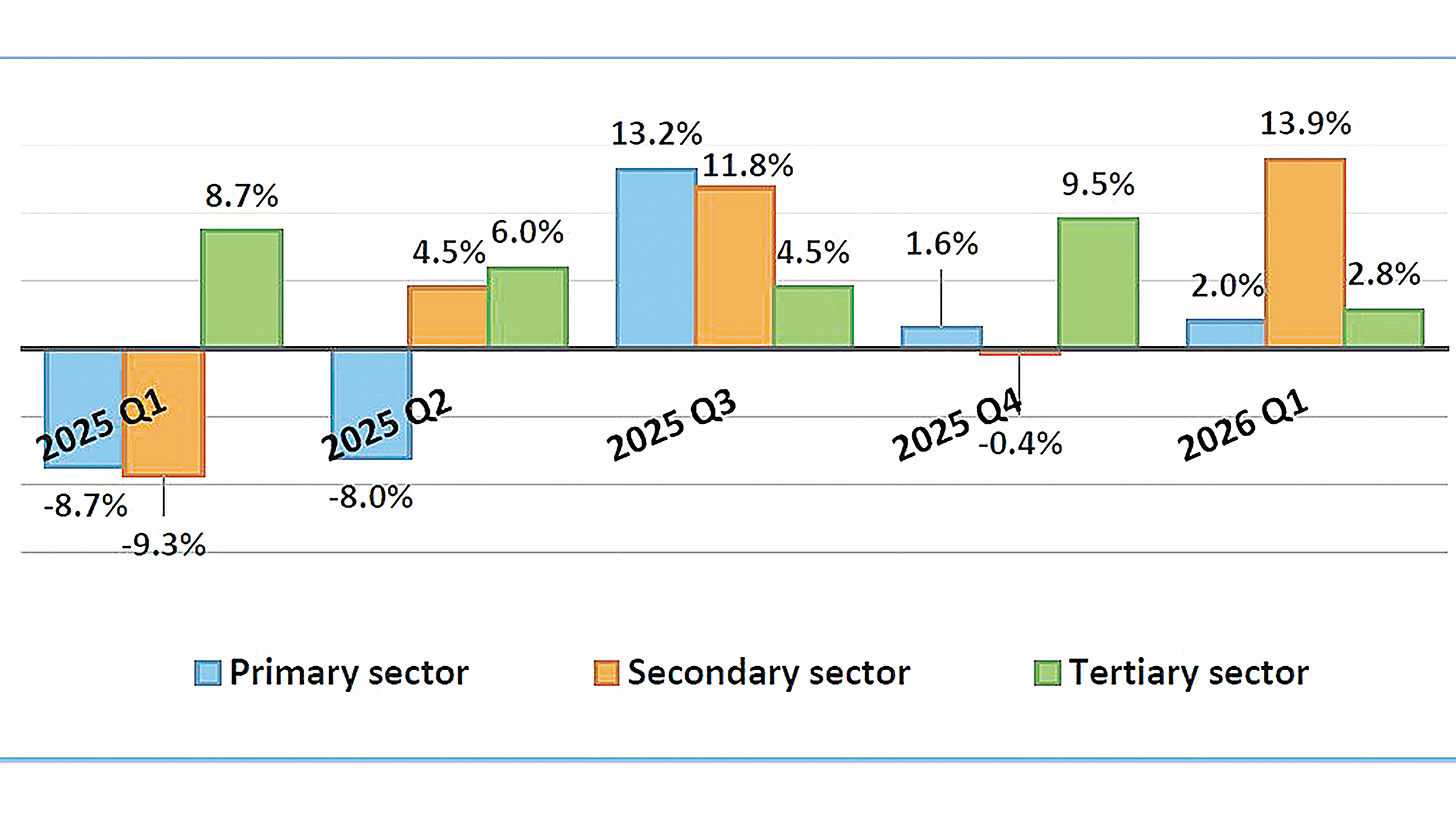
MBABANE – The secondary sector, which comprises manufacturing, construction, electricity and water, expanded by 13.9 per cent, making it the fastest-growing of the three broad sectors of the economy.
Although it contributes 33.3 per cent of total economic output, the sector was responsible for much of the overall GDP acceleration due mainly to strong manufacturing and construction activity.
This trend points towards increasing industrial activity, an encouraging sign for a country pursuing export-led industrialisation and economic diversification.
Although growth in services was more moderate, the tertiary sector remained the largest contributor to the economy, accounting for 60.9 per cent of GDP while expanding by 2.8 per cent.
Several industries recorded exceptional performances.
Information and communication services surged by 59.6 per cent, reflecting increasing digital activity and continued investment in telecommunications and ICT-related services.
Accommodation services expanded by 27.2 per cent, suggesting improving tourism and hospitality activity.
Professional and business services also registered robust growth of 19.4 per cent, indicating increased corporate activity across the economy.
These sectors increasingly represent important drivers of economic diversification as Eswatini seeks to reduce dependence on traditional industries.
… agriculture, mining continue contributing
MBABANE – The primary sector recorded a more modest but still positive 2.0 per cent growth during the quarter.
Growth was supported by crop production, which increased 5.6 per cent, forestry, which expanded 14.6 per cent and mining, which rose 8.5 per cent.
Although the primary sector contributes only 5.8 per cent of overall GDP, its performance remains important because agriculture provides livelihoods for a significant share of the country’s population while supplying raw materials to agro-processing industries.
Construction biggest growth driver
MBABANE – One of the most striking features of the latest GDP report is the exceptional performance of the construction industry.
Construction expanded by an impressive 33.3 per cent, making it the fastest-growing major productive sector in the economy during the quarter.
The surge suggests continued investment in both public and private infrastructure projects, which not only contribute directly to GDP, but also stimulate demand across several supporting industries including manufacturing, transport, wholesale trade and professional services.
Construction’s strong performance comes at a time when government has prioritised infrastructure development as part of broader efforts to stimulate investment, create employment and improve national competitiveness.
Meanwhile, manufacturing once again demonstrated why it remains the backbone of Eswatini’s productive economy.
The sector grew by 12.4 per cent during the first quarter while continuing to account for approximately 24.7 per cent of GDP, making it the country’s single largest productive industry.
The sector’s sustained expansion is particularly significant because manufacturing generates substantial export earnings, supports thousands of jobs and drives demand across agriculture, logistics, financial services and energy.
Combined with robust construction growth, manufacturing largely explains why the secondary sector became the strongest-performing segment of the economy.
Wholesale, retail trade decline 5.8%
MBABANE – Despite the encouraging overall picture, not every industry experienced growth.
Wholesale and retail trade declined by 5.8 per cent, while finance and insurance contracted by 18.1 per cent during the quarter.
These declines suggest that some areas of domestic demand and financial sector activity remain under pressure despite broader improvements across the economy.
However, the strong performance recorded by manufacturing, construction and technology-related industries more than compensated for these weaknesses, allowing overall GDP to record one of its strongest quarterly performances in recent years.