MBABANE - Eswatini is among 10 African countries where governments are projected to spend significantly more than they collect in revenue.
This highlights the growing fiscal pressures facing many economies across the continent amid rising global uncertainty and mounting debt obligations.
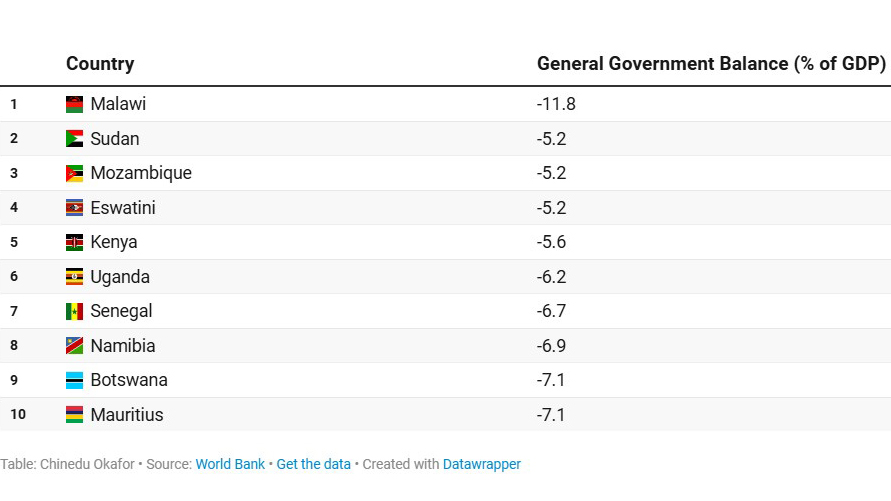
The finding is contained in the latest World Bank Africa Economic Update, which shows that Eswatini is expected to record a fiscal deficit equivalent to 6.3 per cent of Gross Domestic Product (GDP) this year, placing the country among Africa’s largest budget deficit nations.
The ranking, which was highlighted by Business Insider Africa in its analysis of government fiscal balances across the continent, comes at a time when many African governments are grappling with the challenge of balancing economic growth objectives with fiscal sustainability. A fiscal deficit occurs when government expenditure exceeds the revenue collected through taxes, customs duties, levies, grants and other income sources.
In practical terms, it means government must either borrow money, draw down reserves or seek alternative financing to fund the shortfall.
For Eswatini, the projected deficit reflects a broader challenge facing many developing economies that continue to confront rising expenditure commitments while simultaneously dealing with slower revenue growth and an increasingly uncertain global economic environment.
According to the World Bank’s projections, Eswatini’s fiscal balance is expected to stand at negative 6.3 per cent of GDP in 2026.
This means government expenditure will exceed total revenue by an amount equivalent to 6.3 per cent of the country’s annual economic output.
The figure places Eswatini among the African countries with the largest projected budget deficits this year and significantly above the Sub-Saharan African average fiscal deficit of 3.5 per cent of GDP.
In his budget speech delivered in February, the Minister for Finance Neal Rijkenberg said the country’s deficit for 2025/26 financial year is expected to deteriorate to 6.4 per cent of GDP from a budgeted 3.1 per cent of GDP.
He said while government have been able to fund part of this through local borrowing, a large part of it has been financed through external borrowing.
Only a handful of countries are projected to record larger fiscal deficits than Eswatini, including Malawi, Senegal, Mauritius, South Sudan, Namibia, Botswana and Guinea-Bissau.
The World Bank’s analysis shows that while some African countries have made progress in narrowing budget gaps following the COVID-19 pandemic, many continue to spend more than they generate in revenue due largely to increasing debt-servicing costs and growing expenditure requirements.
*Full article available on Pressreader*