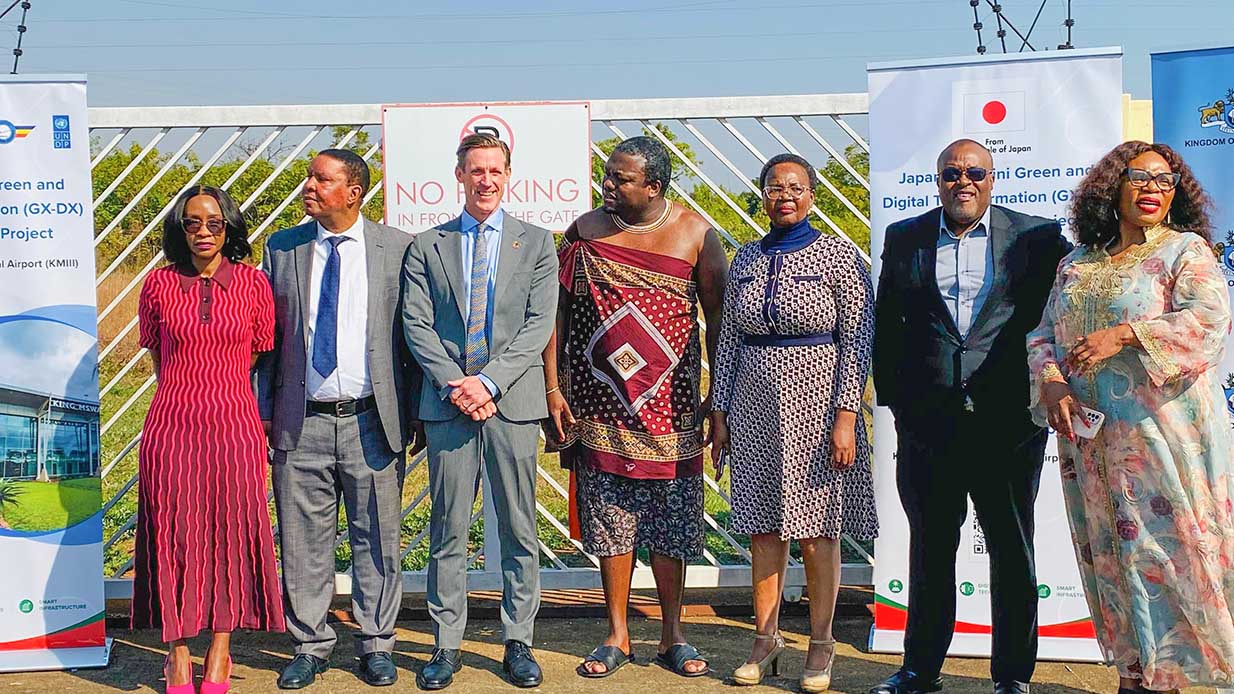
MATSAPHA – The Government of Japan has committed nearly E12 million towards a project aimed at transforming King Mswati III International Airport into a greener and more technologically advanced aviation hub.
The Japan–Eswatini Green and Digital Transformation Demonstration Project was officially launched yesterday through the signing of an agreement at the Eswatini Civil Aviation Authority (ESWACAA) offices in Matsapha.
Speaking during the ceremony, United Nations Development Programme (UNDP) Resident Representative Henrik Franklin said Japan had provided a grant of US$693 333 (just under E12 million) to support the greening of the airport.
Franklin described the investment as more than financial assistance, saying it represented a strategic partnership focused on innovation, clean energy and economic transformation.
“We are kick-starting today a project through which the Government of Japan has made a generous grant investment of US$693 333 for greening the airport,” he said.
He commended Japan for its continued support to Eswatini, saying the country’s assistance had consistently gone beyond financing to include technology, innovation and long-term partnerships.
Franklin also thanked the Ministry of Economic Planning and Development for continuing to work with the UNDP to advance the country’s development agenda.
He said the project aligned with the Sustainable Development Goals (SDGs) by promoting clean energy, innovation, infrastructure, climate action and partnerships.
Franklin noted that reliable and affordable energy remained a key driver of economic growth, industrialisation and investment.
“Energy is one of the most important enablers of development. It is not only about electricity. It is about productivity, jobs, competitiveness and economic transformation,” he said.
Although Eswatini’s aviation industry was still developing, Franklin said it had significant potential to contribute to trade, tourism, logistics and industrialisation.
He said the project would introduce renewable energy technologies, smart logistics systems and measures to improve cargo handling efficiency at King Mswati III International Airport.
According to Franklin, the initiative is designed as a demonstration project that will test practical green and digital technologies before they are expanded on a larger scale.
“It allows us to start in a focused way, learn from implementation and build a credible pathway for future investment,” he said.
He added that the project would position Eswatini as a demonstration site for Japanese green and digital technologies in the aviation and logistics sectors, creating opportunities for exporters, logistics operators, micro, small and medium enterprises (MSMEs) and future investors.
Franklin said the partnership between the Governments of Eswatini and Japan, ESWACAA and the UNDP demonstrated a shared commitment to using green and digital solutions to strengthen economic development.
He pledged the UNDP’s continued support to ensure the project was implemented efficiently and delivered measurable results.
“We look forward to seeing this project move from signing to implementation and from implementation to impact,” Franklin said.
... airport must drive jobs, trade – PS
MATSAPHA – Government has described the Japan–Eswatini Green and Digital Transformation Demonstration Project as a strategic investment that will help transform the country’s main international airport into a stronger driver of trade, industrialisation and job creation.
Speaking during the official signing ceremony at the ESWACAA offices in Matsapha yesterday, Principal Secretary (PS) in the Ministry of Economic Planning and Development, Thabsile Mlangeni, said the initiative is closely aligned with Eswatini’s development priorities and would strengthen the country’s economic competitiveness.
The project, supported by the Government of Japan, in partnership with the United Nations Development Programme (UNDP), the Eswatini Civil Aviation Authority (ESWACAA) and the Ministry of Public Works and Transport, will focus on introducing green and digital technologies at King Mswati III International Airport. Mlangeni said Eswatini had invested heavily in strategic infrastructure over the years, particularly the international airport, and it was now essential to maximise the economic benefits from that investment.
“The next step is to ensure that such infrastructure delivers stronger economic returns through trade, logistics, industrialisation, private sector growth and job creation,” she said.
She stressed that King Mswati III International Airport should not be viewed simply as a transport facility, but as a national economic platform capable of supporting exporters, improving cargo movement, facilitating the transport of time-sensitive products and strengthening regional connectivity. According to Mlangeni, a more efficient airport would improve the competitiveness of Eswatini’s industries and businesses while creating opportunities for micro, small and medium enterprises (MSMEs) to access regional and international markets. However, she noted that achieving these benefits required improvements to the systems supporting airport operations.
She identified high energy costs, inefficient cargo systems and poor coordination as some of the challenges limiting businesses’ ability to make full use of the airport. “These challenges affect exporters, logistics operators, micro, small and medium enterprises and producers who depend on reliable access to markets,” she said. Mlangeni said the Ministry of Economic Planning and Development welcomed the project because it offered practical solutions focused on one of the country’s most important national assets.
Rather than being a broad intervention, she said, the project was designed to answer a critical question: How the airport could work better to promote trade, enterprise development and inclusive economic growth. She also welcomed the fact that it had been structured as a demonstration project, saying it would generate valuable evidence to guide future investment decisions.
The project is expected to collect data on energy savings, operational efficiency, cargo coordination and future infrastructure needs.
“This is important because development must be guided by evidence, and future scale-up must be based on performance, affordability and clear economic value,” she said.
Mlangeni said the initiative also supported the country’s National Development Plan by promoting infrastructure development for job creation, industrialisation, digital transformation, climate-responsive infrastructure and private sector growth. She added that it would also strengthen Eswatini’s position under the African Continental Free Trade Area by improving trade facilitation and regional connectivity.
The principal secretary praised Japan for introducing green and digital transformation technologies into an operational environment, describing the partnership as an example of practical cooperation and innovation.
She said the project could position Eswatini as a demonstration site for solutions that could later be replicated elsewhere in the region.
Mlangeni also acknowledged ESWACAA for hosting the initiative and providing operational leadership, while thanking UNDP for its technical support and the Ministry of Public Works and Transport for leading the sector.
She expressed gratitude to the Government and people of Japan for providing what she described as timely and strategic support. “As we sign today, let us be clear that the work starts now. Let us deliver and create value out of the resources generously provided by the Government of Japan,” she said.