MBABANE – Developments beyond Eswatini’s borders are increasingly shaping its economic outlook, with the World Bank warning of growing risks across Africa and beyond.
Eswatini’s economic outlook remains closely tied to developments beyond its borders, with the World Bank warning that escalating geopolitical tensions, rising fuel costs, mounting debt burdens and slowing investment flows could weigh on growth prospects across Southern Africa and the continent as a whole.
In its latest Africa Economic Update released in April 2026, the World Bank says Sub-Saharan Africa’s economic recovery is losing momentum despite growth remaining relatively resilient.
The report projects regional growth of 4.1 per cent in 2026, unchanged from 2025, but warns that risks have intensified significantly following the escalation of conflict in the Middle East.
For Eswatini, an import-dependent economy heavily reliant on fuel imports, regional trade and foreign investment, the findings carry significant implications.
According to the report, Eswatini is among African countries exposed to rising energy costs due to its dependence on imported petroleum products.
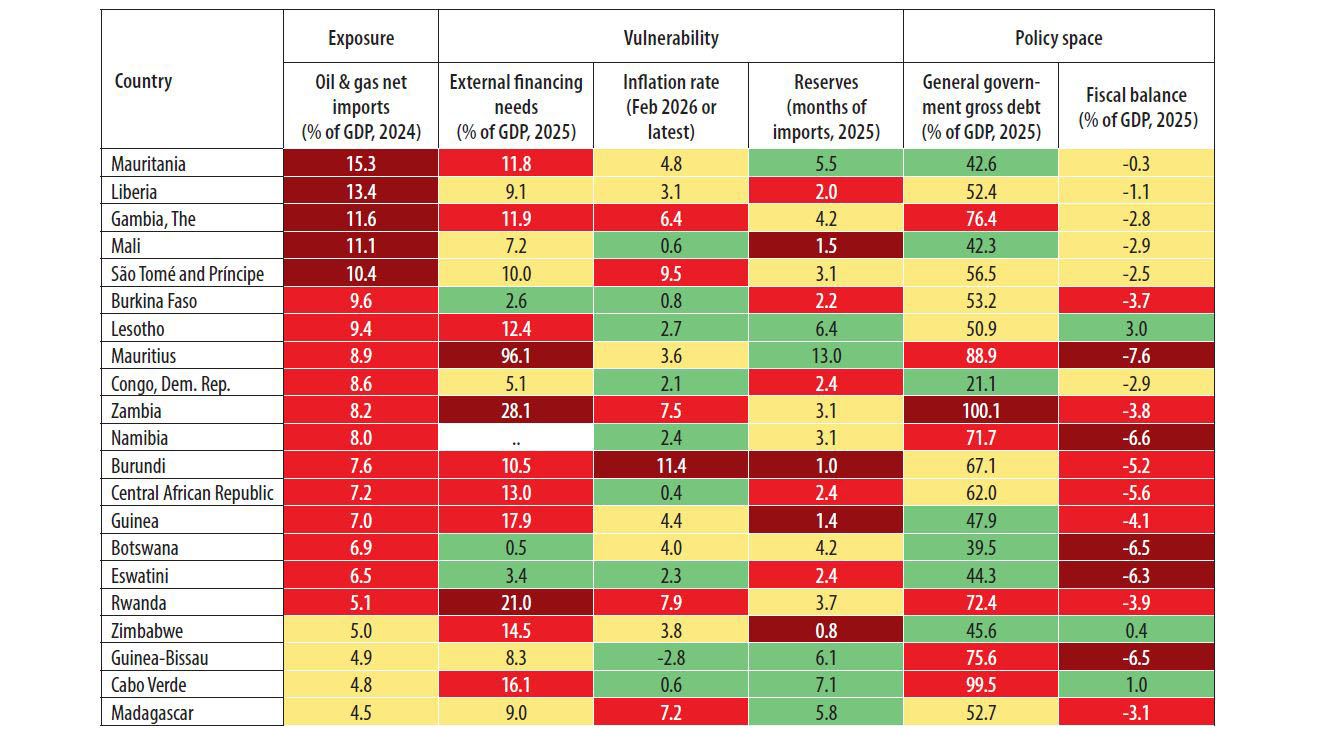
The World Bank’s assessment places Eswatini among countries with relatively high exposure to oil and gas import shocks, with net oil and gas imports equivalent to 6.5 per cent of GDP.
The country also has foreign exchange reserves covering only 2.4 months of imports, while government debt stands at 44.3 per cent of GDP. The fiscal deficit is estimated at 6.3 per cent of GDP.
These indicators suggest that while Eswatini’s debt burden remains lower than many countries in the region, the country’s ability to absorb major external shocks remains limited.
The World Bank notes that more than 60 per cent of African countries exhibit medium to high exposure to oil and gas imports, leaving them vulnerable to energy price spikes resulting from disruptions in global markets.
Industrialisation seen as key to future growth
MBABANE - Beyond the immediate challenges, the World Bank argues that Africa’s long-term growth problem is structural rather than cyclical.
The report notes that growth remains too low to create sufficient jobs or significantly reduce poverty. More than 620 million people are expected to enter Africa’s labour force by 2050, requiring far stronger economic expansion and industrial development.
To address this challenge, the World Bank is urging African governments to pursue more effective industrial policies focused on improving infrastructure, strengthening skills development, deepening financial markets and attracting private investment.
The institution argues that successful industrialisation will depend less on subsidies and protectionism and more on creating the right ecosystem for businesses to grow and compete.
For Eswatini, which has identified manufacturing, agro-processing, tourism, logistics and renewable energy as priority sectors, the recommendations align closely with government ambitions to diversify the economy and create jobs.
While Sub-Saharan Africa is expected to maintain positive growth in 2026, the World Bank’s latest assessment highlights a more fragile economic environment than previously anticipated.
For Eswatini, the message is clear: Developments in the Middle East, Southern Africa and the wider continent will continue to shape domestic economic outcomes.
Higher fuel prices, inflationary pressures, constrained investment flows and regional economic uncertainty pose immediate challenges. At the same time, the report suggests that long-term prosperity will depend on strengthening competitiveness, expanding productive investment and accelerating industrialisation.
As global uncertainties intensify, the kingdom’s ability to build resilience and seize emerging opportunities may prove decisive in determining whether it can sustain growth and create the jobs needed for its young and expanding population.
Fuel prices pose immediate risk
MBABANE – A major concern highlighted by the report is the impact of the conflict in the Middle East on global energy markets.
The World Bank says attacks on energy infrastructure and disruptions to shipping through the Strait of Hormuz have already pushed up prices of crude oil, liquefied natural gas and fertilisers. Brent crude oil prices surged from the low US$70 range per barrel in February to above US$110 by the end of March.
For Eswatini, which imports virtually all of its fuel requirements, higher oil prices could quickly translate into increased transport costs, rising food prices and renewed inflationary pressure.
The report warns that the conflict is evolving into a combined energy and food shock for African economies, particularly oil-importing nations. Higher fuel and fertiliser costs threaten agricultural production while increasing the cost of imported food.
This is particularly relevant for Eswatini, where food inflation has historically been sensitive to fuel costs and developments in neighbouring South Africa.
Although some African oil-producing countries may benefit from higher petroleum prices, most Southern African economies are expected to face increased costs.
The World Bank notes that Eastern and Southern African countries remain highly dependent on petroleum products sourced from the Gulf region. Countries including South Africa, Mozambique, Tanzania and others import a significant share of their fuel from the Middle East, exposing the region to supply disruptions and price volatility.
Given Eswatini’s close integration with South Africa, any increase in fuel costs, transport charges or inflation south of the border is likely to be transmitted into the domestic economy.
South Africa remains Eswatini’s largest trading partner and source of imports, meaning regional economic conditions often have a direct influence on local prices, business activity and consumer spending.
 copy.jpg)