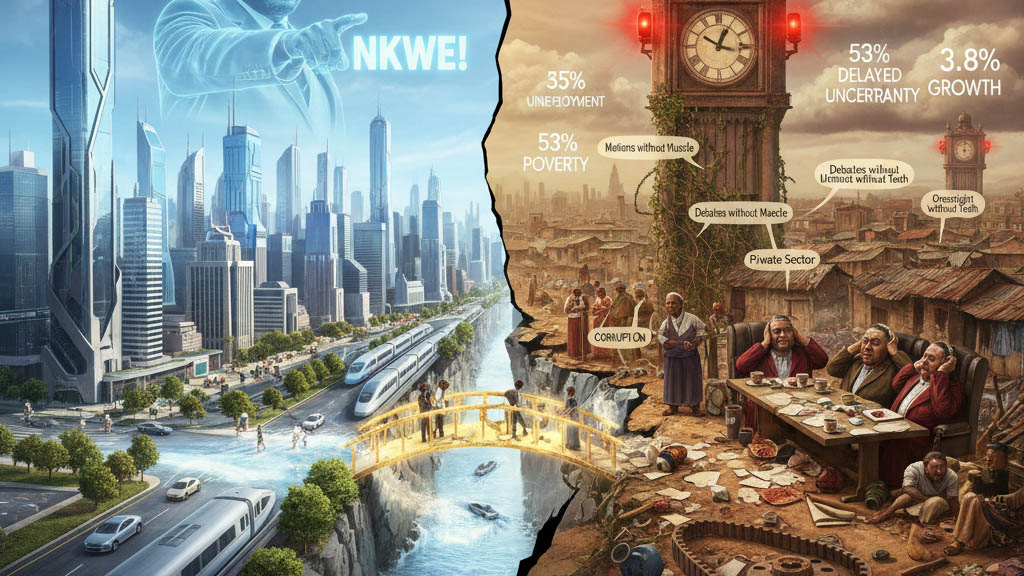
January 2026 arrives without ceremony but heavy with judgement. A new legislative year opens and with it the uncomfortable truth: Time is the one resource Eswatini no longer has in abundance.
A year ago, His Majesty King Mswati III stood before the nation and did what true leadership does: He named the destination and demanded movement. Declaring 2025 the Year of Transformation to the Promised Land was not poetry. It was policy direction. It was a command - ‘Nkwe!’ - to abandon drift, complacency and half-thinking. The King’s vision was unapologetically First World: Speed, delivery, discipline and results.
The problem is not the vision. The problem is the messengers.
Between the Throne and the people stands politicians elected from over 380 chiefdoms across 59 tinkhundla. They are meant to be transmission belts, not shock absorbers. Yet, a year later, the question answers itself: Are they driving transformation — or quietly stalling it?
Here is the punchline that refuses to land gently: You cannot reach a First World destination using Third World thinking.
The King has been intellectually consistent, economically literate and morally firm. He has spoken of renewal of mind, productivity, value creation and national discipline. Meanwhile, too many in Parliament remain stuck in a politics of noise — motions without muscle, debates without direction, oversight without teeth. Vision has been reduced to quotation, not execution.
Look at the numbers, because numbers do not clap at rallies.
The Macro Poverty Outlook for 2026 projects growth slowed to 3.8 per cent, down from 4.2 per cent in 2025. That is not collapse — but it is a warning light. Growth remains consumption-led, not investment-driven. In plain language: We are spending more than we are building. That is not transformation; it is a holding pattern.
Even more damning, over half of emaSwati - about 53 per cent - still live below the lower-middle-income poverty line. That is not a marginal problem. That is a structural failure. You do not ‘manage’ that statistic. You dismantle it - or it dismantles you.
Then there is unemployment: 35 per cent nationally, with youth unemployment above 50 per cent. In a country of 1.2 million people, this is not an abstract economic indicator. It is a social time bomb. Every unemployed graduate, every idle artisan, every young person trapped between hope and frustration is a verdict on policy inertia.
Yet, Parliament sleeps. The 2025/26 Budget was not small-minded. At E32.6 billion, with E7.25 billion for capital spending, it aligned - on paper - with the King’s transformation agenda. Education was prioritised, elderly grants were increased and infrastructure projects were advanced. The tools were placed on the table.
However, here is the truth politicians avoid: Allocation without execution is theatre.
The MPO is explicit: Falling SACU revenues, widening fiscal deficits, rising public debt and persistent arrears threaten macroeconomic stability. These are not acts of God. They are consequences of delayed reform, weak procurement discipline and an oversight vacuum.
Where was Parliament when arrears choked the private sector? Where is the outrage when growth is projected to slow while poverty barely moves?
Sibaya spoke. The people asked for jobs, healthcare, dignity and services that work. The Executive cannot be allowed to operate on autopilot - and Parliament is not a fan club. A First World legislature interrogates policy, tracks outcomes and corrects failure in real time.
This is where basic economics - the kind taught in first-year textbooks - seems to escape our political class. You cannot grow jobs without private investment.
You cannot attract investment without regulatory certainty. You cannot build trust while corruption leaks millions through procurement loopholes.
The MPO is clear on what must be done: improve the business environment, streamline trade and licensing, digitise government services, expand access to finance for SMMEs and spend public money efficiently. None of this requires genius, it requires seriousness.
The private sector, too, must stop waiting for permission to matter. AfCFTA and Made in Eswatini are not slogans - they are survival strategies, though business cannot thrive where tenders are rigged, payments delayed and rules rewritten mid-game. Anti-corruption institutions must do more than ‘exist’. They must bite - visibly and without fear.
A First World mindset does not tolerate the theft of public resources. Not because it is immoral - though it is - but because it is economically suicidal. As we approach the 2026 Budget, the task is not to invent new promises, it is to fix old failures, build on infrastructure momentum, clear arrears, protect macro stability, force investment-led growth and demand results - quarterly, measurable, publicly.
To parliamentarians, this is the final punchline: The King has already done his job, now do yours.
Be the ‘Nkwe’ in the room. Question hard, oversight harder and align policy with evidence, not ego. Stop confusing loyalty with silence. History will not ask how often you praised the vision — it will ask whether you delivered it.
The coffee is brewing, the numbers are shouting, the Promised Land is not a metaphor - it is an economic destination.
Wake up.
A year ago, His Majesty King Mswati III stood before the nation and did what true leadership does: He named the destination and demanded movement.