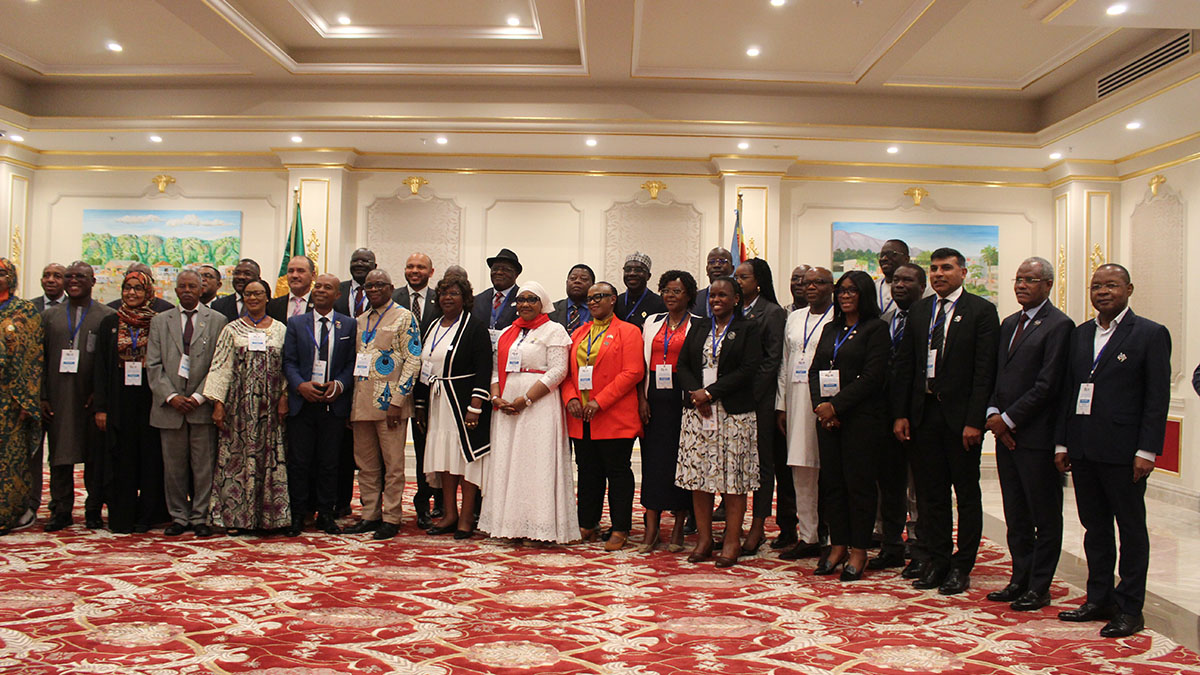
There are moments in a nation’s journey that quietly redefine its place in the world. For Eswatini, the recent convergence of the OACPS-EU Parliamentary Assembly and the celebrations marking His Majesty King Mswati III’s 40 years on the Throne at the newly unveiled Ezulwini Palazzo may very well become one of those defining moments.
For years, many outside our borders viewed Eswatini merely as a small Southern African kingdom tucked between South Africa and Mozambique. Yet in the space of a few weeks, the kingdom hosted diplomats, policymakers, monarchs, presidents, investors and international delegates under one roof, with the eyes of the world suddenly turning towards the Ezulwini Valley. The opening of the Ezulwini Palazzo itself was symbolic - not merely a building of steel and glass, but a declaration that Eswatini intends to participate in the modern global economy on its own terms.
The OACPS gathering carried enormous significance. The Organisation of African, Caribbean and Pacific States (OACPS) is not a ceremonial club; it is a serious international platform dealing with trade, development, climate cooperation and economic partnerships between developing nations. Hosting such an event in Eswatini was not accidental. It demonstrated confidence in the kingdom’s stability, hospitality and growing infrastructure capacity. Delegates discussed issues surrounding economic resilience, intra-African cooperation, sustainable development and strengthening partnerships among developing nations. These are not abstract diplomatic phrases. They are the very conversations shaping the future global economy. By hosting those discussions, Eswatini positioned itself not as an observer, but as a participant in international affairs.
What made the moment even more profound was that it coincided with the Ruby Jubilee celebrations of His Majesty King Mswati III’s reign. Heads of State, monarchs and regional leaders gathered in the kingdom in a display of diplomatic respect rarely afforded to small nations. Leaders from countries such as Mozambique, Zimbabwe, Botswana and Lesotho joined the celebrations, while dignitaries from across the region filled Ezulwini and Lobamba.
The significance of this should not be underestimated. In international politics, attendance matters. Presence and optics matter. Nations that attract world leaders attract attention, investment and opportunity. There was a time when Eswatini struggled to attract this level of global engagement. Yet today, world leaders arrive not merely out of courtesy, but because the kingdom increasingly presents itself as a strategic and stable regional partner. Even international media outlets that often focus on controversy found themselves covering the celebrations and the opening of the Ezulwini Palazzo.
Perhaps the most important lesson from these events is not about prestige. It is about responsibility.
A country cannot host global conversations while maintaining local complacency. The burden now falls heavily on the nation’s elite, policymakers, business leaders and those entrusted with positions of influence. The infrastructure has been built. The doors have been opened. The momentum has begun. What remains is discipline, professionalism and national commitment.
For too long, Africa has suffered from a painful pattern: Moments of promise destroyed by corruption, inefficiency, arrogance and internal sabotage. Eswatini must resist that temptation. The dream of a First World Eswatini, repeatedly articulated by His Majesty over the years, cannot remain a slogan recited at ceremonies. It must become visible in service delivery, governance standards, business ethics, education and national work culture.
The average liSwati must begin to feel that these international events are connected to their daily lives. A world-class convention centre should eventually mean more tourism jobs, more international conferences, more local business opportunities and greater investor confidence.
The roads, airports, hotels, communication systems and public institutions surrounding these developments must now evolve to meet international expectations consistently - not only during major events.
At the same time, citizens must guard against destructive cynicism. Across the world, progress is often attacked by those who benefit from stagnation or those who cannot imagine transformation. Constructive criticism is healthy in any nation, but reckless negativity can suffocate national confidence before growth fully matures. Eswatini cannot afford to tear itself apart every time progress emerges.
This does not mean ignoring challenges. Poverty, youth unemployment and inequality remain real concerns. The international spotlight will also bring increased scrutiny and expectations. However, mature nations do not collapse under scrutiny; they improve under it. The answer is not retreat, but refinement.
What happened at the Ezulwini Palazzo was larger than two events. It was a statement of intent. The kingdom showed that it possesses the cultural pride, diplomatic reach and institutional ambition to stand confidently among nations. Now the challenge is sustaining the standard after the cameras have left and the delegations have departed.
History may eventually remember this season as the moment Eswatini stopped seeing itself as a small country with limitations and began seeing itself as a serious player with potential. History will also judge whether those entrusted with leadership honoured their part of the bargain.
The stage has been prepared. The world has arrived. Now Eswatini must prove that this was not a fleeting performance, but the beginning of a new era.
Delegates to the OACPS in a group picture after their morning session at Ezulwini Palazzo.