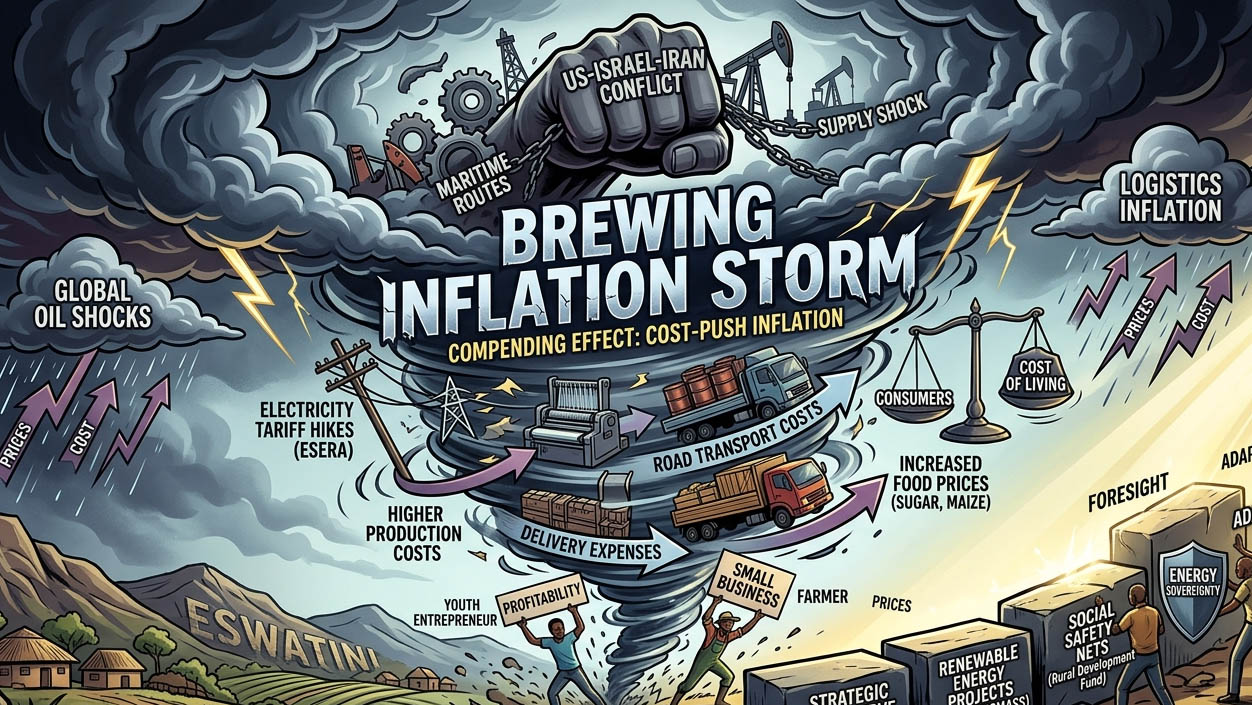
Brewing inflation storm
As the world braces for yet another supply shock, being the US-Israel-Iran war and the shocks of the price of fuel and maritime routes affecting commerce. The world is at present recovering from the COVID-9 shock, which ricked havoc in terms of the cost of living. We find ourselves at a time where we have to navigate yet another economic shock, which might as well be taking us back to those times of high cost of living. Inflation is an economic phenomenon characterised by a sustained increase in the general price level of goods and services over time. It affects the purchasing power of consumers and can have wide-ranging impacts on households, businesses and the overall economy.
Recent developments, both domestically and internationally, have contributed to rising inflationary pressures, posing significant challenges to economic stability and growth. This page explores the key factors driving inflation in Eswatini, their effects and the strategic responses aimed at mitigating these impacts.
Domestic pressure: Electricity tariff hike
Energy is the backbone of modern economies and the kingdom is no exception. The recent electricity tariff adjustments by ESERA have placed households and industries under strain. With rural electrification reaching 82 per cent, more citizens are connected to the grid than ever before. Rising tariffs directly reduce disposable income, forcing families to choose between electricity and essential goods like food and education.
The indirect impact is equally significant. Energy-intensive industries such as manufacturing and textiles face higher production costs, which are inevitably passed on to consumers. Everyday goods, ranging from bread to clothing, will become a bit more expensive, not due to changes in raw materials, but because powering ovens and sewing machines costs more.
Global shock: USA-Iran conflict
Beyond domestic tariffs, global geopolitical tensions are amplifying inflationary pressures. The ongoing USA-Iran conflict threatens oil supply routes, particularly the Strait of Hormuz, through which 20 per cent of global petroleum flows. Rising oil prices translate directly into higher fuel costs in Africa and Eswatini.As a landlocked nation, Eswatini relies heavily on road transport for both imports and domestic distribution. Increased fuel costs drive up logistics expenses, raising the price of transporting sugar, maize and other essentials. This logistics inflation disproportionately affects poorer households, where food comprises a larger share of monthly spending.
The compounding effect: Cost-push inflation
The convergence of electricity tariff hikes and global oil shocks creates cost-push inflation. Unlike demand-pull inflation, where prices rise due to increased consumer spending, cost-push inflation occurs because production and distribution become more expensive.
The Central Bank of Eswatini (CBE) faces a dilemma. Raising interest rates can curb inflation, but also makes borrowing more expensive. For households with loans and for entrepreneurs relying on credit, higher rates exacerbate financial strain. The purchasing power of the Lilangeni diminishes, leaving citizens struggling to maintain their standard of living.
Monetary policy trajectory
Albeit the fact that inflation continues to deflate downwards and the inflation rate in South Africa continues to decline, setting the ground for a cut in the inflation rate. However, the current pressures place additional pressure on the Central Bank to hold interest rates steady and even push for an increase. This is contingent on the length of time this war continues and trickles further in the red sea as the axis of resistance has threatened. Also, on the length of the closure of the Strait of Hormuz. This has a direct impact on the cost of money (borrowing) and this will have an impact on commerce.
Impact on entrepreneurs and youth
Youth and rural entrepreneurs, supported by initiatives like FINCORP and the YERF, face mounting challenges. Rising operating costs reduce profitability, making it harder for small businesses to survive. Sectors such as agro-processing, where margins are already thin, are particularly vulnerable. Inflation threatens to erode the progress made in fostering indigenous business development.
Strategic national responses
To achieve true economic resilience, Eswatini is actively pursuing energy sovereignty through ENPC, which is developing a Strategic Oil Reserve at Phuzumoya to provide a vital 60-day fuel buffer against global market volatility. This is complemented by a strategic shift towards renewable energy, including biomass initiatives in the forestry sector and independent solar projects, which together reduce dependency on South Africa’s Eskom and help stabilise domestic tariffs. These high-level industrial strategies are underpinned by robust social safety nets like the Rural Development Fund and the National Pension Scheme, which provide a critical cushion for vulnerable households, ensuring that the nation’s pursuit of First World status remains inclusive and protected from the inflationary pressures of global fossil fuel fluctuations.
To mitigate inflationary pressure, diversify investments into inflation-hedging assets, optimise operational efficiencies and prioritise essential spending while leveraging local renewable energy and debt-restructuring options.
Inflationary pressures stem from both domestic and global forces. Electricity tariff hikes and rising oil prices combine to create cost-push inflation, squeezing households and businesses alike. Yet, the nation’s institutional resilience pushed through energy sovereignty initiatives, renewable diversification and social safety nets, offering hope.
Navigating this storm requires adaptability and strategic foresight. By strengthening its buffers and supporting its citizens, Eswatini can weather global uncertainty, while continuing its pursuit of economic progress.
As the world braces for yet another supply shock, being the US-Israel-Iran war and the shocks of the price of fuel and maritime routes affecting commerce.