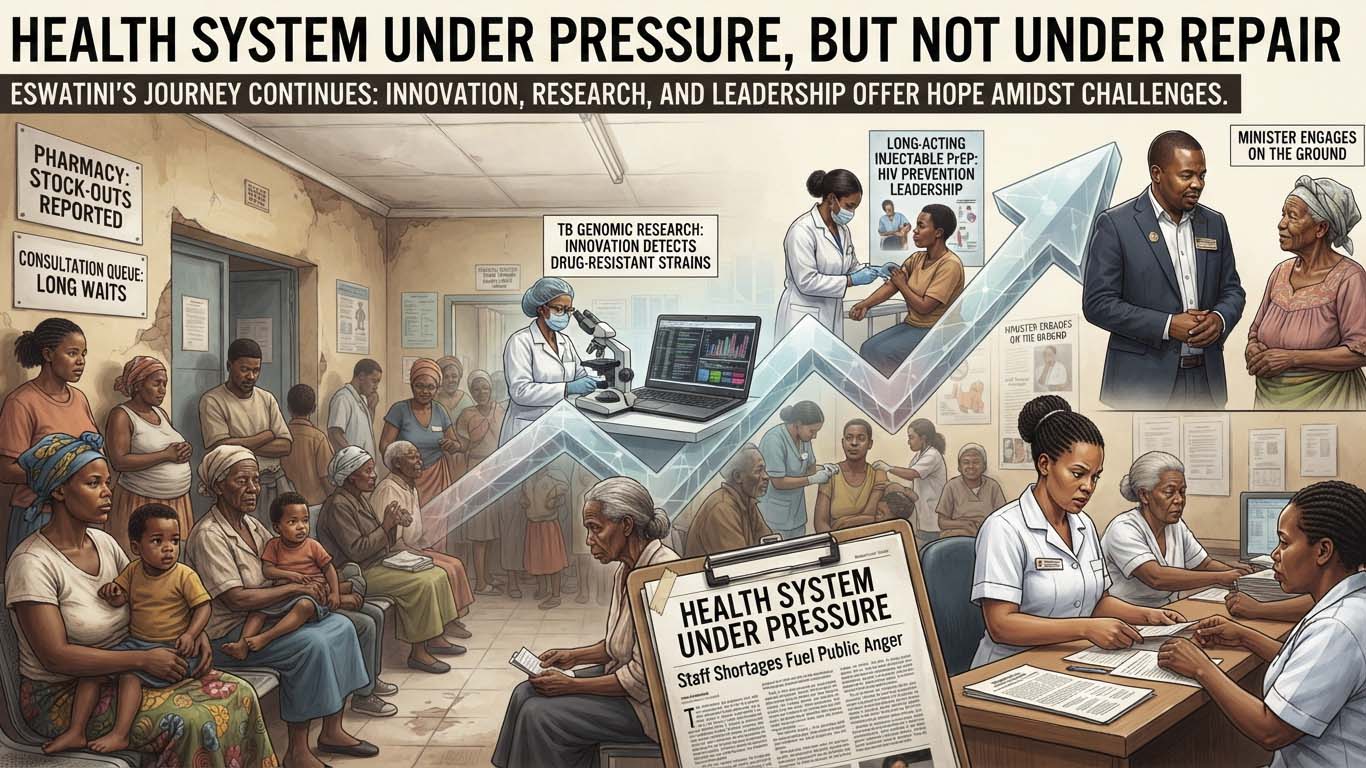
It has become increasingly common to describe Eswatini’s public health system as though it has completely collapsed. Long queues, medicine shortages, overworked healthcare professionals and the frustrations experienced by patients have understandably fuelled public anger. For many emaSwati, these experiences are real and deeply personal.
Yet, while criticism remains justified, it would be inaccurate to conclude that the country’s health system is entirely defunct. Looking beyond the daily challenges reveals encouraging signs that progress is taking place. These developments should not excuse existing shortcomings, but they do demonstrate that there are committed professionals, researchers and policymakers working to improve healthcare. The task now is to ensure that these successes become the norm rather than isolated victories.
One of the clearest examples comes from Eswatini’s continued contribution to global tuberculosis (TB) research. A groundbreaking study published in Nature Communications this month showed that researchers implementing targeted next-generation genomic sequencing were able to identify dangerous drug-resistant TB strains that routine diagnostic methods had failed to detect. The study analysed hundreds of patient samples collected between 2021 and 2024 and found that many patients classified under routine testing were, in fact, carrying far more resistant forms of TB. More importantly, the new technology directly informed changes in treatment for over half of the patients studied, with treatment success reaching 88 per cent among those whose outcomes were available.
This is not a small scientific achievement. It places Eswatini among countries contributing meaningful solutions to one of the world’s deadliest infectious diseases. Such research would not be possible without local expertise, functioning laboratories, collaboration between the Ministry of Health and international partners and health professionals committed to improving patient outcomes. It is proof that innovation continues to exist within our health sector even during difficult times.
The country’s HIV response also offers reason for cautious optimism. Eswatini has remained a continental leader in HIV prevention by embracing long-acting injectable pre-exposure prophylaxis (PrEP). The response from emaSwati has been encouraging, with well over 1 000 people taking up the injectable option shortly after its rollout and reports later indicating that uptake had reached around 2 000 recipients within a few months. The strong demand demonstrates public confidence in innovative healthcare interventions while giving individuals an additional tool to protect themselves against HIV infection.
These achievements matter because they represent more than statistics. Every accurate TB diagnosis means a patient has a better chance of receiving appropriate treatment. Every person protected through PrEP represents a potential HIV infection prevented. These are tangible improvements in people’s lives.
Leadership also matters in rebuilding public confidence. Recently, Minister for Health Mduduzi Matsebula chose not to rely solely on reports presented in boardrooms. Instead, he queued alongside ordinary patients at a public health facility to experience the healthcare system firsthand. While just one visit will not solve systemic problems, the gesture demonstrated an important principle: Those responsible for policy should also understand the daily realities facing citizens.
There is value in leaders listening directly to patients, observing waiting times, interacting with frontline staff and identifying operational bottlenecks themselves.
Such experiences often reveal challenges that statistics alone cannot capture. They also send a message to healthcare workers that their concerns are being heard.
None of this should minimise the serious work that still lies ahead. Medicine stock-outs, staffing shortages, infrastructure maintenance, procurement systems and patient waiting times continue to demand urgent attention.
For many families, healthcare is not an abstract policy discussion but a matter of survival. Progress in research cannot compensate for a mother unable to obtain essential medication for her child or an elderly patient waiting hours for treatment. That is why the country should resist two equally damaging narratives. The first is that everything is fine when it is clearly not. The second is that nothing works at all, despite evidence to the contrary.
Eswatini’s health sector stands somewhere between these extremes. It is a system facing undeniable pressure while still producing remarkable scientific breakthroughs, embracing innovative prevention strategies and showing signs of leadership willing to engage with problems directly. These positive developments provide something often missing from public debate: Hope grounded in evidence rather than wishful thinking.
The journey towards a stronger health system remains long, but it has not stalled.
If research continues to translate into better patient care, if innovation remains a national priority and if leadership continues to engage honestly with challenges on the ground, then the light at the end of the tunnel becomes more than just an aspiration. It becomes a destination worth working towards because the health, dignity and livelihoods of every liSwati depend on it.
It has become increasingly common to describe Eswatini’s public health system as though it has completely collapsed. Long queues, medicine shortages, overworked healthcare professionals and the frustrations experienced by patients have understandably fuelled public anger.