Well, it was a Viking, Leif Erikson, who was the first from Europe to discover America. That was at today’s Newfoundland on the east side of the continent of North America, and a part of the Canada which Mr Trump believes should be part of the United States. And Leif arrived there in one of those rather special Viking boats – sorry, no available photographs of that momentous landing – and nearly half a millennium before Christopher Columbus made the journey.
The date was somewhere around 1000AD (or I should now use 1 000CE). All said with no wish to discredit Columbus. He struck me – well, he didn’t go quite that far – as being a decent guy; but he didn’t discover the New World. Furthermore, the biography of Columbus, written by Washington Irving in the 1800s, said Columbus had also discovered that the world was round. In reality, ancient Greek scholars and philosophers had done that, 2 000 years ago. And then, 70 or so years after Columbus had, at least, brought America into contact with the Old World, reminding everyone in 1492 that their world really was round, Gerardus Mercator muddied the waters. Highly beneficially, I should add, by laying out our world, flat as a pancake, onto a piece of paper. It does, of course, make Russia look much bigger than it really is, which no doubt causes Mr Putin to reassure himself and his people that Russia is the ‘greatest’ country in the world. They may feel the same in Canada; also looking huge. Perhaps the effect of the Mercator Projection hasn’t been mentioned to Mr Trump.Enough frivolity; allow me please to remind the reader that if this writer had the opportunity to study for another university degree and, given his low techno-savvy mentality, then it would be to read history. Also play the guitar and sing in the evenings. With others, of course. More on the benefits of communal singing in a future article.
Well, that university course isn’t going to happen, but one can still love history. It may be a function of age. You’ve seen a lot, read about a lot and it has to be inevitable, especially given our own relatively short stay on planet Earth, that we should be fascinated by earlier groups of people. History simply has a continuum of generations – three to four decades at a time – who have left their footprint on this earth and then departed.
Most are not available for interview, of course, so we have to rely on the historians to explain about those pockets of civilisation, gone for ever in earthly terms but never forgotten. It is enthralling to learn about how people thought, conversed and behaved many years ago. And, sadly, how much they fought.
The Vikings were among the most effective participants in that highly negative form of human activity. Built out of rock, those guys were strong. My Norwegian friend, Bjorn Tolfsen, not since seen for sixty years – no WhatsApp in those days - once strolled into the university gym where we were doing two-arm overhead presses with 50kg dumbbells. He smiled and did the same action; but with one arm. Our first reaction was shock. Our second was ‘what do you guys eat over in Norway?’One fantasy of mine is to spend a couple of days and nights in accurately regenerated living conditions of, say, nine hundred years ago surrounded by actors playing the part of human beings of that era and precisely how they behaved. I guarantee that the average individual of today in such circumstances, myself included, would need trauma therapy at the end of it. Life was rough in those days.
How fascinating it was, therefore, to learn about the Jorvik Viking Centre in York up in northern England, created 40 years ago with, to date, more than 20 million visitors. For a modest fee you can be taken back 1 000 years. Those were happier times than a number of centuries earlier when the Vikings first came over from Scandinavia – mostly Denmark, Norway and Sweden - and killed and pillaged their way through eastern and northern England.
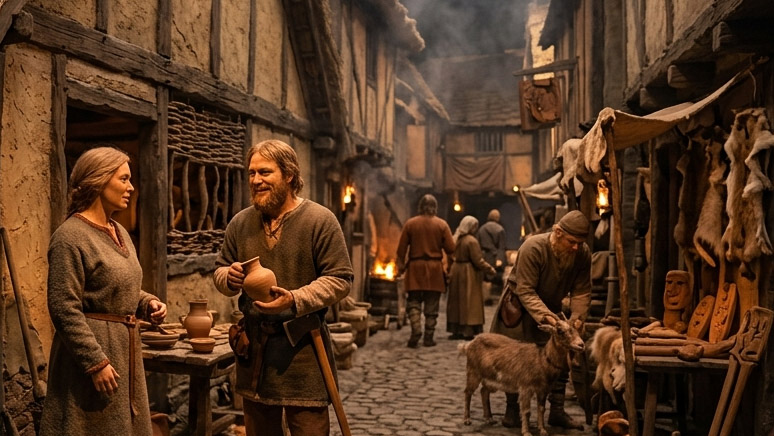
At this reconstructed city of Jorvik the visitor is taken on a ride through superbly re-created conditions; that would be around 960CE, when the Vikings had settled in peace to farm and breed animals. Visitors come across 22 new animatronic (electronically controlled) characters, behaving like people and animals at the time (no one you would recognise though). All the traditions and languages are brought out. There are even interactive touch screens that enable the user to be an archaeological conservator – that’s maintaining the integrity of excavated items. You see a huge number of artefacts carefully excavated from the site, including shoes and socks; no, you certainly can’t try them on. You even encounter three Viking-age skeletons and learn what their bones tell us about where they came from, how they lived and the challenges they faced. Interestingly, despite the early and extremely violent period of Viking history in England, that country has retained many Viking names like York (Jorvik, the capital of Viking territory), and Ormskirk (Ormr’s church). My sister lives in Ormskirk. The Vikings are peaceful now, but I still make sure to wear a hard helmet when I’m up there.
Well, it was a Viking, Leif Erikson, who was the first from Europe to discover America.