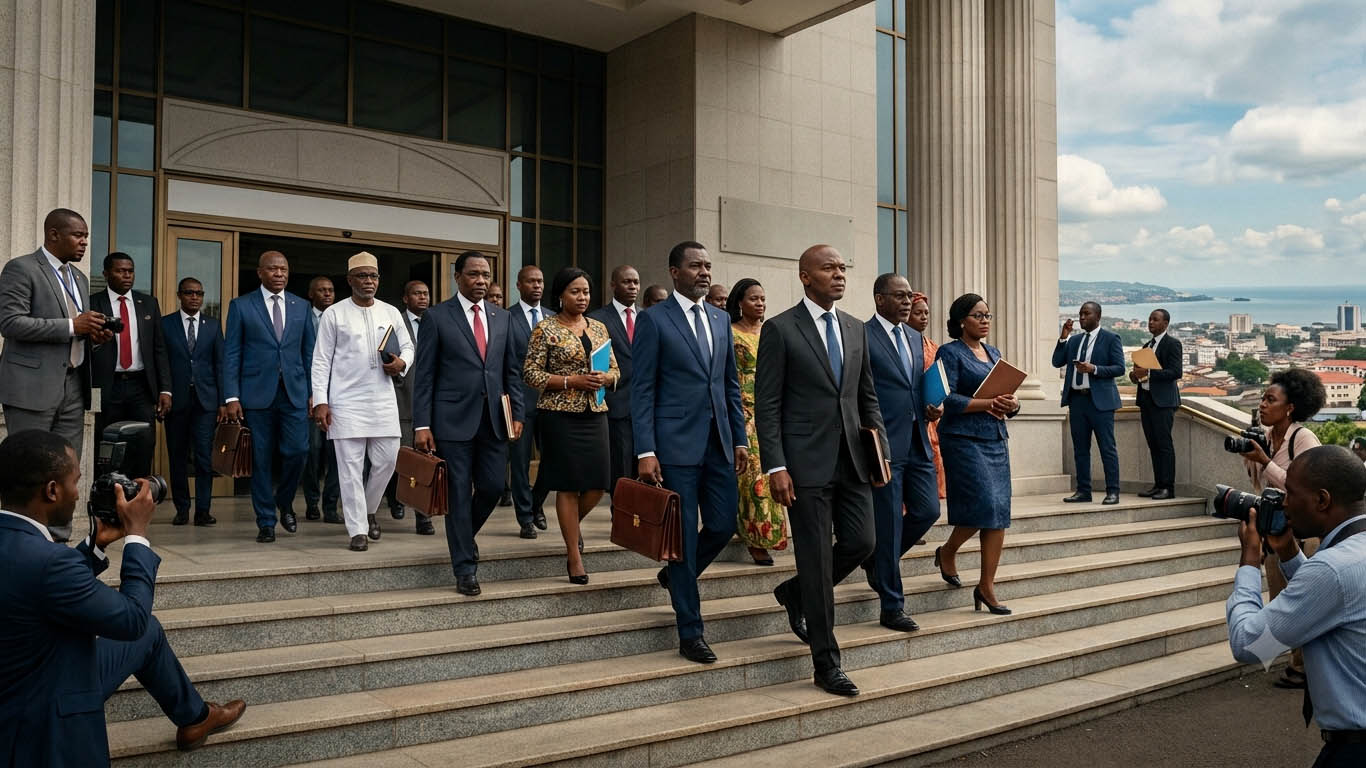
In a political world where excuses often outlive accountability, the resignation of Equatorial Guinea’s entire government after failing to meet its targets has provided a rare and thought-provoking example of political responsibility. Prime Minister Manuel Osa Nsue Nsua recently submitted the collective resignation of the government after it reportedly achieved only around 10 per cent of its objectives. Vice President Teodoro Nguema Obiang Mangue stated that the level of implementation was far below what was expected from a government tasked with considerable resources and responsibilities.
On the surface, the development is an admission of failure. Governments are elected or appointed to deliver services, implement policies and improve the lives of citizens. Achieving only a fraction of stated goals is undoubtedly unacceptable.
However, the deeper point is that this government stepped aside and accepted responsibility, unlike many administrations across the world that cling to power despite poor performance.
That simple act is both refreshing and a rarity.
Modern politics has become accustomed to a culture where leaders survive scandals, broken promises, economic decline and governance failures without ever considering resignation. Political office is often treated as a prize to be protected at all costs rather than a public trust that must be earned continuously through performance.
Imagine how different the world would be if politicians everywhere adopted the same principle. Imagine ministers resigning after repeated failures to deliver infrastructure projects. Imagine governments stepping down when unemployment rises sharply, corruption flourishes or public services deteriorate. Imagine leaders acknowledging that they have not met expectations and making room for others to try.
Citizens would likely have greater confidence in democratic institutions because accountability would be more than a campaign slogan. It would be a lived reality.
The notion that public office carries responsibility is not new. British wartime leader Winston Churchill once observed that, ‘The price of greatness is responsibility’. Those words remain relevant today. Leadership is not merely about enjoying authority; it is about accepting the consequences that come with it.
Examples of leaders resigning because they felt they had failed are uncommon, but they do exist. One notable case is former Japanese Prime Minister Yukio Hatoyama, who resigned in 2010 after failing to fulfil a key election pledge regarding the relocation of a United States military base. While not a president, his departure remains one of the clearest examples of a national leader stepping down after concluding that he had failed to deliver on a major promise.
Unfortunately, such accountability remains the exception, not the norm.
Across the globe, there are countries where allegations of corruption continue to dominate public discourse, while few senior officials face meaningful consequences. In some instances, politicians accused of wrongdoing remain in office for years, successfully seeking re-election despite repeated controversies.
South Africa’s years of State capture allegations, Brazil’s long-running corruption scandals involving political and business elites and recurring governance controversies in several African and Latin American States depict how difficult it can be to hold leaders accountable through formal mechanisms alone. Even when wrongdoing is widely reported, resignation is often viewed as a political defeat, not an honourable acceptance of responsibility.
The result is a dangerous disconnect between citizens and those who govern them. Voters witness failures, yet the same faces remain in office. Promises are broken, but political careers continue largely unaffected. In some cases, individuals emerge stronger from controversy than before and are rewarded with another term in office.
That reality makes the events in Equatorial Guinea noteworthy regardless of the country’s overall political circumstances.
The decision sends a message that performance matters and that occupying public office should not be unconditional. To be clear, one resignation does not erase long-standing concerns surrounding governance in Equatorial Guinea. Critics argue that meaningful reforms require more than changes in Cabinet personnel. Nevertheless, accountability should be recognised wherever it appears.
The late former United Nations Secretary General Kofi Annan once said: “Good governance is perhaps the single most important factor in eradicating poverty and promoting development.”
The resignation also asks the citizenry to set standards and expectations for those who govern us.
Too often, voters lower the bar. We celebrate minor achievements while overlooking major failures. Fish cannot be celebrated for swimming. We become accustomed to delays, inefficiency and unfulfilled promises. Over time, poor governance becomes normalised. When governments fail, there should be consequences, whether through elections, parliamentary oversight or voluntary resignation.
The collective resignation in Equatorial Guinea may not transform global politics overnight. It may not even fundamentally alter governance within the country itself. However, it offers an important lesson that public office should be tied to measurable performance and personal responsibility.
In a political world where excuses often outlive accountability, the resignation of Equatorial Guinea’s entire government after failing to meet its targets has provided a rare and thought-provoking example of political responsibility.