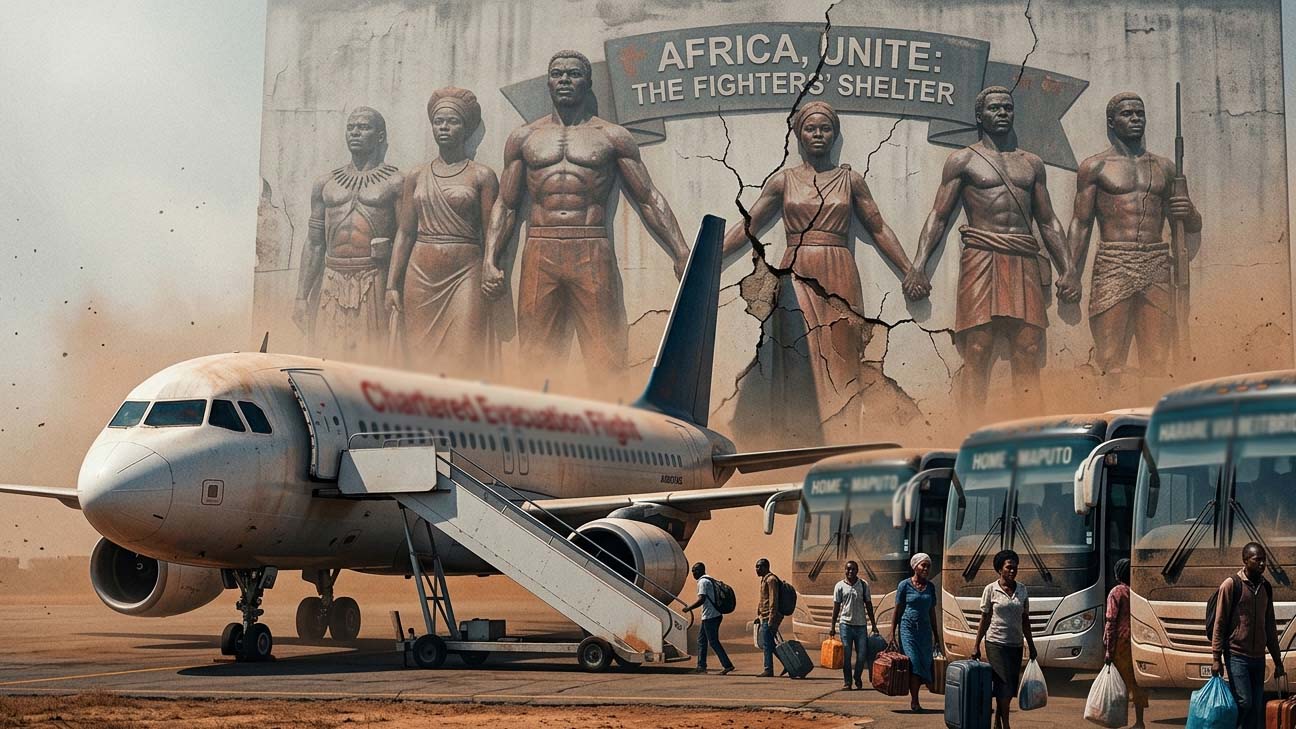
There is something uniquely humiliating about the image of a government scrambling to evacuate its own citizens, not from a war zone, not from a natural disaster, but from a neighbouring country on the same continent. Yet that is precisely what we have witnessed in recent weeks. Ghana chartered a flight that airlifted 297 of its nationals home from OR Tambo International Airport in Johannesburg.
Nigeria is planning to fly between 2,000 and 4,000 of its people home.[1] Mozambique has bused out 545 nationals through the Ressano Garcia border post and is ready to evacuate more.[2] Malawi's Ministry of Foreign Affairs has announced a repatriation programme for citizens who have requested assistance.[3] Zimbabwe's government-assisted evacuation programme has already seen 74 nationals arrive home through the Beitbridge Border Post.[4]
The African diaspora in one of the continent's wealthiest economies is being systematically dismantled. And the extraordinary thing is that the country presiding over this expulsion is the one that once asked the rest of Africa to shelter its liberation fighters.
South Africa's immigration crisis has long been simmering beneath the surface of polite diplomatic language. What is different now is that the heat has become impossible to ignore. The attacks are documented. The casualties are real. The evacuations are real. And the diplomatic fallout, played out in extraordinary public exchanges between foreign ministers, has shattered the fiction that this is simply a matter of law enforcement and orderly border management.
The Human Cost
Deaths, Displacement, and a June 30 Deadline
The human cost of this crisis is not abstract. Mozambique has confirmed that five of its nationals were killed in xenophobic attacks in the coastal town of Mossel Bay in late May 2026, with the total death toll among Mozambican nationals reaching seven when two road accident fatalities are included.[5] Around 800 Mozambican nationals were caught up in the violence, with approximately 300 returning home on their own means over the weekend before the formal evacuation began.
In Zimbabwe, the Civic Engagement Forum has described the situation as a growing humanitarian crisis, with 146 Zimbabweans displaced in Daggafontein, Springs, on the East Rand alone, and reports of residents being given a deadline of 15 June to leave.[6] Kenya, Lesotho, Zimbabwe and Malawi had earlier in the crisis all advised their nationals to stay indoors.[7]
Driving the panic is an ominous deadline set by anti-immigrant groups: June 30, by which all undocumented foreign nationals have been ordered to leave South Africa. The threat has fuelled fear across migrant communities throughout the region.[3]
For Mozambique, the pain is particularly acute. Mozambicans form the largest single group within the SADC migrant community in South Africa, and their economic links to South Africa run deep: remittances, mine labour, cross-border trade. Each bus that leaves Ressano Garcia carries not just people, but the severed economic ties of two neighbours who should, by any reasonable measure, be partners in prosperity.
The Government's Answer
Ramaphosa's Five Pillars and the Weight They Must Carry
President Cyril Ramaphosa outlined what his administration called a comprehensive response to the immigration crisis. Five pillars: cracking down on immigration and labour law violations, securing borders, rooting out corruption in the immigration system, strengthening legislation, and engaging African countries on a continental migration framework. He acknowledged, with commendable candour, that his government has failed, saying there had been weaknesses in how migration was managed, weaknesses in enforcement, and weaknesses of corruption. He even conceded that over 450,000 people were intercepted attempting to cross the border illegally in a single year.[8]
Ramaphosa promised 10,000 additional labour inspectors. He promised dedicated immigration courts. He promised the phasing out of the green identity book, which has been exploited for identity fraud on an industrial scale. He promised that employers who hire undocumented workers would face imprisonment, not merely a fine. If delivered, some of them would represent a genuine structural shift.
If delivered.
The Opposition's Verdict
March and March: A Movement With a Point
Jacinta Ngobese-Zuma of the March and March movement was having none of it. Her response to the president's address was scathing, detailed, and in several key respects accurate. She claimed the country's border is operating at just 25 percent capacity, that there are only 800 immigration officers nationwide, that the Home Affairs system is so under-resourced that officials rely on personal mobile phones to process cases, and that the deportation infrastructure simply does not exist at the scale the government is promising.[9]
One does not have to endorse every position held by March and March to acknowledge that some of Ngobese-Zuma's operational critique lands. There are serious concerns about how the movement's rhetoric has at times shaded into the very xenophobic incitement that Ramaphosa correctly warned against. But a government cannot deport its way out of a crisis if it lacks the planes, the personnel, and the functioning courts to do it. Promises without capacity are not policy. They are performance.
What is harder to accept is the implication that enforcement alone solves a problem rooted in economic desperation, governance failure, and a continent-wide infrastructure deficit. Patching the border does not build a hospital in Harare or a school in Maputo. It does not create a job in Lusaka. And it does nothing for the South African who is unemployed not because a Zimbabwean took their job, but because a well-connected tender fraudster stole the budget that should have funded that job. The anger is real. The diagnosis is incomplete.
The Diplomatic Fracture
Ghana, Nigeria, and the Breakdown of Diplomatic Trust
Nothing illustrates the depth of this crisis more vividly than the extraordinary public confrontation between South Africa's Minister of International Relations Ronald Lamola and Ghana's Foreign Affairs Minister Samuel Okudzeto Ablakwa. The exchange, conducted with barely disguised fury on both sides, revealed not just a bilateral dispute but a fundamental collapse of trust.
Ablakwa alleged that Nigerian and Mozambican nationals had been killed in the violence, that 16 Ghanaians had been hospitalised, and that a substantial portion of the Ghanaians on a repatriation flight had been in the country legally. Lamola rejected each claim. He produced Home Affairs data showing that approximately 90 percent of those on the repatriation flight were undocumented, with many having overstayed their visas by more than a year.[10]
Ablakwa, for his part, said he had personally instructed the Ghanaian High Commission to check the status of evacuees and found that more than 80 percent were documented. He revealed that South African crime authorities stationed officers at the High Commission to cross-check returning Ghanaians against criminal databases, and that not a single person was flagged. He cited 255 recorded incidents of xenophobic violence since 2022 and 57 deaths across various waves of attacks.[10]
Two foreign ministers. Contradictory facts. No shared account of reality. This is what a diplomatic relationship looks like when it has been pushed to its limit. Lamola's warning that operating conditions for South African companies in Ghana had already been made untenable opened a window into how badly the relationship has deteriorated below the surface of formal diplomacy. Trade, investment, and continental integration do not survive environments like this indefinitely.
The Scholar's View
Bello's Eight Factors and What They Demand
Into this charged landscape steps Braimoh Bello, a Nigerian epidemiologist, entrepreneur, and nearly two-decade resident of South Africa, with a framework that deserves more serious engagement than it typically receives in the heat of political crisis. Bello identifies eight drivers of xenophobia: ignorance, unemployment, political manipulation, a poor sense of history, economic jealousy, the criminal behaviour of a small minority of migrants, the colonial legacy, and weak governance across Africa.[11]
The data supports his case. Foreign-born people make up roughly 3.9 percent of South Africa's population, with a maximum of 6 percent under broader definitions.[11] Eighty percent of them come from SADC countries: Zimbabwe, Mozambique, Lesotho, Malawi. South Africa's unemployment rate stands at 33 percent overall, and as high as 60 percent among young people.[11] That crisis is not the product of immigration. It is the product of deindustrialisation, skills mismatches, and governance failures at scale. The Tembisa Hospital scandal, involving over R2 billion looted through fraudulent procurement by more than 100 officials, did not happen because a Mozambican cleaner stole the money. Former President Thabo Mbeki was direct: foreigners are not the cause of South Africa's economic crisis.[11]
Bello also raises the point that is most uncomfortable for the loudest voices in this debate: South African liberation had African addresses. Mozambique. Tanzania. Zambia. Nigeria. The African continent sheltered, educated, and funded the movement that ended apartheid. History, Bello says, is simply not being taught. And in its absence, the scapegoat fills the void.
The Eswatini Question
When the Crisis Comes to Our Door
Here in the Kingdom of Eswatini, it would be tempting to watch these events as a distant drama: South African politics, continental diplomacy, someone else's problem. That temptation should be firmly resisted.
Eswatini shares a long border with South Africa and Mozambique. It is one of the smallest landlocked nations on the continent. And it is already experiencing what those in regional migration circles describe as secondary displacement: the movement of migrants who have been pushed out of, or feel unsafe in, South Africa, and who look to Eswatini as an alternative destination or a transit route. Some come seeking work. Some come fleeing violence. Some are genuinely desperate. A small kingdom with its own unemployment pressures, its own informal economy, and its own governance challenges is ill-equipped to absorb that pressure without planning.
Zimbabwe's situation is instructive. With an estimated 1.5 million Zimbabwean nationals having made the journey south over years of political and economic upheaval, the sheer scale of potential return migration, should conditions in South Africa deteriorate further, would overwhelm regional infrastructure across the board. Eswatini sits in that corridor.
This is not a call for Eswatini to close its borders or to adopt the rhetoric currently inflaming South Africa's streets. It is a call for this country's leadership to engage proactively, at the level of SADC and at the level of bilateral policy, before the spillover becomes a domestic crisis. The time to prepare a roof is before the rain comes.
THE VERDICT
What the Continent Deserves
South Africa occupies a unique and frankly irreplaceable position in the African story. It is the continent's most industrialised economy. It is the proof-of-concept for a negotiated democratic transition. The dream that is South Africa, a rainbow nation genuinely free, matters not just to its 64 million citizens but to the whole of Africa, which watched the walls come down in 1994 and wept with joy.
That dream is not served by demagogues who march on foreign-owned shops. It is not served by politicians who stoke fear about tuck shops taken over by foreign nationals while the state procurement budget is being systematically plundered by their allies. It is not served by a government that makes sweeping promises about immigration courts and biometric registries without first ensuring it has 800 immigration officers who can do their jobs on government-issued equipment rather than personal mobile phones.
And it is not served by the rest of Africa looking away. The airlifts are not merely humanitarian operations. They are votes of no confidence. When Ghana charters a flight to bring its people home, when Nigeria plans to fly out thousands, when Mozambique sends buses to the Ressano Garcia border, when Zimbabwe receives its people at Beitbridge, when Malawi prepares its own corridor home: those journeys carry a message. We cannot guarantee our people's safety in your country. That message, delivered at this scale, is a civilisational indictment that no amount of diplomatic communiques can fully absorb.
Ramaphosa is right that migration requires continental solutions: peace where there is conflict, economic growth where there is stagnation. He is right that South Africa's future is inseparable from the future of the African continent. But you cannot invoke continental solidarity in one breath and permit the burning of African-owned shops with the next. The continent is watching. And increasingly, it is packing its bags.
References and Sources
[1] Vanguard News (Nigeria), "Xenophobia: African Nations Threaten Retaliatory Action Against South Africa," May 2026. https://www.vanguardngr.com
[2] Daily Maverick, "Here Are the Countries Repatriating Citizens from SA During Anti-Foreigner Protests," June 3, 2026. https://www.dailymaverick.co.za
[3] Reuters / CNBC Africa, "Malawi to Repatriate Citizens from South Africa Amid Anti-Immigrant Attacks," June 3, 2026. https://www.cnbcafrica.com
[4] The Zimbabwe Mail, "74 Zimbabweans Repatriated from South Africa After Xenophobic Attacks," June 2026. https://thezimbabwemail.com
[5] Al Jazeera, "Mozambique Says 5 Citizens Killed in Xenophobic Attacks in South Africa," June 2, 2026. https://www.aljazeera.com
[6] Briefly News, "Zimbabwean Forum Calls Situation in South Africa a Humanitarian Crisis," June 2026. https://briefly.co.za
[7] Proximities, "Another Wave of Xenophobia in South Africa," May 2026. https://www.proximities.news
[8] President Cyril Ramaphosa, Address to the Nation on Immigration and Border Security, June 7, 2026. Official transcript via South African Presidency.
[9] March and March, Jacinta Ngobese-Zuma response to Ramaphosa address, June 7, 2026. As reported by IOL and Swazi24.
[10] Lamola vs Ablakwa exchange, as reported across multiple outlets including Daily Maverick and Swazi24, June 2026.
[11] Braimoh Bello, "Foreigners Are Not the Cause of SA's Economic Crisis," Swazi24 / Cesar Africa, October 2025. Includes statistical references to Statistics South Africa, 2022 data.
As African nations airlift their citizens out of South Africa, and as desperate migrants eye Eswatini's borders, a continent is being forced to ask a question it has long avoided: What does African solidarity actually mean?