


SIMUNYE – Climate-smart agriculture, irrigation expansion and stronger partnerships between government, financiers and agribusinesses will be critical in securing the future of the Southern African sugar industry amid mounting climate pressures.
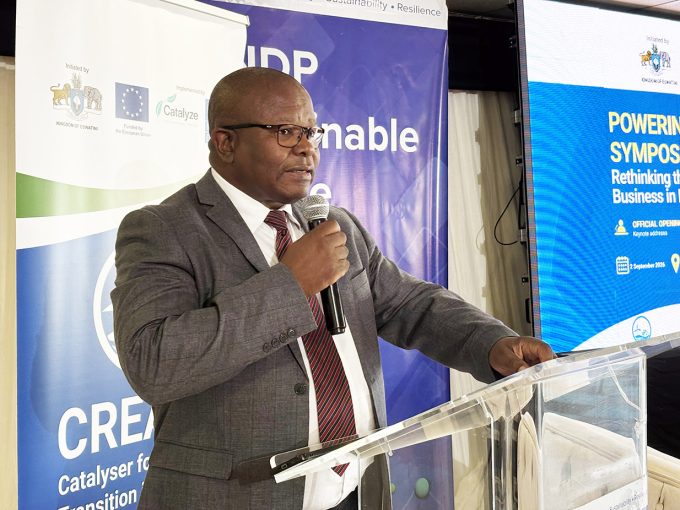
This was the message from Dr Samson Sithole, Chief Executive Officer of the Eswatini Water and Agricultural Development Enterprise (EWADE), during one of the panel discussions at the Standard Bank Regional Sugar Summit held at Simunye Country Club last Friday.
Dr Sithole said climate change continued to pose serious threats to agricultural productivity across Southern Africa, making irrigation-led agriculture increasingly important in protecting the sustainability and competitiveness of the sugar sector.
He said EWADE was positioning itself at the centre of agricultural transformation through irrigation expansion, climate-smart farming technologies and inclusive development models that support smallholder farmers.
“We are actively positioning irrigation-led and climate-smart agriculture as a long-term solution to sustain and enhance the competitiveness of Eswatini’s sugar industry amid growing climate pressures,” said Dr Sithole.
He said EWADE was championing sustainable water access and management through innovative irrigation technologies such as sub-surface drip systems and centre pivots aimed at improving water efficiency and ensuring reliable supply for sugar cane production.
*…
… EWADE, Ubombo collaboration uplift smallholder sugar cane growers
SIMUNYE – EWADE CEO Dr Sithole, pointed to EWADE’s partnership with Ubombo Sugar Limited under LUSIP II as a practical example of how collaboration uplifts smallholder sugar cane growers through expanded irrigation access and technical support.
Under the partnership arrangement, Ubombo Sugar manages sugar cane establishment on targeted hectares while Eswatini Water and Agricultural Development Enterprise (EWADE) develops infrastructure for farmer companies. “This partnership model supports smallholders by providing access to necessary infrastructure and technical support, enabling them to produce at scale and meet commercial standards,” he said. He revealed that approximately 30 per cent of Ubombo Sugar’s cane supply currently came from smallholder growers, demonstrating the growing role emerging farmers continued to play within the industry.
Dr Sithole said capacity building and extension services also remained critical in helping smallholder farmers improve yields, quality and competitiveness. He explained that EWADE continued providing training and technical support aimed at helping growers adopt climate-smart agricultural practices, mechanisation and improved farming methods.
“This increases sugar cane yields and quality, making their produce more competitive in the market,” he said.
The EWADE CEO further highlighted limited access to finance as one of the biggest barriers affecting smallholder farmers and emerging growers. He said many farmers struggled to invest in improved seedcane varieties, mechanisation and soil conservation because of financial constraints.
According to Dr Sithole, financial institutions such as Standard Bank Eswatini had an important role to play in providing tailored financial products suited to the realities of agriculture.
He said emerging farmers required flexible loan structures, lower interest rates and financing products aligned with agricultural production cycles.
“Without these financial services, many emerging farmers would remain unable to invest adequately in their farms, limiting the potential of the sugar industry and rural development,” he said.
Dr Sithole said mechanisation financing was equally important in helping farmers modernise operations, improve productivity and reduce labour intensity. He added that climate financing would become increasingly critical as Eswatini’s agriculture sector remained vulnerable to droughts and erratic rainfall patterns. “Financial institutions can facilitate this by providing loans or grants for irrigation infrastructure, drought-resistant crop varieties and sustainable farming practices,” he said.
*Full article available on Pressreader*

















Leave a comment