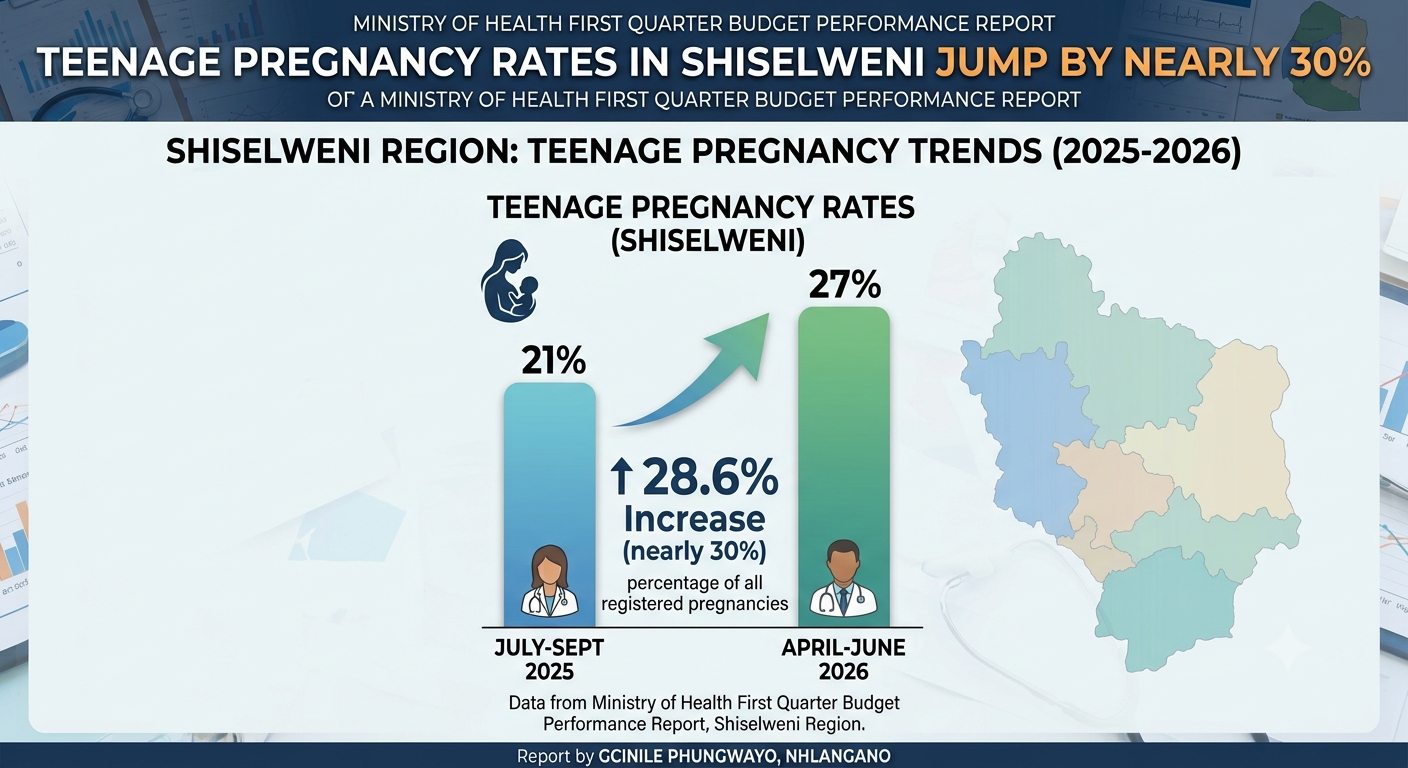
NHLANGANO – The Ministry of Health’s First Quarter Budget Performance Report for the 2026/27 financial year shows a surge of about 30 per cent in teenage pregnancy.
The pregnancy rate, according to the report, rose from 21 to 27 per cent of all registered pregnancies within a nine-month period in the Shiselweni Region. The published document highlights a severe socio-medical challenge for a regional healthcare system already buckling under the weight of rising patient numbers, critical drug shortages, and depleted human resources.
The performance report outlines a highly fluctuating trend in clinic attendance across Shiselweni’s catchment population of 212 982 citizens between January 2025 and June 2026. It recorded that the region experienced its lowest outpatient department attendance between October and December 2025, when 44 201 clients visited local facilities.
The health audit notes that during the earlier July to September 2025 period, teenage pregnancies among young girls aged between 10 and 19 years stood at 21 per cent of all registered pregnancies in the region.
As detailed in the quarterly report, by the April to June 2026 quarter, the proportion of teenage pregnancies had expanded significantly to reach 27 per cent.
The statistical tables in the report reveal that this dramatic percentage growth coincided with the highest outpatient department volume recorded in recent times, as visits peaked at 48 420 outpatient visits during the same April to June 2026 quarter, even though trend data was incomplete at the time of compilation.
Medical records in the document establish that upper respiratory tract infections were the leading cause of these outpatient visits, followed closely by diarrhoea diseases, which remained consistent across all three months of the quarter.
On a more positive note, the evaluation highlights that despite the mounting operational challenges and the influx of young, vulnerable expectant mothers, healthcare facilities in Shiselweni achieved several key milestones, such as recording zero maternal deaths at Hlatikhulu Government Hospital during the reporting period.
The report details that the outpatient department pharmacy at Hlatikhulu Government Hospital expanded its services to remain open during lunch hours to reduce waiting times, while the hospital’s Dental Department became fully functional and the Renal Unit transitioned to a 24-hour operation.
It is further stated in the review that clinical staff across the facility underwent vital training in Clinical Management Information Systems, Infection Prevention and Control and Quality assurance.
The ministry’s data reveals that Matsanjeni Health Centre maintained a sufficient stock of essential medicines, experiencing only minor stock-outs during the quarter.
According to the compiled statistics, over 440 healthcare workers across the wider region were trained in customer care, quality of care and infection prevention.
The document points out that disease surveillance remained highly effective, with 98 per cent of all health facilities actively reporting through the Integrated Disease Surveillance and Response system, allowing the regional Surveillance Unit to investigate every single reported case.
The first-quarter performance file highlights that Integrated Chronic Disease Management was successfully piloted at the Gege, Nkwene and Nhlangano Health Centres.
Conversely, the performance review warns that these achievements are overshadowed by severe shortages and infrastructural deficits, noting that Hlatikhulu Government Hospital is currently experiencing a critical human resource shortage that has blocked the opening of its High Dependency Unit.
The report clarifies that this particular unit requires a minimum of eight nurses, four orderlies, one medical officer and one nursing sister to operate.
Government inspectors state in the report that the hospital’s outpatient department is in desperate need of major renovation and is currently considered a health hazard, while the Male Medical Ward is far too small to handle the volume of patients.
The compiled paperwork laments that the facility completely lacks a Neonatal Intensive Care Unit, leaving it to contend with a high neonatal mortality ratio of 41.40 per 1 000 live births.
Hospital assessments reveal that basic safety at Nhlangano Health Centre has been compromised due to the complete unavailability of masks, which threatens the continuity of patient care and violates infection prevention and control standards.
The report indicates that this facility is also experiencing high inpatient defaulter rates driven directly by drug unavailability.
Logistical evaluations show that the oxygen supply at Matsanjeni Health Centre must be transported in cylinders all the way from Nhlangano Health Centre or Hlatikhulu Government Hospital, a system frequently disrupted by severe vehicle and fuel shortages.
The budget review notes that Matsanjeni’s financial allocation is highly insufficient for basic operations, leaving the facility struggling to purchase cleaning materials, personal protective equipment, printing services and stationery, which is further exacerbated by delayed quarterly fund releases.
To address these compounding issues, the report lists clear forward-looking priorities for each key facility in the region, starting with Hlatikhulu Government Hospital, where administrators intend to construct a well-equipped Neonatal Intensive Care Unit, advocate for the inclusion of selected officers in specialised nephrology training, and actively promote early antenatal booking through health promotion campaigns to help manage the surge in high-risk teenage pregnancies.