MBABANE – Eswatini’s sugar industry proved its resilience against the most challenging global trading environments in recent years.
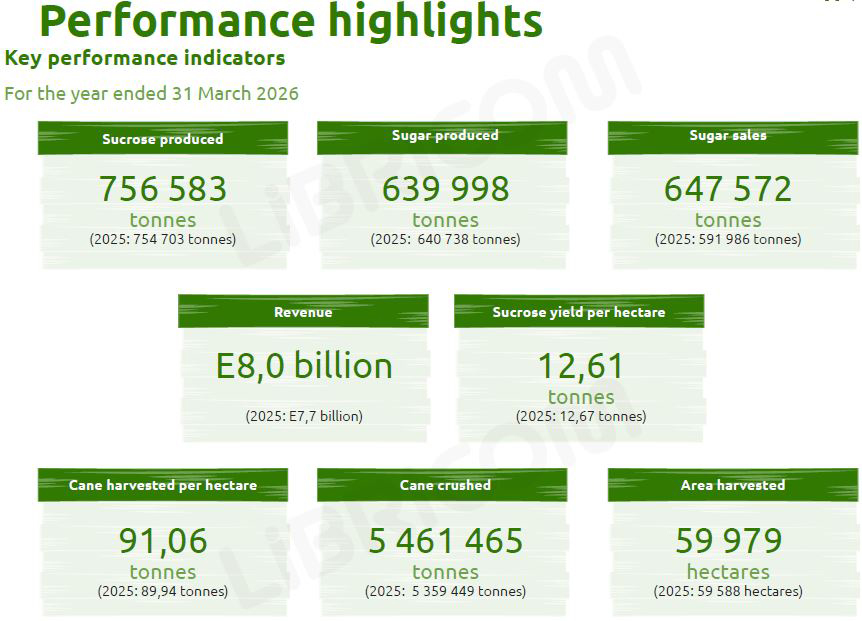
The sugar industry generated E8 billion in revenue during the 2025/26 financial year, up from E7.7 billion recorded the previous year.
The latest Eswatini Sugar Integrated Annual Report paints a picture of an industry that managed to grow revenues even as global sugar prices tumbled to their lowest levels in almost five years, adverse weather disrupted harvesting, production costs escalated and cheap imports increasingly threatened the Southern African Customs Union (SACU) market.
Revenue growth was underpinned by higher production volumes, improved sugar sales and strategic investments aimed at increasing exports of premium value-added sugar products instead of relying primarily on bulk raw sugar exports. The report shows that sugar sales rose sharply to 647 572 tonnes, compared to 591 986 tonnes a year earlier, while sugar production remained largely stable at 639 998 tonnes. Sugar cane crushed increased to 5.46 million tonnes from 5.36 million tonnes, with the harvested area also expanding to almost 60 000 hectares.
Chief Executive Officer Banele Nyamane said the year demonstrated both the strength of the local sugar industry and the realities of operating in a volatile global market. “The year under review revealed both the strength of the Eswatini sugar industry and the realities of operating in a volatile global market. Although the industry is currently facing headwinds, the industry has weathered similar cycles before and is well positioned to navigate this period,”
Nyamane said the increase in production reflected the effectiveness of industry-wide measures implemented to address declining yields and strengthen agricultural performance. “Despite strong headwinds, production increased this year, reflecting the effectiveness of measures implemented to address declining yields and strengthen agricultural performance across the industry. Management remains satisfied with performance in the areas within our control.”
He added that customer complaints regarding sugar quality had declined significantly after quality issues experienced in previous seasons were addressed. The stronger revenue performance came against an exceptionally difficult international market backdrop.
Meanwhile, Industry President Nick Jackson described the season as a perfect storm. “Low global sugar prices, currency movements and adverse weather conditions converged to place significant pressure on the industry.”
He noted that international sugar prices had fallen from more than 25 US cents per pound two years ago to below 14 cents per pound, creating extremely challenging operating conditions for producers. The report shows that global sugar production is estimated at 182 million tonnes in the 2025/26 season, resulting in a projected 2.2 million-tonne surplus after a deficit in the previous season. Increased production in India, Thailand and Pakistan added downward pressure on prices, while Brazil remained the dominant force in global sugar exports.
… SACU imports become major concern
MBABANE – A key issue highlighted throughout the report is the growing pressure from imported sugar entering the Southern African Customs Union market (SACU).
Sugar Industry President Nick Jackson said rising volumes of sugar from major low-cost producing countries were challenging the stability of the SACU market, while a weakening US Dollar had reduced the effectiveness of the dollar-based reference price used to set import tariffs.
“When global prices fall, more sugar from major low-cost producing countries enters the SACU market, intensifying pressure on us as producers.”
The report notes that SACU remains the industry’s most important market, accounting for approximately 72 per cent of total sales. However, imports into the market reached their highest levels in years, contributing to depressed regional prices.
While production increased overall, weather conditions created significant operational challenges. Jackson said the industry also faced unfavourable weather conditions during the latter part of the season.
Prolonged rainfall during the latter part of the season disrupted harvesting activities and left approximately 200 000 tonnes of cane unharvested by the end of the milling season.
Jackson added that despite these challenges, the industry continues to strengthen its long-term productive capacity. Over the past several years, the area under cane has expanded through both investment and new grower schemes.
Phase II of the Lower Usuthu Smallholder Irrigation Project (LUSIP II) in particular has brought additional land into production. While cane yields have declined in recent years, encouraging signs suggest that productivity may now be stabilising and beginning to recover following industry-wide interventions.
Chairman warns on rising electricity costs
MBABANE – Eswatini Sugar Chairman Meshack Kunene said rising electricity tariffs had become a major burden for growers who depend heavily on grid power for irrigation pumping.
“The cost of electricity has become a major concern for the industry. Growers are heavily dependent on grid power for irrigation pumping and rising electricity tariffs continue to place significant pressure on production costs.”
He said with the industry currently experiencing lower sugar prices and margin pressure, disciplined cost management, operational efficiency and strong collaboration become especially important.
Kunene said the industry is nevertheless well positioned for the future. Production costs are competitive in comparison to other producers, and the industry benefits from established regional and international market relationships, together with growing demand across the African continent.
Looking ahead, the chairman said safeguarding access to key markets, along with investment in production efficiencies and smallholder grower development will be critical to ensuring that the industry remains competitive.
“I would like to strongly commend the sugar industry in our country for showing great resilience, despite the many challenges of the past year. My thanks to the growers and millers whose collaboration sustains the industry. I would also like to acknowledge the government for its continued support and the council, management and staff for their commitment during a challenging year. Sugar is indeed Eswatini gold,” he added.