MBABANE – Minister for Tourism and Environmental Affairs Jane Simelane has reported the ministry’s Under Secretary (US), Hlobsile Dlamini, to Cabinet after operations were brought to a standstill by a fuel access problem that crippled service delivery.
In a letter dated July 16, 2026 and addressed to the Secretary to Cabinet, Victor Nxumalo, the minister sought urgent intervention, stating that the ministry had been unable to function normally since July 15, because it could not draw fuel from the Central Transport Administration (CTA).
According to the minister, the disruption was caused by a technical glitch encountered by the CTA while uploading the ministry’s information onto a new digital system.
However, Simelane alleged that despite requests for assistance, the US, who also serves as the ministry’s fleet management officer with the CTA, failed to act to resolve the problem.
The minister stated that the officer had been requested to approach the CTA offices to facilitate the correction of the system glitch but ‘could not attend to it’. She further claimed that whenever the US was available to address the issue, she instead chose to visit the Ministry of Public Works and Transport, effectively leaving operations at the Ministry of Tourism and Environmental Affairs at a standstill.
According to the letter, the minister said the situation had severely disrupted the ministry’s ability to execute its mandate, with key departments unable to carry out their work because government vehicles could not access fuel. She said the Accounts Section had already been affected, while preparations for the ongoing Regional Chiefs’ Conference had also been disrupted. The minister further warned that the situation threatened to affect the ministry’s participation in Parliament during deliberations on its first quarter performance report before the Portfolio Committee. Simelane noted that the staffing situation had further complicated efforts to resolve the matter.
She said the principal human resource officer had been transferred, the human resource officer was out of the country on official duty and the US was the only available senior administration official. “In view of the above, we hereby seek your intervention in this matter,” the minister wrote, adding that the continued disruption was affecting critical ministry operations.
The letter was copied to the chairperson of the civil service commission (CSC), the acting principal secretary and the under secretary.
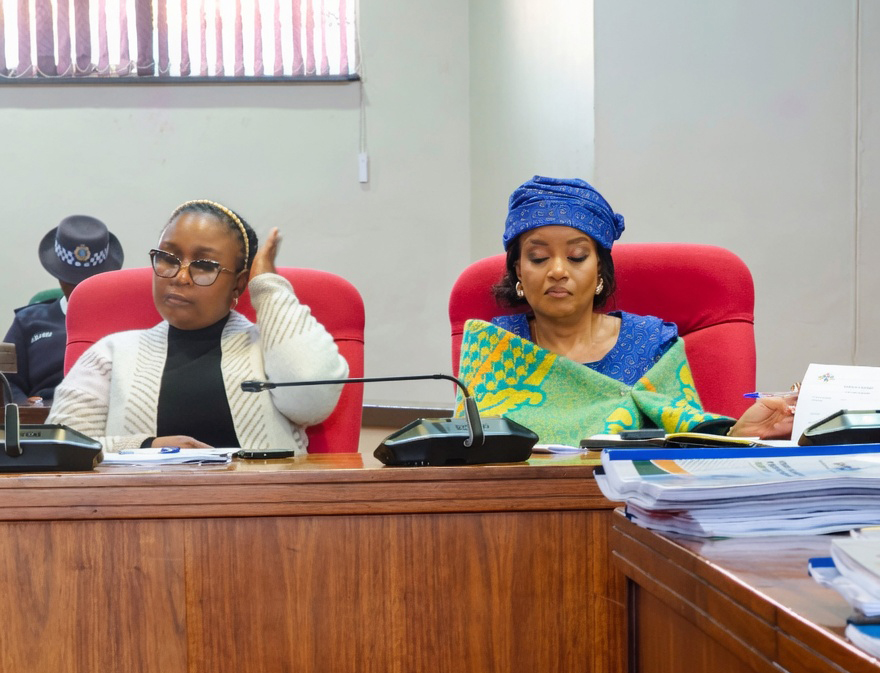
Notably, during Friday’s Portfolio Committee debate in Parliament, the minister touched on the issue involving the acting principal secretary and the under secretary.
This came after several MPs urged officials in the ministry to put the country’s interests first and avoid personal conflicts. Responding to the concerns, the minister said she preferred not to discuss the matter in Parliament.
Speaking in siSwati, she said: “Tibi tasendlini leti, letidzinga tsine bendlu,” loosely translated as: “These are internal issues that will be dealt with within the ministry.” Before addressing the matter, the minister expressed concern over what she described as the media’s tendency to focus on negative stories about the ministry.
She said that instead of highlighting the ministry’s achievements, journalists often gave prominence to controversies.
“Even now, the media will not report on the positives that have come from the ministry but will instead focus on the issue raised by MPs. They will make sure that the issues at the ministry are widely reported. That is a concern I have with journalists,” Simelane said.
She added that although the ministry had recently hosted chiefs from different countries, the event had received little coverage in the mainstream media.
Instead, she said, it was mainly publicised on social media.
“The only thing that is widely publicised is the issue involving the two officers and the minister,” she said.
The minister then explained that following the departure of former Principal Secretary Khangeziwe Mabuza, the ministry had to consider how best to fill the vacancy.
She said the ministry had both the under secretary and the director of meteorology in the F2 salary grade.
“The law stipulates that an officer cannot act for more than six months. The under secretary did act, but her term came to an end. We then had to appoint another officer who was at the same grade. As a result, I could not recommend someone in a lower position,” she said.
Elaborating further, the minister explained that her role was limited to making a recommendation to the secretary to Cabinet.
The secretary to Cabinet, she said, then engages the Civil Service Commission. “A recommendation is simply that, a recommendation. It can either be accepted or rejected. What I am saying is that the under secretary was given an opportunity to act, her term expired and I subsequently recommended another officer in the same grade. It was also part of our capacity-building efforts,” Simelane said. Meanwhile, this publication engaged the secretary to Cabinet who, however, said he was yet to see the letter.
Nxumalo said once he has seen the letter, he will engage with the acting PS as she is the one who is the controlling officer at the ministry. Last month, this publication reported that the controversy surrounding the appointment of the acting principal secretary resurfaced in Parliament, resulting in renewed tensions during the ministry’s appearance before the Public Accounts Committee (PAC). The issue arose at the start of the session when the ministry was expected to respond to audit queries raised by Auditor General Timothy Matsebula.
In terms of the law, responses to audit queries are expected to be presented by the controlling officer, who is the principal secretary. In the absence of the principal secretary, that responsibility ordinarily falls to the under secretary. However, the acting position is currently being held by Duduzile Nhlengethwa, the Director of Meteorology.
Her appointment has been the subject of debate, with some stakeholders maintaining that the under secretary should have been appointed to the acting position. When PAC Chairperson Madala Mhlanga invited the controlling officer to respond to the audit queries, Nhlengethwa instead indicated that Dlamini should take the lead.
However, Dlamini appeared reluctant to do so.
She told the committee that she found it surprising that she was being asked to respond when the ministry’s controlling officer was present and seated before the committee.
Mhlanga acknowledged her concerns and explained that it was standard practice for the controlling officer to respond to matters before the PAC.
The incident revived issues that had emerged when the ministry had previously appeared before the committee.
During that earlier sitting, confusion arose after it emerged that neither official possessed an instrument authorising them to act as controlling officer.
As a result, the ministry was unable to proceed with its presentation. Instead, its parastatals continued with their submissions while Mhlanga indicated that consultations would be undertaken to establish the correct position.
It was subsequently communicated that Simelane had issued an instrument appointing Nhlengethwa as Acting Principal Secretary.
The uncertainty prompted Mhlanga to adjourn the meeting for 20 minutes to allow further consultations after some PAC members questioned whether proceedings should continue amid the apparent confusion.
When the committee reconvened, Mhlanga announced that consultations had resulted in a decision for the meeting to proceed.
Although the session continued, several PAC members appeared dissatisfied with the situation.
At various points during the proceedings, members suggested that there was a lack of cohesion within the ministry’s leadership.
The matter resurfaced at the conclusion of the sitting when Khubuta MP Masiphula Mamba expressed concern about recurring disputes over acting appointments in government ministries.
Mamba said the situation was making the work of the PAC unnecessarily difficult.
He questioned why substantive appointments were not being made when vacancies arose and argued that established administrative structures should provide a clear succession path.
He observed that, in many organisations, deputies automatically assume leadership responsibilities when the head of an institution is absent.
The MP further expressed concern over instances where directors were appointed to acting positions ahead of under secretaries, saying this created uncertainty and raised questions about leadership processes within the public service.
He urged the Ministry of Public Service to ensure that appointments were handled in a manner that avoided recurring disputes and unnecessary confusion.
His remarks prompted Mhlanga to invite Civil Service Commission representative Sibusiso Vilakati to explain the appointment process.
Vilakati clarified that the CSC does not initiate acting appointments.
Instead, recommendations originate from the respective ministries.
He explained that when a substantive Principal Secretary is absent, a nomination is submitted through a formal minute to the Secretary to Cabinet before being referred to the CSC for consideration.
According to Vilakati, the commission considers recommendations received through the prescribed channels.
He added that the Secretary to Cabinet also assesses the capacity and suitability of the nominated officer before the matter reaches the CSC.
Mhlanga then sought clarification on whether it was normal practice for a director to be appointed ahead of the Under Secretary, given the widely held view that the latter occupies the more senior administrative position.
In response, Vilakati explained that while the Under Secretary oversees administrative matters and coordinates the work of directors, both directors and undersecretaries are heads of departments who report functionally to the Principal Secretary.
“Structurally, within the administration, the Under Secretary is the senior officer,” Vilakati said.
Mhlanga concluded by stating that further engagement on the matter would be necessary to provide clarity and prevent similar disputes in future.
He noted that unresolved questions surrounding acting appointments could continue to create unnecessary tensions within ministries and complicate the work of oversight bodies such as the PAC.