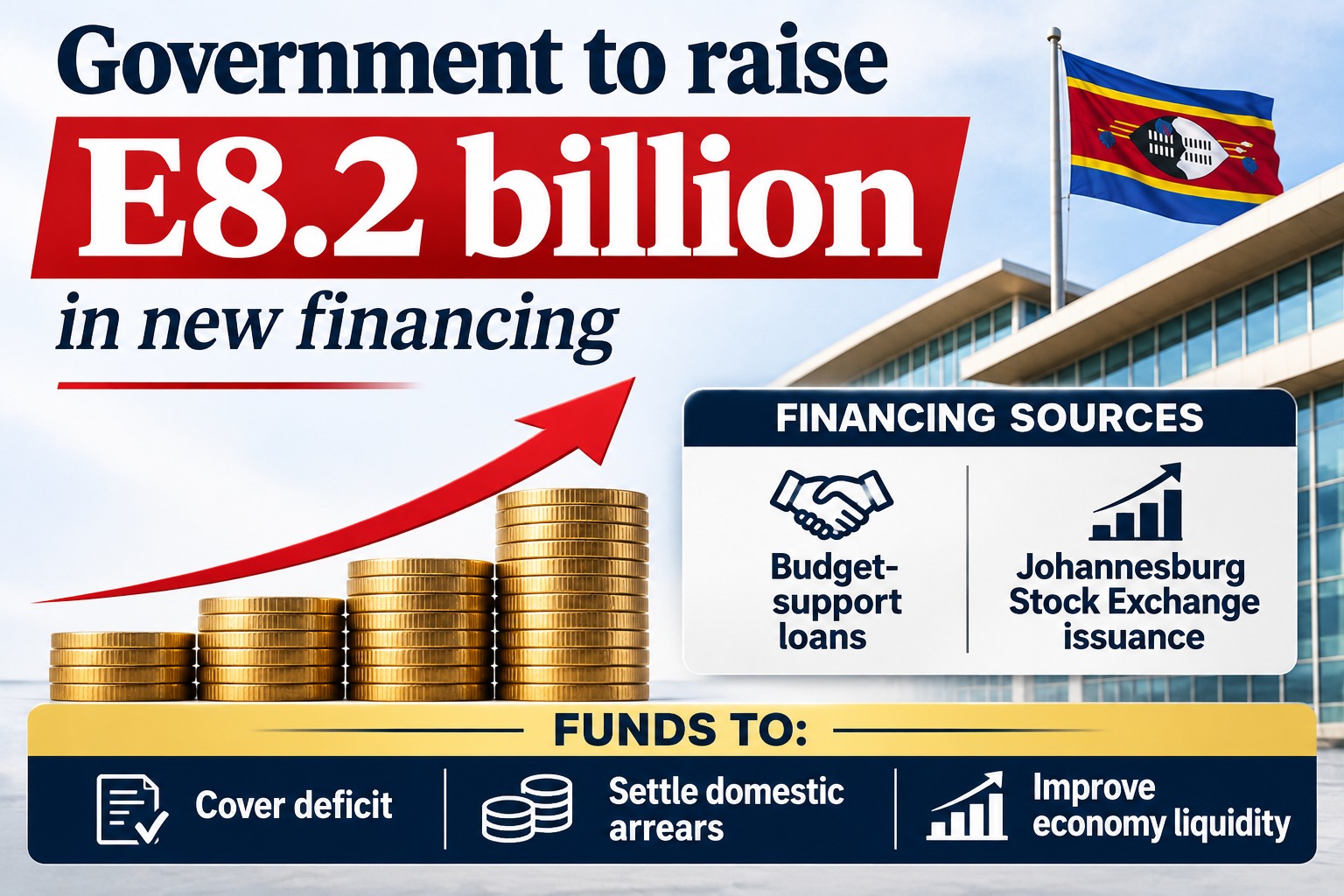
MBABANE – Government plans to raise E8.2 billion through budget-support loans and the Johannesburg Stock Exchange (JSE) to settle outstanding domestic arrears.
The financing plan, disclosed in the 2026/27 Mid-Year Budget Review, forms part of government’s efforts to address its financial shortfall and improve cash flow.
According to the statement, the proposed financing will help cover the budget deficit while providing resources to settle outstanding payments owed to domestic suppliers and contractors.
Government believes clearing these arrears will improve liquidity in the local economy and rebuild confidence among businesses that provide goods and services to the State.
The review identifies the accumulation of domestic arrears as one of the financial risks requiring continued attention.
However, the statement does not disclose the total value of outstanding arrears or indicate how much of the proposed financing will go towards their settlement.
It also does not identify the financial institutions expected to provide the budget-support loans.
The Ministry of Finance has not specified the amount government intends to raise through the JSE or the terms of the proposed issuance.
These details would determine the borrowing costs, repayment obligations and the extent to which the financing would add pressure to future budgets.
The JSE is one of Africa’s major financial markets, providing a platform through which governments and businesses can raise capital.
For Eswatini, the proposed issuance would form part of a broader strategy to secure financing beyond existing domestic borrowing arrangements.
The proposed financing comes amid substantial debt repayments.
Government reported total public debt service of E11.9 billion during the first half of the financial year.
Domestic debt service accounted for E10.8 billion, including the repayment of a E4.1 billion Central Bank advance.
External debt service amounted to E1.2 billion.
The review separately identifies E590.4 million in external debt repayments.
These figures demonstrate the scale of government’s financial obligations beyond routine expenditure on salaries, goods and services.
The Ministry of Finance says improved financial management and tighter commitment controls are necessary to prevent further accumulation of arrears.
It also acknowledges that borrowing costs and tight financing conditions remain major risks to the country’s financial outlook.
The proposed E8.2 billion financing package could provide immediate relief to government and businesses awaiting payment.
However, the review leaves unanswered questions about its composition, borrowing costs and the timetable for settling outstanding obligations.
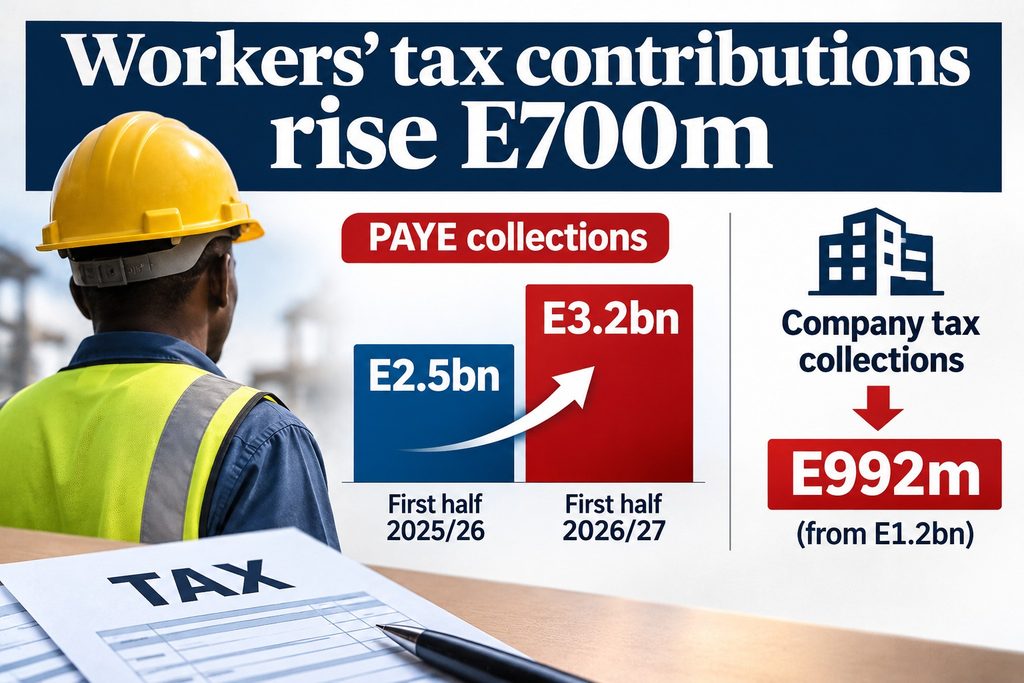
Workers’ tax contributions rise E700m
MBABANE – Government collected E700 million more in Pay-As-You-Earn (PAYE) taxes during the first half of the financial year, while company tax collections declined.
The 2026/27 Mid-Year Budget Review shows that PAYE collections increased from E2.5 billion during the corresponding period last year to E3.2 billion.
This represents a 28 per cent increase in revenue collected through the tax on employees’ earnings.
In contrast, company tax collections fell from E1.2 billion to E992 million.
The decline amounts to E208 million, or approximately 17.3 per cent.
The figures reveal contrasting performances in two major sources of government revenue.
While taxes collected from employees increased substantially, revenue from company taxation weakened.
The Ministry of Finance did not explain the increase in PAYE collections or the decline in company tax.
It also did not indicate whether the PAYE increase resulted from higher salaries, additional employment, improved tax compliance or other factors.
The distinction matters because stronger PAYE collections do not necessarily mean that more people have secured employment.
Government’s annual PAYE revenue target stands at E6.6 billion.
By mid-year, collections had reached 48 per cent of this projection.
Company tax collections represented 44 per cent of the annual target of E2.3 billion.
The review identifies income tax as the largest contributor to domestic revenue.
Combined collections from company tax, PAYE, graded tax and other income taxes reached E4.7 billion during the first six months.
This compares with E4.3 billion during the same period in 2025/26.
Government expects total income tax collections to reach E9.9 billion by the end of the financial year.
The report attributes improved domestic revenue performance partly to efficiencies introduced by the Eswatini Revenue Service (ERS).
Overall domestic revenue collections reached E8.2 billion, compared with E7.7 billion during the corresponding period last year.
The E500 million increase represents growth of approximately 6.5 per cent.
Government collected 47 per cent of its E17.5 billion annual domestic revenue target during the first half.
Taxes on goods and services remained the second-largest source of domestic revenue.
Value Added Tax (VAT) collections reached E2.8 billion, representing 46 per cent of the E6 billion annual projection.
The review nevertheless identifies VAT and company tax among the revenue categories that performed below their corresponding previous-year levels.
Non-tax revenue also continued to underperform, with collections amounting to E142 million at mid-year.
The Ministry of Finance expects domestic revenue to increase over the medium term through improved collection efficiency, digitalisation and tighter compliance.
The review projects average government revenue growth of 4.1 per cent over the medium term.
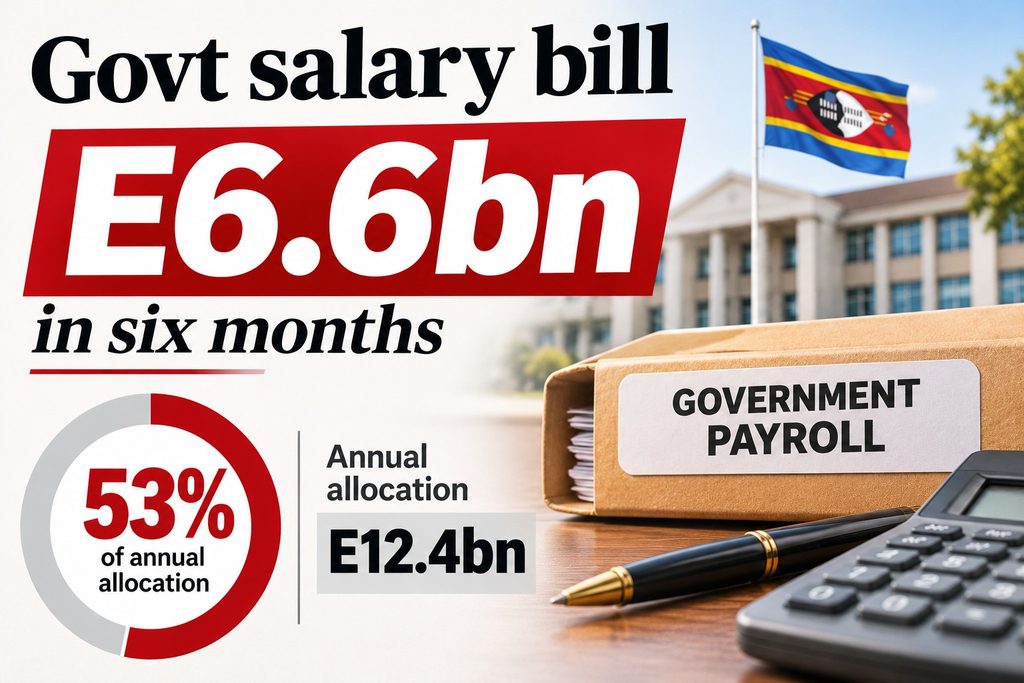
E6.6bn spent on govt salaries
MBABANE – Government’s wage bill reached E6.6 billion during the first six months of 2026/27, consuming 53 per cent of its annual allocation.
The Mid-Year Budget Review shows that employee compensation remains the largest single component of government expenditure.
The annual wage bill stands at E12.4 billion, leaving approximately E5.8 billion of the allocation for the second half of the financial year.
The figures indicate that government had already used more than half its salary budget by September.
The Ministry of Finance identifies employee compensation as one of the principal pressures affecting expenditure management.
Government has repeatedly emphasised the need to contain recurrent spending while preserving resources for essential services and development.
The latest review indicates that achieving this balance remains difficult.
The wage bill is particularly significant because salaries and other employee compensation commitments generally recur throughout the financial year.
Unlike some project expenditure, these obligations cannot easily be postponed without affecting public-sector employees.
Government’s medium-term projections nevertheless indicate that employee compensation will remain a major expenditure item.
The Ministry of Finance expects compensation costs to grow by an average of 0.74 per cent over the medium term.
It attributes the projected growth partly to the normalisation of employee compensation following implementation of the salary review exercise.
Aside from salaries, other recurrent expenditure categories recorded different execution rates.
Government committed E1.9 billion towards goods and services against an annual allocation of E4.8 billion.
This represented 40 per cent of the budget.
Transfers reached E2.6 billion against an annual allocation of E5.7 billion, equivalent to 46 per cent.
The figures show that employee compensation was progressing through its annual allocation faster than goods and services or transfers.
The Ministry of Finance says expenditure discipline remains essential to restoring fiscal sustainability.
It identifies improved public financial management, tighter commitment controls and greater spending efficiency among the measures required.
The review also calls for accelerated civil service reforms.
The ministry further warns that financial pressures could intensify if new spending commitments are undertaken without secured financing.