

EZULWINI – Eswatini’s financial system is operating under increasingly complex and interlinked pressures, with risks emerging from fiscal constraints, external uncertainties and domestic credit developments.
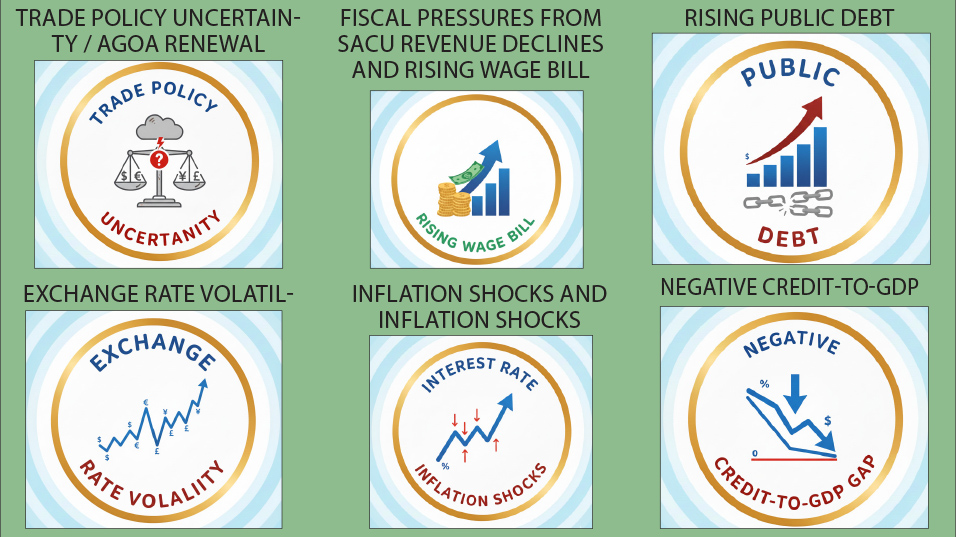
This is according to the latest Financial Stability Report (FSR) released on Monday by the Central Bank of Eswatini (CBE) and presented by Governor Dr Phil Mnisi, who highlighted six major vulnerabilities that require close monitoring and decisive policy action.
Key risks to Eswatini’s financial system arise from both regional and global developments.
Presenting the findings, Dr Mnisi said the country’s financial stability remains broadly intact, but the operating environment is tightening, particularly due to global economic shifts and domestic structural challenges. He emphasised that emerging risks – if left unattended – could weaken resilience across the banking, non-bank and household sectors.
One of the most pressing risks identified is the uncertainty surrounding the African Growth and Opportunity Act (AGOA) renewal. Should the US decline to extend Eswatini’s AGOA eligibility, the country’s export competitiveness would take a significant hit.
The report notes that lower foreign currency inflows would negatively affect export-driven industries, reducing employment levels and weakening the ability of households and firms to service loans. In turn, banks could experience rising stress in their credit portfolios.
The CBE recommends accelerating export diversification efforts, particularly through deeper participation in the African Continental Free Trade Area (AfCFTA). It also identifies manufacturing and ICT as priority sectors in mitigating external exposure.
The second risk flagged by the CBE is that weakening fiscal buffers remain a key concern. The CBE warns that declining Southern African Customs Union (SACU) receipts, combined with an expanding government wage bill, continue to strain public finances.
Reduced revenue inflows limit government liquidity and force increased borrowing to meet expenditure commitments. The report cautions that such borrowing could crowd out private-sector credit availability, thereby constraining investment and overall financial intermediation.
To foster resilience, the FSR emphasises the need for continued fiscal consolidation, broadening the tax base and protecting the country’s stabilisation fund.
The third risk is that Eswatini’s public debt increased to 40.3 per cent of GDP, up from 38.6 per cent in the previous year. This rise is largely attributed to growing domestic borrowing as government continues to finance budget gaps.
*…
Deposit Protection Fund nears launch
EZULWINI – The Central Bank of Eswatini (CBE) has moved a step closer to fully operationalising the Deposit Protection Fund (DPF).
This is a development that the CBE Governor, Dr Phil Mnisi, said will significantly reinforce depositor confidence and strengthen the resilience of the domestic banking system.
The update was shared on Monday during the presentation of the latest Financial Stability Report (FSR), where Dr Mnisi highlighted several institutional and regulatory milestones aimed at safeguarding the country’s financial stability amid growing domestic and global uncertainties.
Dr Mnisi said the nearing operationalisation of the Deposit Protection Fund marks a major enhancement of Eswatini’s financial safety net. Once fully implemented, the fund will protect depositors by guaranteeing a portion of their deposits in the unlikely event of a bank failure.
He explained that a functional DPF not only shields households and small businesses but also promotes trust in the financial system, thereby encouraging savings and strengthening banking sector stability.
Another step forward is the establishment of the resolution function, which provides a structured mechanism for the orderly resolution of failing financial institutions.
Dr Mnisi said the framework enables timely intervention before distress escalates into systemic risk. With this structure in place, authorities will be better equipped to manage crises, preserve critical banking functions and limit contagion within the financial sector.
During the review period, major strides were also made in advancing key financial sector legislation. These legislative reforms give the central bank enhanced authority to deploy a full suite of macroprudential tools – regulatory instruments designed to detect and mitigate system-wide risks.
*…
Interest rate, inflation shocks could elevate credit risk
EZULWINI – The CBE cautions that both rising interest rates and higher inflation could negatively affect household spending power and bank profitability.
If borrowers’ repayment capacities weaken, non-performing loans – particularly in household and SME portfolios – could increase. Banks may also feel margin pressure, especially if interest rate adjustments lag behind market conditions.
Prudent credit pricing, continuous supervision and frequent stress testing are highlighted as critical tools in containing these vulnerabilities.
The report further highlights the sixth risk being a continuing negative credit-to-GDP gap, signalling that Eswatini’s economy remains under-leveraged.
*Full article available in our publication



















Leave a comment