

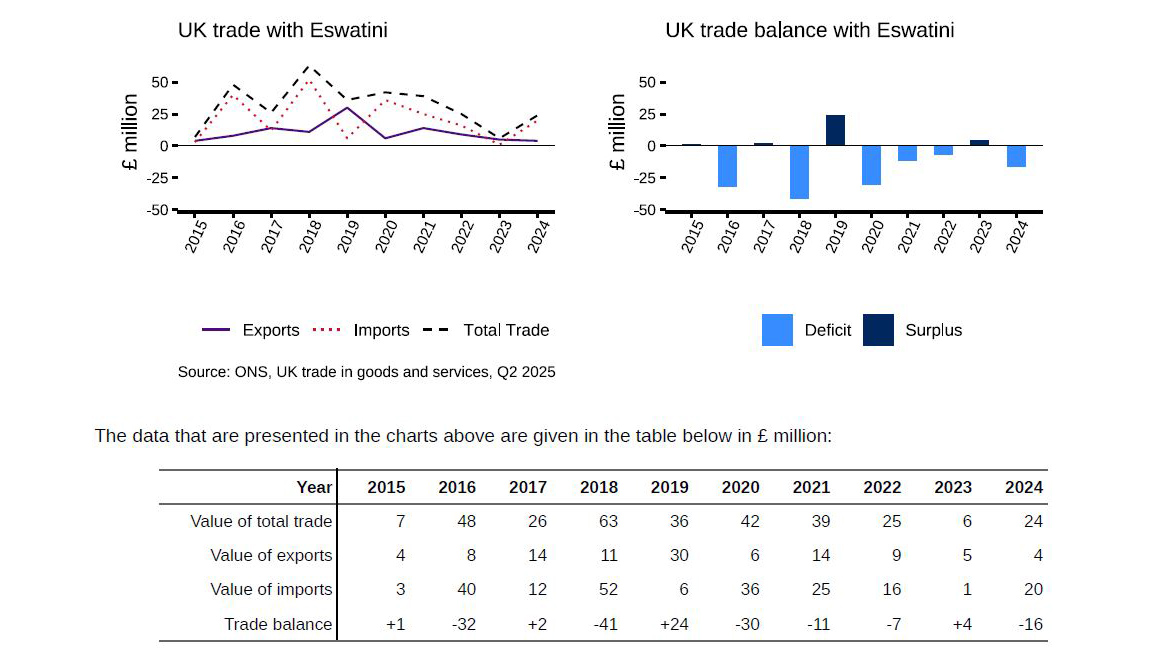
MBABANE – Eswatini’s trade performance with the United Kingdom (UK) has taken a significant downturn.
The latest data released by the UK’s Department for Business and Trade shows that bilateral trade plunged by E58 million (£4 million) in the 12 months to June 2025, down from E587 million (£26 million) in the year to June 2024.
The report indicates that UK exports to Eswatini stood at E9 million (£4 million), representing a modest decline of about 20 per cent compared to the previous year. However, the composition of these exports has shifted dramatically.
Goods exports from the UK to Eswatini fell to less than E2.3 million (less than £0.1 million), a 100 per cent decrease, leaving services as the dominant component. Services exports remained unchanged at E9 million (£4 million).
Among goods exported, the top categories in the review period were beverages and tobacco (E17.4 million/£770 000), dyeing and colouring materials (E5.2 million/£230 000), other manufactured consumer items (E3.8 million / £170 000), toilet and cleansing preparations (≈ SZL 3.4 million / £150 000), and scientific instruments (≈ SZL 2.9 million / £130 000).
On the other side of the trade ledger, UK imports from Eswatini shrank dramatically from E475 million (£21 million) to less than E22.6 million (less than £1 million) in the year to June 2025 – a full 100 per cent drop in merchandise imports.
The fall in goods imports was driven largely by sharp declines in key product categories such as sugar, which decreased by 98.3 per cent, clothing (down 64.2 per cent) and fruit and vegetables (down 37.5 per cent).
Sugar had traditionally been one of Eswatini’s major export earners in the UK market.
*…
UK market share in Eswatini continues to shrink
MBABANE – The UK’s overall market share in Eswatini fell to 0.2 per cent in 2024, down from 0.3 per cent in 2023.
Goods market share declined to 0.0 per cent, while services dropped sharply to 0.5 per cent – reflecting dwindling UK presence in both merchandise and services trade.
The factsheet also reports that UK foreign direct investment (FDI) into Eswatini stood at E294 million (£13 million) at the end of 2023.
Meanwhile, Eswatini’s investment stock in the UK remained below E11.3 million (£500 000) – highlighting a limited investment relationship between the two countries.
The report further incorporates Eswatini’s economic performance, showing real GDP growth estimated at 2.8 per cent in 2024 and projected to rise to 4.3 per cent in 2025.
Imports and exports are also expected to pick up in 2025, following contractions in 2024. However, the sharp decline in bilateral trade with the UK suggests that the United Kingdom is playing a diminishing role in Eswatini’s external sector – both as a destination market and as a source of imports.
*Full article available in our publication



















Leave a comment