

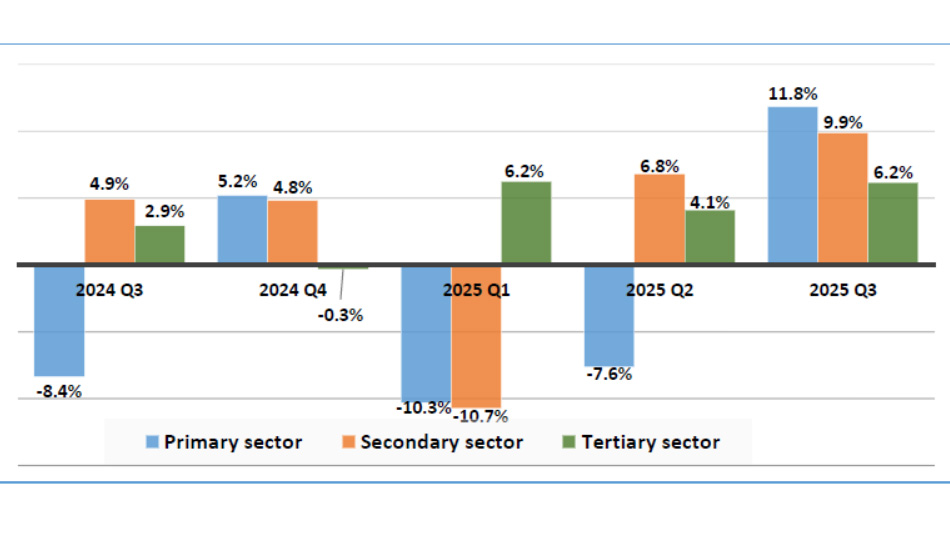
MBABANE – Eswatini’s economy showed a strong improvement in the third quarter of 2025, growing by 5.8 per cent compared to the same period in 2024, when growth stood at 1.9 per cent.
This is according to the latest Gross Domestic Product (GDP) Bulletin released by the Central Statistical Office (CSO) on Friday.
In simple terms, this means that more goods and services were produced in the country between July and September 2025 than in the same period last year. The economy expanded faster, signalling stronger business activity, improved production and increased demand across several key sectors.
GDP measures the total value of everything produced in the country, including agriculture, manufacturing, construction, trade, transport, finance and services. When GDP grows, it usually indicates that businesses are doing better, people are earning more and the overall economy is becoming stronger.
A 5.8 per cent year-on-year growth means Eswatini’s economy was nearly three times stronger in the third quarter of 2025 compared to the 1.9 per cent growth recorded in the third quarter of 2024.
This growth is ‘seasonally adjusted’, meaning it removes normal seasonal effects such as farming cycles, holidays and weather patterns. This allows for a fair comparison between the same quarters in different years.
*…
… growth matches IMF, World Bank projections
MBABANE – International institutions such as the International Monetary Fund (IMF) and the World Bank had projected a moderate recovery in economic activity for Eswatini in 2025.
This is a trend that appears to be reflected in the strong 5.8 per cent year-on-year growth recorded in the third quarter.
Recent IMF consultations indicated that the economy was expected to strengthen in 2025, driven by public and private investments, with real GDP growth forecast to rise to around 4.3 per cent for the year as a whole.
Although the IMF’s overall annual projection of 4.3 per cent growth for Eswatini in 2025 is slightly below the pace suggested by the Q3 results, the 5.8 per cent expansion in the third quarter underscores a faster-than-anticipated rebound, especially in sectors such as mining, manufacturing and services.
This suggests that the country is not only on track with multilateral expectations, but may also outperform them during parts of the year.
Similarly, the World Bank’s economic outlook emphasises the potential for accelerated growth in Eswatini, noting that structural reforms, digital transformation and increased investment could underpin stronger economic performance throughout 2025.
The bank’s Eswatini Economic Update projected real GDP growth of approximately 5 per cent in 2025, a figure that sits comfortably between the IMF’s forecast and the stronger quarterly readings in the GDP bulletin.
*Full article available on Pressreader*


















Leave a comment