

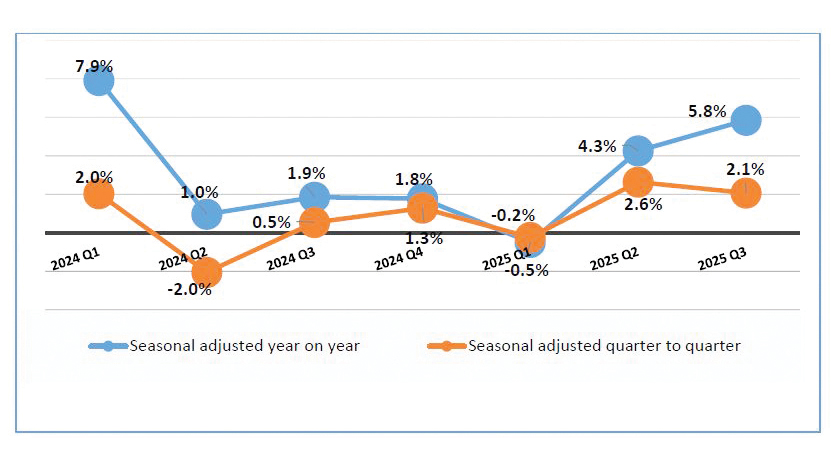
MBABANE – Eswatini’s economy recorded a robust rebound in the third quarter of 2025, with real gross domestic product (GDP) growing by 5.8 per cent year-on-year and 2.1 per cent quarter-on-quarter.
This is according to the latest GDP Bulletin released by the Central Statistical Office (CSO). Reacting to the figures, Economist Sanele Sibiya said the strong performance places the country on track to exceed its 5 per cent growth target for 2025, although sustaining this momentum into 2026 will require a strategic shift towards private sector–led growth.
“The 2025 Quarter 3 GDP bulletin reveals that the country’s economy is experiencing a strong rebound, with real GDP growing by 5.8 per cent year-on-year and 2.1 per cent quarter-on-quarter. This is significantly better than the 1.9 per cent growth recorded in Q3 2024,” Sibiya said.
He added that the performance reflects broad-based expansion across all major sectors, with particularly strong growth in the primary, secondary and tertiary sectors.
According to the bulletin, the primary sector surged by 11.8 per cent, driven largely by a 65.3 per cent increase in mining and quarrying and solid forestry output.
The secondary sector expanded by 9.9 per cent, supported by growth in manufacturing and construction, while the tertiary sector grew by 6.2 per cent, led by information and communication technology (ICT), finance, and retail trade. Sibiya said this pattern of growth demonstrates renewed economic activity across the economy. “The primary sector surged by 11.8 per cent, the secondary sector grew by 9.9 per cent, and the tertiary sector expanded by 6.2 per cent. This reflects strong recovery momentum across mining, manufacturing, construction, ICT, finance and retail,” he explained.
*…
…fiscal constraints looming
MBABANE – With government debt approaching the upper limits of sustainability, Economist Sanele Sibiya warned that fiscal space for large-scale public spending is narrowing.
“Tighter fiscal conditions will constrain future public investment. This makes it critical for the private sector to step in as the main engine of growth,” he said.
He added that reforms aimed at improving the business environment, attracting foreign direct investment and supporting local enterprises will be essential to sustain economic performance beyond 2025.
For the business community, Sibiya said the current economic environment offers short-term opportunities, particularly in growth-driven sectors.
“For businesses, the current environment presents short-term opportunities, especially in sectors like construction, retail and digital services,” he said.
However, he advised firms to prepare for a more moderate growth outlook in 2026 and beyond. “Companies should expect tighter fiscal conditions and potential shifts in consumer demand. Export readiness, diversification, and operational efficiency will be key to resilience and long-term success,” Sibiya said.
*Full article available on Pressreader*



















Leave a comment