

MBABANE – Eswatini’s latest monetary data reveal resilient private sector credit growth, steady interest rates and seasonal liquidity shifts, but declining foreign reserves continue to pose risks to macroeconomic stability.
This is according to the Central Bank of Eswatini’s (CBE) monthly statistical release for December 2025 and January 2026, which highlights sustained growth in private sector credit, resilient money supply trends on an annual basis, but a weakening reserve position and tightening liquidity conditions in the banking system.
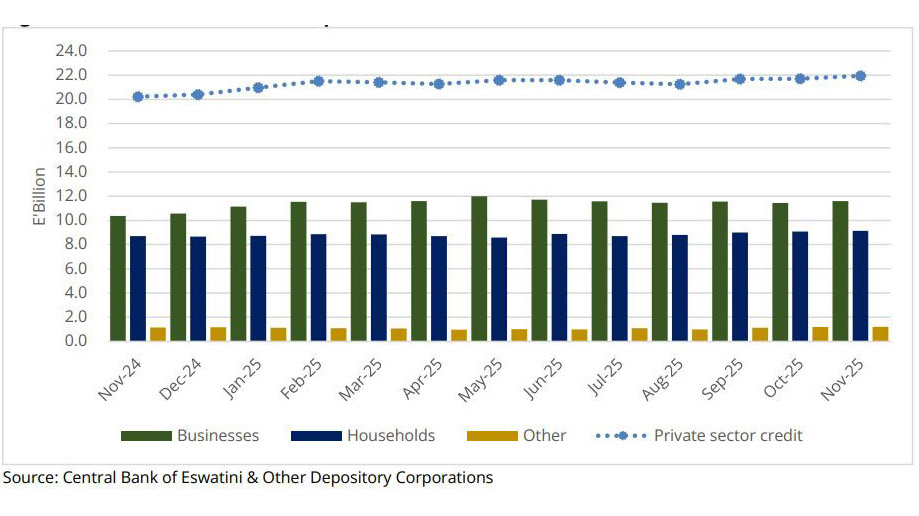
At the heart of the latest data is the continued expansion of credit to the private sector, which rose to E22.4 billion in December 2025. This represents a month-on-month increase of 2.1 per cent and a robust year-on-year growth of 9.8 per cent, signalling that households and businesses remain willing and able to borrow despite a relatively high-interest-rate environment.
The growth in private sector credit was broad-based, driven primarily by increased lending to households, non-profit institutions serving households (NPISH), and the business sector.
Credit extended to households and NPISH rose by 3.2 per cent month-on-month and 8.9 per cent year-on-year to reach E9.4 billion in December 2025.
The CBE data show that household borrowing remains largely consumption oriented. Other unsecured personal loans recorded the strongest growth, rising by 5.9 per cent to E3.8 billion, an indication of heightened demand for short-term credit, particularly during the festive season.
*…
Business credit shows sectoral divergence
MBABANE – Credit extended to the business sector increased by 2.2 per cent month-on-month and a notable 12.2 per cent year-on-year, reaching E11.9 billion in December 2025.
However, a closer look at the data reveals uneven performance across sectors.
Strong growth was recorded in transport and communications, where credit expanded by 14.9 per cent, reflecting ongoing investment in logistics, telecommunications and related infrastructure.
Manufacturing credit rose by 8.7 per cent, suggesting steady industrial activity, while agriculture and forestry recorded a modest increase of 0.9 per cent. Real estate lending edged up by 0.4 per cent.
These gains were, however, partially offset by contractions in several key sectors. Construction credit fell sharply by 14.8 per cent, pointing to subdued activity in building and infrastructure projects.
Distribution and tourism declined by 2.9 per cent, while mining and quarrying contracted by 2.6 per cent. Community, social and personal services also registered a decline of 5.7 per cent.
*Full article available on Pressreader*



















Leave a comment