

MBABANE – Eswatini’s insurance industry delivered a mixed performance in the third quarter of 2025.
Long-term insurers posted marginal growth in premium income while the short-term insurance market recorded a contraction, largely driven by sharp declines in engineering and workmen’s compensation business.
According to the latest Quarterly Statistical Bulletin published by the Financial Services Regulatory Authority, the insurance sector continued to play a stabilising role in the non-bank financial institutions (NBFI) landscape, despite growing pressure from subdued economic activity in key productive sectors, rising claims in some portfolios and soft demand for corporate insurance cover.
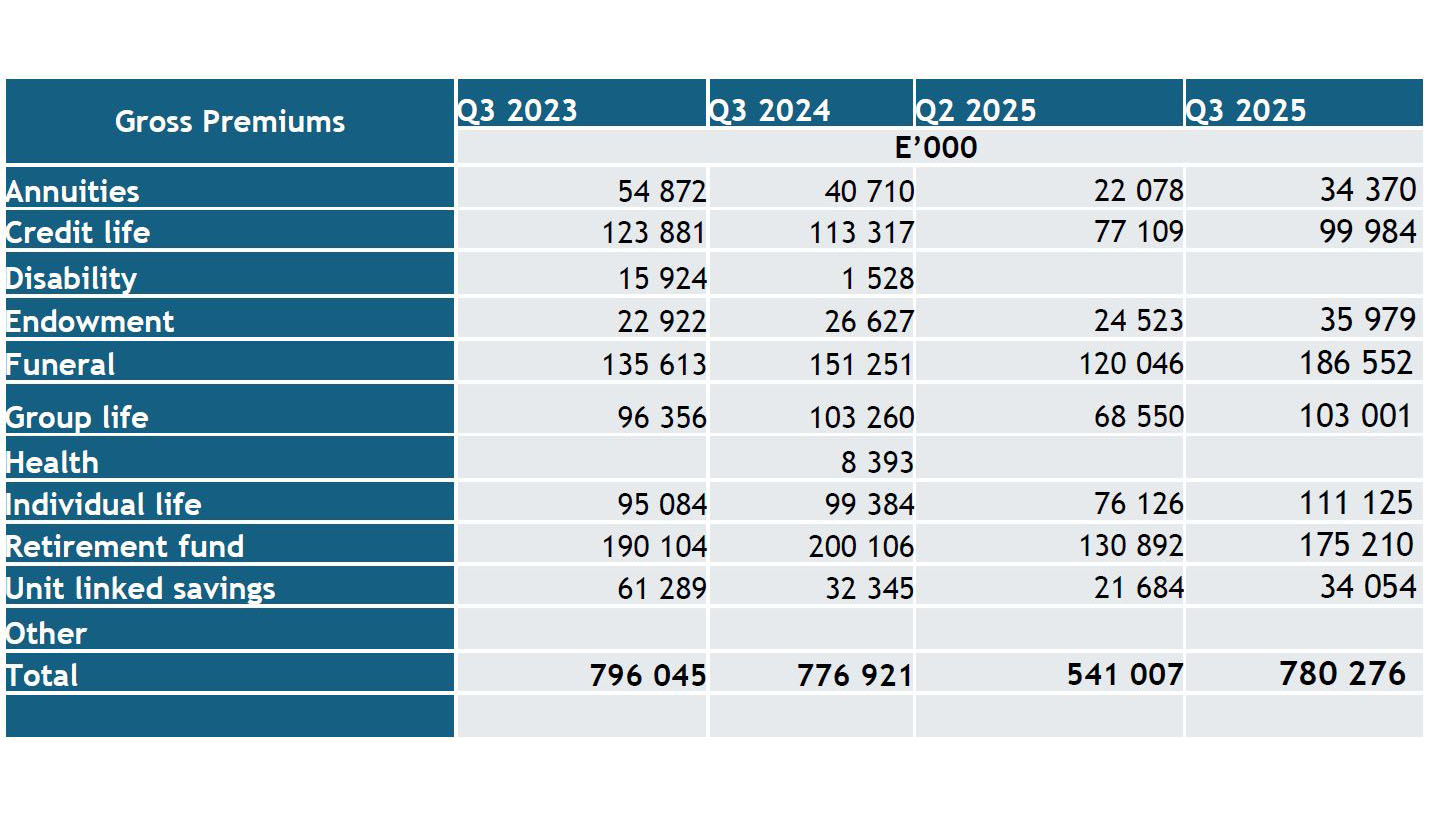
The long-term insurance (LTI) sector recorded gross written premiums (GWP) of E780.27 million in Q3 2025, representing a 0.43 per cent year-on-year increase from E776.92 million in the same period in 2024.
While the growth rate remained modest, the underlying composition of premiums revealed strong demand in specific retail-driven product lines.
Funeral and individual life policies emerged as the strongest growth drivers, rising by 29.40 and 31.71 per cent year-on-year, respectively.
Together, these two product classes accounted for 36.26 per cent of total long-term insurance premiums, underscoring the continued importance of risk protection products among households, particularly in a context of rising living costs and economic uncertainty.
Endowment policies also recorded impressive growth, with premiums increasing by 58.76 per cent year-on-year.
However, despite this rapid expansion, endowments accounted for only 4.53 per cent of total long-term insurance premiums, indicating that savings-linked insurance products remain a niche offering compared to traditional risk cover.
Retirement-related insurance business registered notable momentum, expanding by 23.98 per cent year-on-year. This growth points to increasing uptake of long-term savings and retirement solutions, reflecting heightened awareness of retirement preparedness among formally employed emaSwati and corporate clients. From a financial soundness perspective, the FSRA bulletin indicates that long-term insurers maintained healthy solvency positions during the quarter, supported by steady asset growth and conservative investment allocations. This stability is critical for policyholder protection, particularly given the long-term liabilities carried by life insurers.
*Full article available on Pressreader*



















Leave a comment