

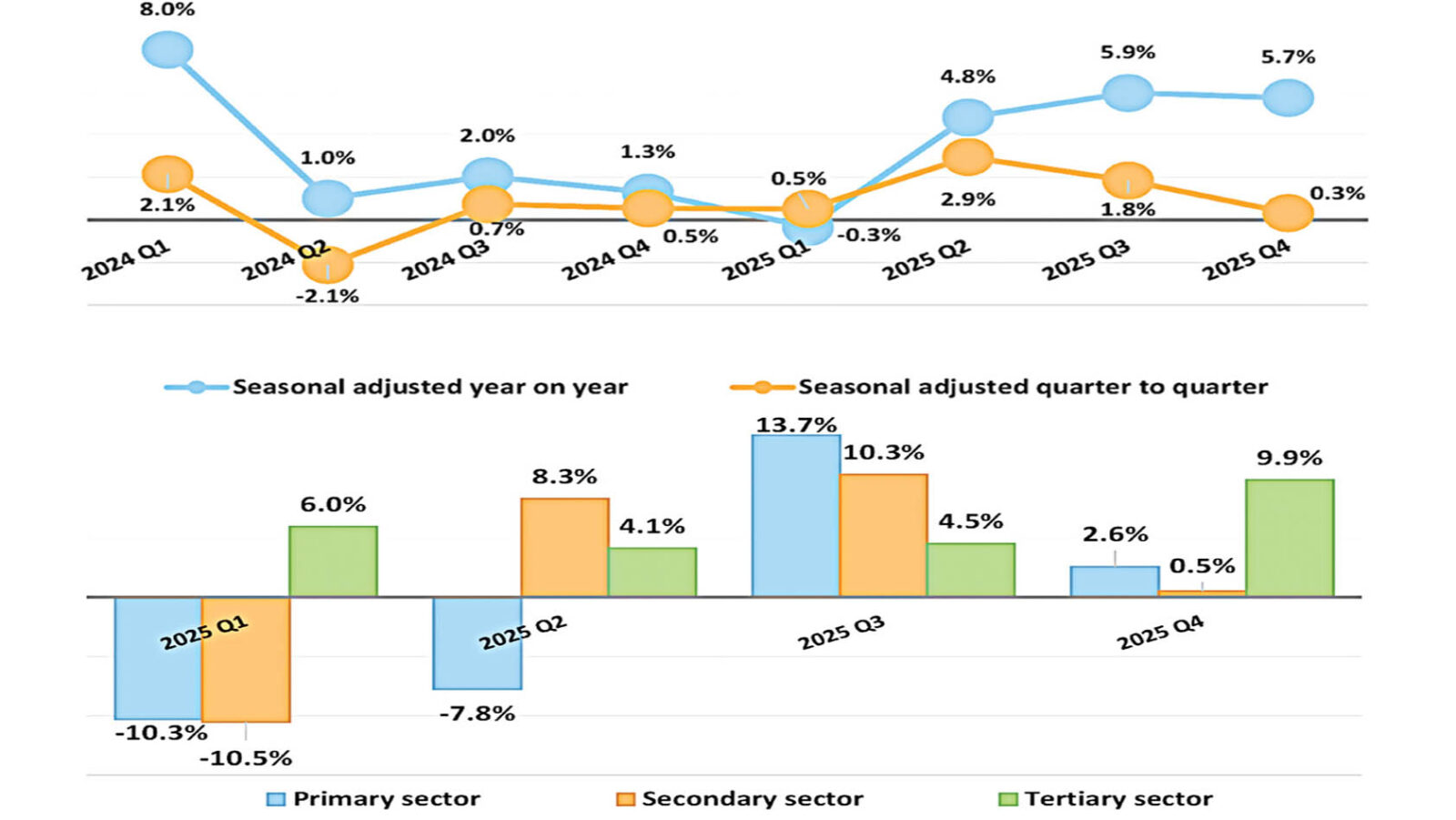
MBABANE – Eswatini’s economy staged a strong comeback in the final quarter of 2025, with real Gross Domestic Product (GDP) growth accelerating to 5.7 per cent year-on-year.
This marked an improvement from the 1.3 per cent recorded in the same period in 2024.
The latest data released by the Central Statistical Office (CSO) reflects a broad-based recovery across key sectors of the economy, underpinned by strong gains in services, renewed activity in construction and modest improvements in primary industries.
The performance signals growing economic resilience and suggests that Eswatini may be entering a more stable growth phase following a relatively subdued 2024.
The year-on-year (Y-Y) growth measure, which compares the same quarter across different years, provides a clearer indication of underlying economic performance by eliminating seasonal distortions. In this context, the jump to 5.7 per cent highlights a significant strengthening in economic activity and points to improved conditions for businesses and consumers alike.
*…
… tertiary sector records strong 9.9 per cent year-on-year growth
MBABANE – At the centre of the fourth quarter performance is the continued dominance of the tertiary sector, which remains the largest contributor to Eswatini’s GDP.
Accounting for 56.3 per cent of total economic output, the sector recorded a strong 9.9 per cent year-on-year growth, making it the primary driver of overall expansion.
This growth was supported by notable gains in several key industries. Wholesale and retail trade expanded by 15.5 per cent, reflecting increased consumer spending and improved business activity during the period. The information and communication sector grew by 16.8 per cent, signalling continued digital transformation and the rising importance of technology in the economy. Most significantly, financial and insurance activities surged by 26.5 per cent, indicating deepening financial intermediation and increased demand for financial services.
The strong performance of the services sector highlights an ongoing structural shift within Eswatini’s economy, where services are increasingly becoming the main engine of growth. This trend aligns with global patterns, where economies tend to move towards service-led growth as they develop and modernise. The expansion in financial services is particularly noteworthy, as it suggests increased economic activity across multiple sectors. A growing financial sector often reflects higher levels of investment, improved access to credit and greater business confidence. Similarly, the rapid growth in information and communication points to a digital economy that is gradually gaining traction, with implications for productivity, efficiency and innovation.
Despite the strong performance of the services sector, the secondary sector presented a more mixed picture. Contributing 35.6 per cent to GDP, the sector recorded a modest 0.5 per cent year-on-year growth in the fourth quarter. Within this sector, construction stood out as a key driver, expanding by 11.8 per cent. This growth suggests increased infrastructure development and investment in both public and private sector projects. Construction activity often has a multiplier effect on the economy, creating jobs and stimulating demand in related industries such as manufacturing, transport and retail.
*Full article available on Pressreader*


















Leave a comment