

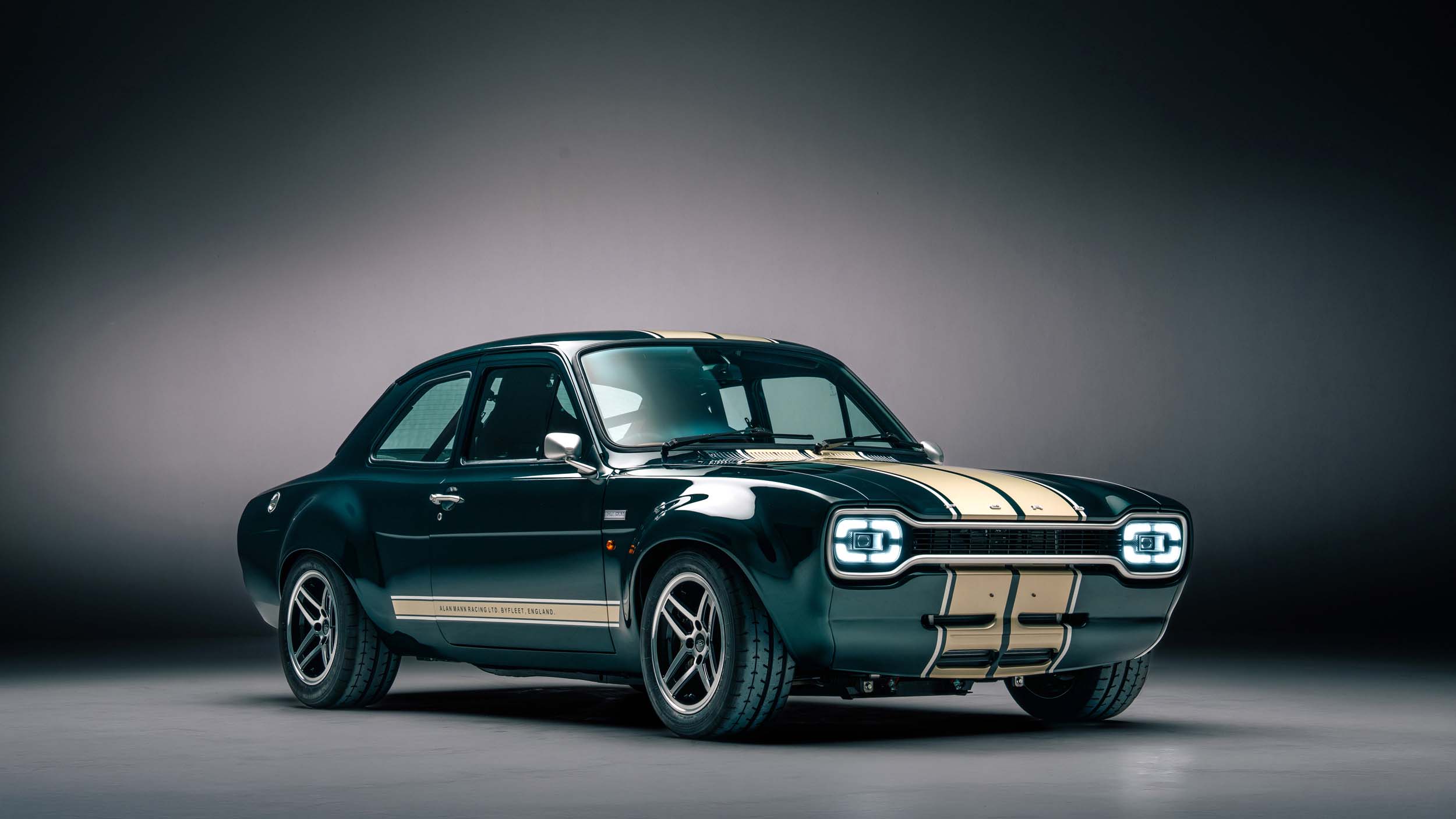
If you grew up around the 1970s, 1980s or even the 1990s, chances are the Ford Escort was more than just a car.
It was a street icon, a rally hero and for many enthusiasts, a machine tied to childhood memories and stories of sideways driving and roaring exhaust notes.
Now, the legend is back.
British motorsport specialist Boreham Motorworks has gone far beyond simply restoring an old classic.
Working under an official licence from Ford Motor Company, the company has built an entirely new Escort Mk1 RS from the ground up.
Boreham wants one thing made very clear: This is not a replica, not a restomod and not a tribute act.
This is Ford’s new RS, the true modern descendant of the RS bloodline, created with respect for its heritage, engineered with precision and designed to be driven.
What’s roaring under the hood?
The heart of the new Mk1 RS is where Boreham’s engineering ambition becomes impossible to ignore.
Buyers can choose from two naturally aspirated four-cylinder engines, but the headline act is undoubtedly the bespoke 2.1-litre “TEN-K” motor. It develops around 326 horsepower and, true to its name, screams all the way to a staggering 10 000rpm redline.
That alone sounds outrageous in today’s world of turbocharged performance cars, but the engineering story runs much deeper.
The engine block uses lightweight construction techniques and motorsport-focused design principles to keep weight down without sacrificing strength. Boreham has also incorporated Formula One-inspired port geometry within the cylinder head, allowing airflow to move more efficiently through the engine at high speeds.
In simple terms, the engine breathes like a race car.
Instead of relying on forced induction to create excitement, the Mk1 RS delivers performance through response, sound and mechanical intensity. The individual throttle bodies sharpen throttle response, while the high-revving nature creates a soundtrack that feels more race circuit than public road.
The result is an engine that demands involvement rather than simply delivering speed.
How light is it and how does it handle on the road?
Modern performance cars have become increasingly powerful, but also increasingly heavy.
Boreham decided to move in the opposite direction.
The new Escort Mk1 RS tips the scales at roughly 895kg, making it lighter than many of today’s hot hatches and even some sports cars. To achieve this, the car combines steel construction with carbon fibre panels including the bonnet, boot lid and interior components.
Weight savings were only part of the mission. Boreham also increased structural rigidity by roughly 50 per cent compared to the original Escort shell.
The stance has also evolved. The wheelbase has been stretched by 30mm over the original Mk1 Escort dimensions, improving stability at speed while retaining the sharp, playful personality that made the Escort such a motorsport legend.
At the front sits a bespoke tubular subframe supporting MacPherson strut suspension, while the rear end receives a six-link floating axle arrangement, a setup inspired by motorsport that allows the chassis to put power down with greater control and confidence.
Stopping power has also moved into modern territory. Larger performance stoppers sit behind lightweight wheels, giving the Mk1 RS the braking confidence required to match its aggressive performance potential.
What makes the package special is that Boreham deliberately avoided electronic interference. There are no driving modes, no traction control systems and no layers of software deciding what the driver should feel.
What you do with the steering wheel and pedals is exactly what the car gives back. Pure analogue driving.
Is there any modern tech inside?
Surprisingly, the answer is mostly no. The Mk1 RS avoids large digital screens and trendy technology altogether. There is no Apple CarPlay, no giant infotainment display and no digital instrument cluster dominating the dashboard.
Instead, the cabin stays faithful to an old-school driving experience, featuring exposed carbon fibre surfaces, mechanical window winders and traditional analogue dials.
However, Boreham hasn’t completely ignored modern usability.
Owners still get a fully developed electric climate-control system with heating and air conditioning for everyday comfort, a discreet single-DIN stereo with smartphone connectivity and high-performance LED headlights styled to resemble the taped-over rally lamps of classic Escort race cars.
The standout detail inside the cabin is arguably the coolest feature of all: A pair of mechanical rally chronographs mounted side-by-side in a shotgun-style layout on the centre console, developed together with luxury watchmaker Breitling.
It’s old-school engineering meeting modern craftsmanship.
Let’s talk money
The price tag starts at a staggering £295 000 before taxes and options.
Converted into local currency, that works out to roughly E7 million to E7.5 million before shipping and import-related costs.
So why is it so expensive?
For starters, production is limited to only 150 examples worldwide. Every car is hand-engineered and built specifically to deliver Boreham’s ‘Peak Analogue’ driving philosophy.
AutoTrader has also reported that Ford South Africa will not officially sell the Mk1 RS locally. However, Boreham is building both left-hand and right-hand-drive versions.
For anyone in Southern Africa considering a private import, shipping fees, import duties, VAT and luxury taxes could easily push the final price beyond E10 million.
That places the Mk1 RS firmly in supercar territory, but then again, this isn’t just another performance car. It’s a 10 000rpm celebration of Ford history and for a handful of collectors, that sound alone may be worth the price of entry.




















Leave a comment