

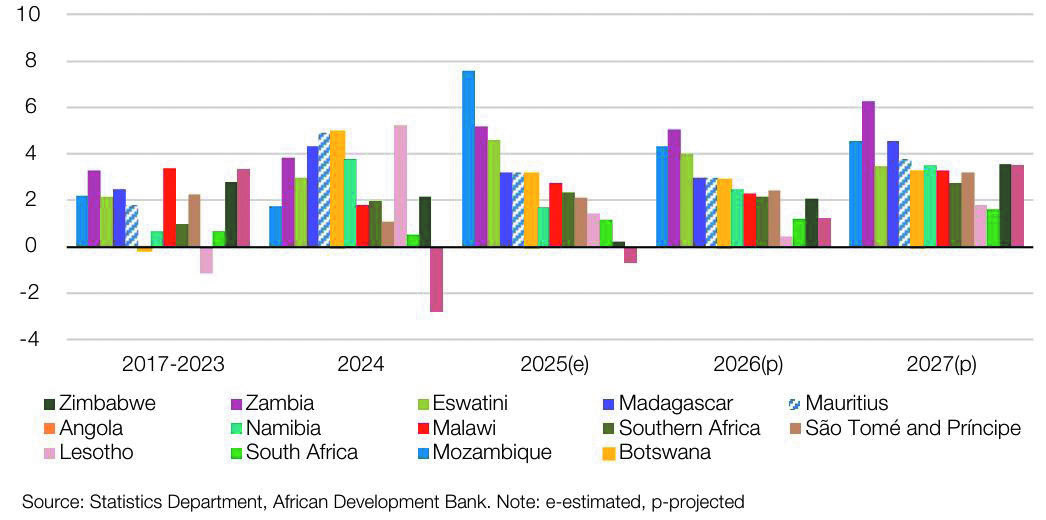
MBABANE – Eswatini is expected to remain among Southern Africa’s strongest-performing economies this year, with African Development Bank projections placing the kingdom third in regional growth rankings.
The kingdom has emerged as one of Southern Africa’s standout economic performers, recording projected economic growth of 4.6 per cent in 2026, well above the regional average of 2.3 per cent, according to the African Development Bank’s (AfDB) Southern Africa Economic Outlook 2026.Only Zimbabwe, with projected growth of 7.6 per cent, and Zambia, at 5.2 per cent, are expected to expand faster than Eswatini this year. The kingdom is forecast to outperform larger regional economies including South Africa, Angola, Namibia, Mauritius, Mozambique, Botswana and Lesotho. The report attributes the stronger performance to improved agricultural production, favourable base effects and relative macroeconomic stabilisation, making Eswatini one of the principal contributors to Southern Africa’s modest recovery.
For a country whose fortunes are closely tied to regional developments, the ranking is particularly significant as Southern Africa remains Africa’s slowest-growing region despite a gradual economic recovery.
While the regional economy is showing signs of recovery, the AfDB warns that Southern Africa continues to underperform compared to the rest of the continent.
Regional growth is estimated to have improved from 2.0 per cent in 2024 to 2.3 per cent in 2025, before easing slightly to 2.1 per cent in 2026 and recovering to 2.7 per cent in 2027. “The recovery is supported by stronger performances in Zimbabwe (7.6 per cent), Zambia (5.2 per cent) and Eswatini (4.6 per cent), driven by improved agricultural output, favourable base effects and relative macroeconomic stabilisation. However, the expected moderation in 2026 suggests that these gains remain constrained by structural challenges, including infrastructure gaps, limited diversification and continued dependence on commodities,” read the outlook.
Even then, growth remains well below Africa’s broader economic expansion.
According to the AfDB, stronger household consumption, improving activity in the services sector and a modest cyclical rebound are supporting the recovery.
However, these gains remain constrained by structural weaknesses including inadequate economic diversification, poor agricultural productivity, infrastructure bottlenecks and weak domestic resource mobilisation. The bank notes that these long-standing challenges continue limiting productivity, investment and improvements in living standards despite positive GDP growth. One of the report’s most striking findings is how Eswatini compares with its neighbours. While Eswatini is projected to grow by 4.6 per cent, South Africa—the region’s largest economy—is expected to record significantly slower growth.
Botswana continues recovering from a severe downturn caused largely by weakness in the global diamond market, while Angola’s economy is slowing as oil production moderates.
Lesotho is projected to experience one of the sharpest slowdowns in the region following weaker external demand, reduced development assistance and trade-related pressures. This places Eswatini among a small group of countries currently providing momentum for Southern Africa’s overall economic recovery. The AfDB, however, cautions that much of the region’s recent growth, including in stronger-performing economies, remains driven by cyclical recovery rather than fundamental structural transformation. Agriculture and extractive industries continue accounting for much of the expansion, sectors that create relatively limited formal employment and remain highly vulnerable to external shocks.
Inflation easing across region
MBABANE – One positive development identified by the AfDB is the continued moderation of inflation across much of Southern Africa.
Regional inflation is projected to decline from 26.1 per cent in 2024 to 12.3 per cent in 2025 before easing further to 8.4 per cent in 2026, providing Central Banks with greater room to support economic activity.
Nevertheless, the AfDB cautions that inflation remains uneven across countries and continues facing risks from global commodity prices, exchange-rate movements and geopolitical developments.
The easing inflation environment should improve household purchasing power while reducing pressure on businesses facing rising operating costs.
However, policymakers remain cautious because external shocks could quickly reverse these gains.
Although Eswatini’s growth outlook is comparatively strong, the report identifies several risks that could derail both the kingdom’s economy and the wider region.
Among the biggest concerns are escalating geopolitical tensions, particularly conflict in the Middle East, which could push up global oil prices, disrupt international shipping routes and tighten global financial conditions. For import-dependent economies such as Eswatini, higher fuel prices would increase transport costs, food prices and inflation while raising the country’s import bill. The bank estimates that sustained increases in global oil prices could increase inflation across Southern Africa by between one and three percentage points while raising import costs by as much as 25 per cent depending on each country’s exposure. Higher freight costs would also weaken export competitiveness and place additional pressure on government finances.
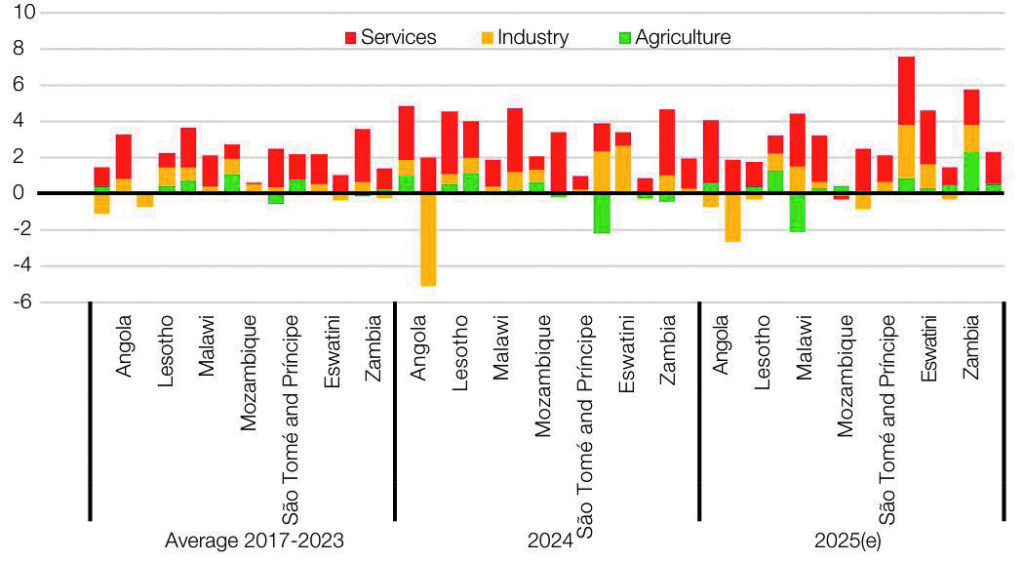
2017-2025.
Reforms still needed
MBABANE – While Eswatini’s current performance compares favourably with many regional peers, the AfDB argues that maintaining such momentum will require sustained structural reforms.
Among the priorities identified are improving domestic revenue mobilisation, strengthening public expenditure efficiency, expanding regional integration and encouraging greater private sector investment.
The report also recommends modernising infrastructure, improving agricultural productivity and strengthening financial systems to support long-term growth.
According to the bank, Southern Africa’s biggest development financing challenge is no longer simply finding additional resources but improving the ability to mobilise, channel and invest available capital efficiently.
Large pools of domestic savings remain underutilised, while investment levels continue falling short of development needs because of shallow capital markets, weak project preparation and limited long-term financing.
Unlocking this capital, the report argues, will require stronger investment climates, deeper financial markets, expanded public-private partnerships and improved governance.
















Leave a comment