

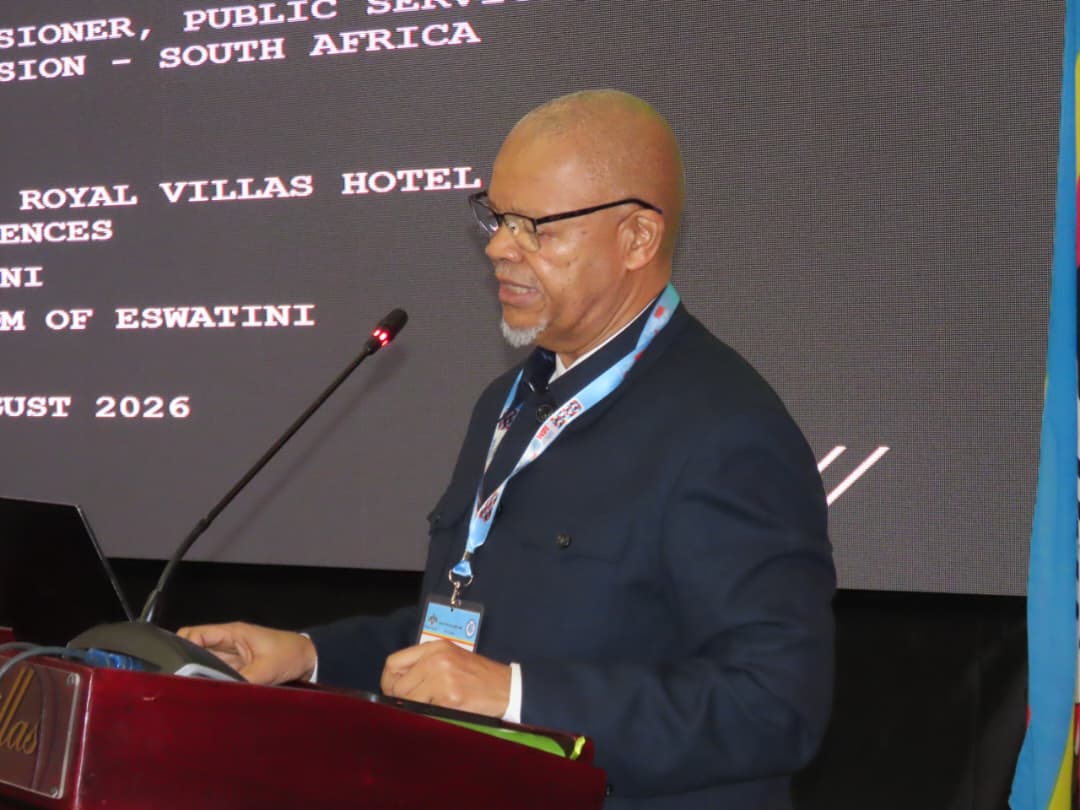
EZULWINI, ROYAL VILLAS — Public service transformation across the Southern African Development Community (SADC) region cannot succeed without embedding strong consequence management systems, South Africa’s Public Service Commission Commissioner, Professor Mandla Makhanya, has said.
Makhanya was speaking on Saturday during the ongoing 3rd Annual General Meeting (AGM) of the SADC Public Service Commissions, held at the Royal Villas Hotel and Conferences in Ezulwini, where delegates from across the region have gathered.
Eswatini is being represented at the AGM by Senate President Lindiwe Dlamini and other key government officials and is also expected to deliver her own keynote address during the gathering.
In his address, titled “Embedding Consequence Management as an Essential Pillar for Public Service Transformation,” Makhanya said the central question facing public service reform across the region was what happens when there are no consequences for failure, misconduct, or abuse of public power. He said this question shapes the relationship between States and citizens and directly influenced the ability of institutions to deliver on their mandates in areas such as education, healthcare, safety, infrastructure, social protection and local government services.
While many SADC countries had strong constitutions, laws and policy frameworks in place, Makhanya said governance weaknesses persisted across the region, with weak accountability and the absence of effective consequence management identified as the common factor behind many institutional failures.
Drawing on experiences from South Africa, Zimbabwe, Malawi and Mozambique, Makhanya said the core challenge facing the region was not the absence of accountability systems, but their inability to deliver credible, timely and consistent consequences when wrongdoing or financial mismanagement was detected. He pointed to recurring organisational weaknesses undermining accountability, including vague job responsibilities, poorly designed performance agreements, weak supervisory capacity, delayed investigations, inconsistent disciplinary practices and reluctance by management to act due to resistance from organised labour.
Makhanya urged a shift in how consequence management is understood, saying it should not be viewed merely as punishment, but as a systematic process through which institutions respond to conduct and performance based on clearly defined responsibilities, standards and evidence.
He outlined three key functions of an effective system: A corrective and disciplinary function, a developmental and preventive function, and positive reinforcement for good performance.
Describing consequence management as the “enforcement hinge” of transformation, Makhanya said it ultimately determined whether public service reforms succeeded in practice. He noted that without it, audits and investigations often ended with reports rather than remedies, since behaviour only changes when incentives change.
Looking ahead, Makhanya called for the development of ethical, technically skilled and development-oriented public servants, the establishment of regional peer-review mechanisms across SADC, and the use of graded accountability systems that distinguish deliberate misconduct from capacity-related shortcomings.
He also recommended linking sanctions to service delivery commitments and citizen feedback, and adopting digital governance systems to improve performance traceability.
In his concluding remarks, Makhanya said public service transformation in the SADC region could not rely on policy design alone, stressing that institutions had to move beyond detecting problems to acting decisively on their findings. He called for consequence management to be embedded as a structured, rules-based and reviewable system across the region, rather than one triggered only in response to scandals.
The AGM continues at the Royal Villas, with further keynote addresses, including from Senate President Lindiwe Dlamini, expected as part of the ongoing programme.
















Leave a comment