Among the many good aspects of human behaviour that countries like Eswatini and the United Kingdom have in common, let us share today a number of less appealing on-the-road characteristics; hopefully to be of benefit to the respective users.
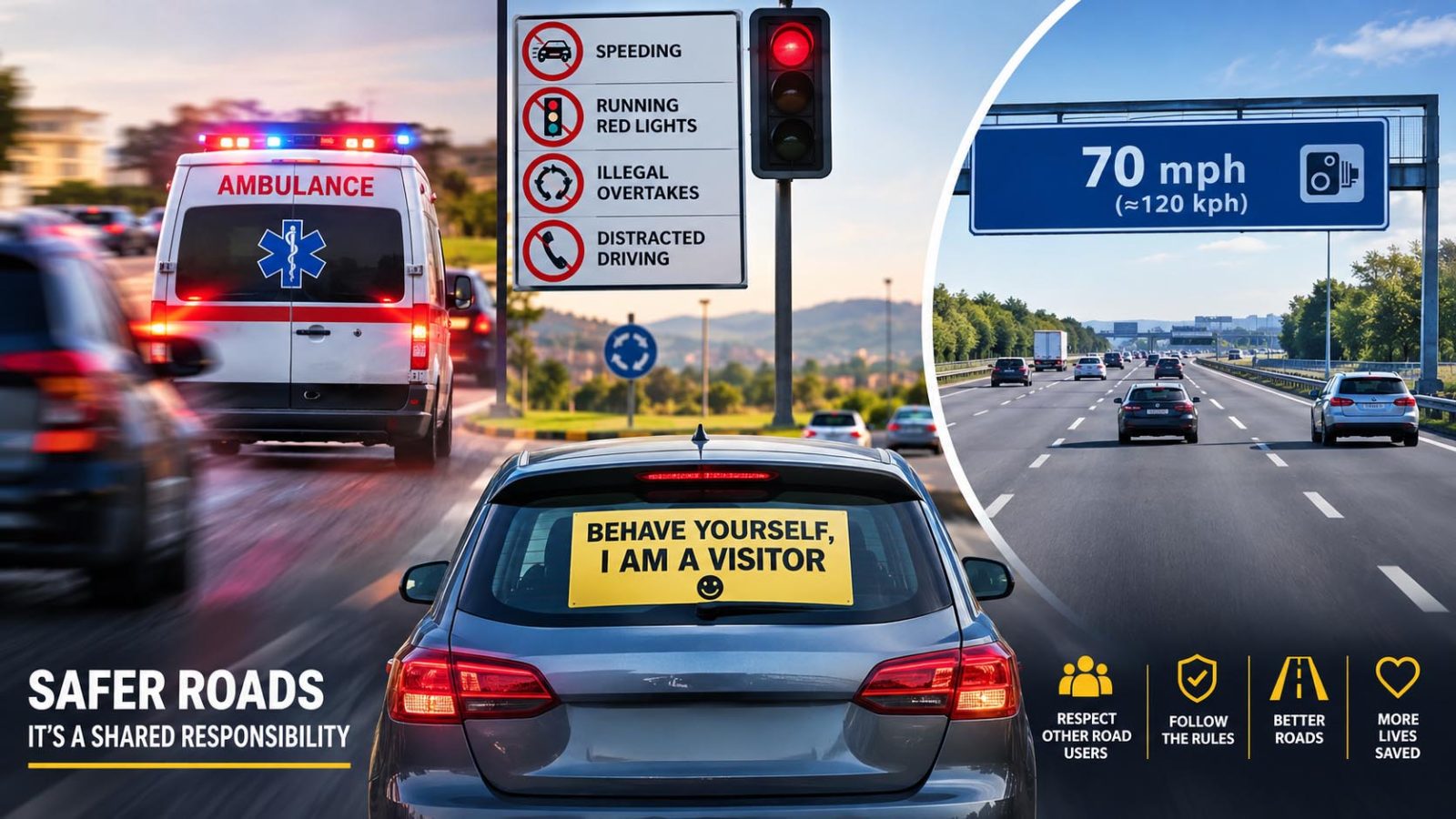
If I mention the word ‘ambulance’ what do these countries have in common? Having recently been almost run off the road by one ambulance in the UK and actually off the road by another, I was reminded of a similar characteristic in Eswatini. One that suggests a prevailing motto of – it is perfectly justifiable to risk taking three or more lives on the road just to save one in the back of the ambulance. Decent people turn into maniacs when they have a sick person in the back who stands just as good a chance of survival in a slower vehicle, arriving at the hospital only 10 minutes later.
The moral of the tale is that drivers of such vehicles very often experience a significant change in mindset and resultant behaviour which can be very dangerous and carries no justification; the power donated by the wheel. The same sometimes applies also to police vehicles. Though, it gets really annoying when the offending vehicle is a cash security one. They might as well display the slogan for all to see: ‘Money is more important than people’. Sadly, for some it is.
If one has an opportunity to help save lives, then that becomes a duty. Let´s start by agreeing that even one life lost unnecessarily is a huge tragedy. The roads of all countries are inhabited by individuals who sometimes deliberately and always selfishly behave very badly when driving a vehicle. And invariably it is the tiny minority which, if unmonitored and driving dangerously, risks human lives and drags down the reputation of the vast majority.
You don´t need me to point out that an increasing number of drivers are crossing red lights in Eswatini. Some are even taking a short cut by crossing roundabouts on the right-hand side. Compare that to the scene on a major motorway in England, occupied by a much larger volume of traffic than ever encountered in Eswatini and what do you see the vehicles doing in a 70mph (approx. 120kph) speed limit?
You see them obeying the rules, adhering to or close to that speed limit. You then ask the question: Why the better behaviour? It is certainly not because those drivers are any more concerned about human safety on the roads. It is because they are being monitored. And if they misbehave, they are automatically hit by tough penalties and not the E60 police fine that is now older than the majority of the Eswatini population. It is quite simply the presence of a highly effective combination of speed monitoring and police visibility. That is precisely what makes people behave on the roads. Equipment costs money, so let increased revenue from bigger fines help contribute to the funding requirements. And police visibility should not be officers occupying the same STOP signs that every motorist knows by heart. Just a few surprise road checks at roundabouts and traffic lights, supported by much heavier fines for offenders will soon create a deterrent that significantly reduces bad behaviour on the roads.
In Eswatini, we claim to pursue a perfectly valid objective called First World status. There are many determinants of that and we are miles away at present. We need some solid steps of progress. One of the first is to substantially increase the number of urban pavements to protect pedestrians, especially learners. Then you improve the state of the roads. To strengthen the resolve, visit a First World country and ask the average motorist – what is a ‘pothole’. Somewhat hesitantly comes a reply: Is that a hole in which you put a pot? The reply: Yes, absolutely correct, could you show me one? The reply would be: Well, not really, because we tend to put pots on shelves. I jest and exaggerate within that silly stuff, simply to make the point that First World countries constantly check for potholes in their busy streets and fix them the same day.
What, however, you get in those First World countries is a serious degree of congestion. In UK, you have 65 million vehicles on the roads. That´s one per inhabitant. In Eswatini it’s a tiny fraction of that which, of course, is a mixed blessing. But driving on our roads is generally a very pleasant experience compared to the First World countries, which experience massive traffic blockages and thousands of impatient drivers. I am currently designing a large sign: ‘Behave yourself, I am a visitor’ to flash from the back of the vehicle. You really feel the pressure of those impatient drivers, hundreds of them who could drive the respective roads blindfolded. They crowd you and flash you because you are slow to obey the instructions from the charming lady on your GPS, at some gigantic roundabout in the dark. You might say: Ignore them. That’s easier said than done and you have to care about other motorists if you want them to care about you.