Zimbabwe’s economic story is one of extraordinary contrasts. A country once associated with economic collapse, hyperinflation, political violence and mass emigration is now climbing Africa’s economic rankings, offering hope that even nations written off by the world can find their way back towards prosperity.
According to Business Insider Africa, Zimbabwe’s gross domestic product (GDP) is projected to reach US$65.9 billion in 2026, placing it 14th among Africa’s largest economies. Stronger mining activity, agricultural recovery and higher gold export earnings have contributed to this improvement. The country recorded economic expansion of 8.3 per cent in 2025, with growth forecast at five per cent this year. These figures deserve recognition. However, they also invite a deeper question: What does economic growth mean for a country whose citizens have endured years of hardship?
Zimbabwe’s history makes its present position particularly striking. Under the late president Robert Mugabe, the country experienced periods of political repression, disputed elections and allegations of violence against political opponents. Economic difficulties worsened dramatically during the 2000s, when hyperinflation destroyed savings, businesses struggled to operate and ordinary citizens faced shortages of basic commodities. Millions left the country in search of better opportunities.
The controversial land reform programme, economic mismanagement and political instability contributed to the decline. Although Zimbabwe’s difficulties cannot be attributed to one factor alone, the consequences were devastating. A country once regarded as having considerable agricultural potential became synonymous with economic distress.
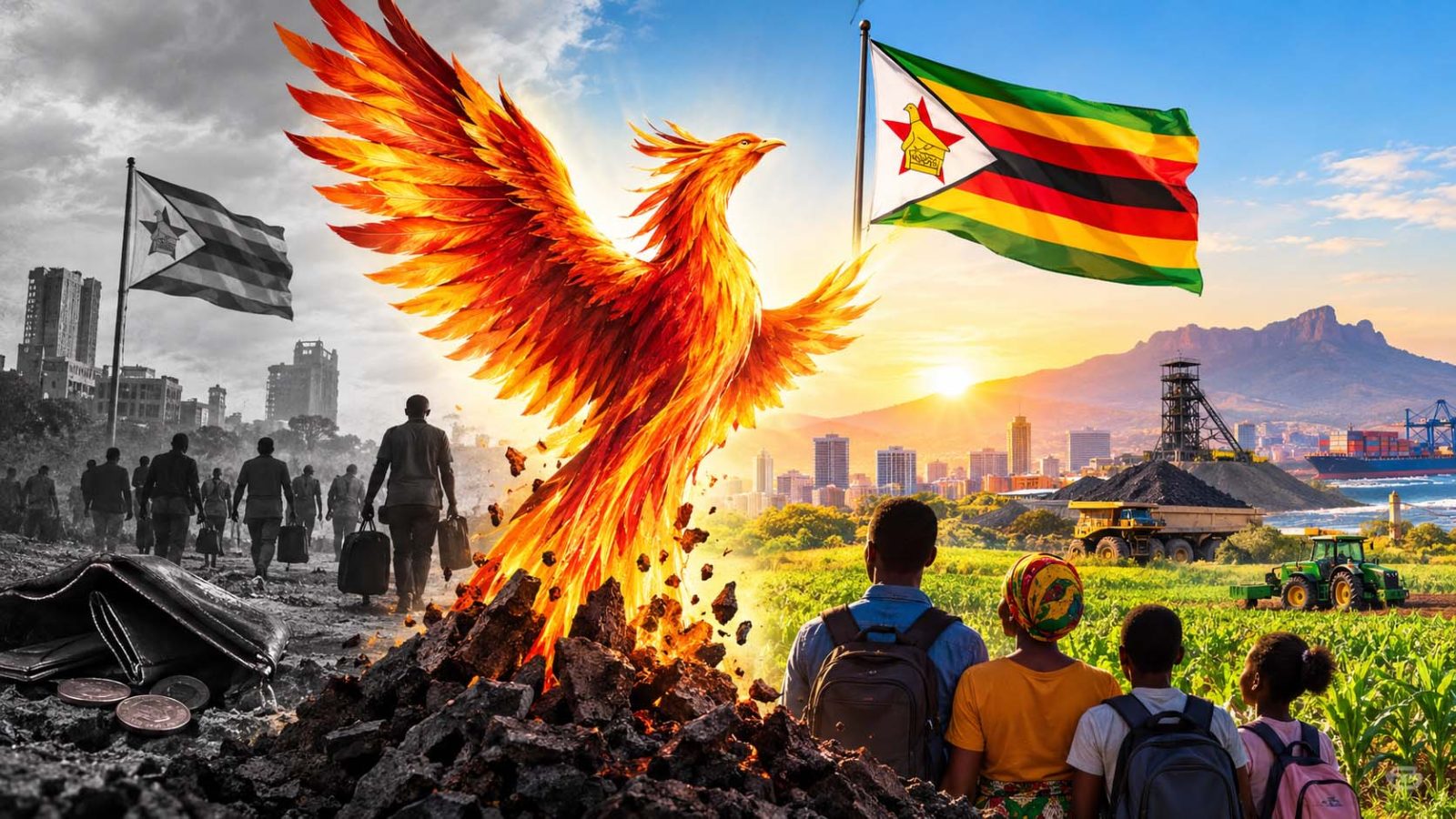
That is why the latest figures evoke the image of a phoenix rising from the ashes. Zimbabwe has not disappeared from the economic map, as its darkest years might have led some to expect. It is producing, exporting and generating economic activity on a scale that places it among the continent’s larger economies. Nevertheless, the comparison with Tanzania offers an important qualification. Tanzania’s projected GDP stands at US$96.18 billion, approximately US$30.3 billion above Zimbabwe’s, while its projected growth rate of 5.9 per cent exceeds Zimbabwe’s forecast of five per cent. Zimbabwe’s recovery is encouraging, but it has not yet translated into economic performance matching that of its eastern African neighbour.
The differences in their monetary arrangements are equally interesting. Zimbabwe continues to depend heavily on the US Dollar, which accounts for about two-thirds of payments by value in its national payment system, according to the report. Widespread Dollar use has helped households and businesses protect themselves against currency depreciation. However, it also limits the central bank’s control over monetary policy.
Tanzania, meanwhile, has promoted the use of its own currency in domestic transactions while investing in infrastructure, energy and productive sectors. Its performance suggests that economic growth cannot be explained by currency arrangements alone. Production, investment, economic management and opportunities for citizens all matter. There is another reason to approach Zimbabwe’s recovery with optimism and caution. GDP measures economic output, not how wealth is distributed among citizens.
A country can become wealthier on paper while households struggle to afford food, electricity, transport, healthcare and school fees. Mining exports can generate billions without creating enough decent jobs for young people. Agricultural output can improve without guaranteeing that rural families earn sufficient incomes. Rising national GDP does not automatically translate into a fuller shopping basket for a pensioner or a better life for a family surviving on irregular wages. This is where the true test of Zimbabwe’s recovery lies. Nelson Mandela once said: “Overcoming poverty is not a gesture of charity. It is an act of justice.” His words capture the responsibility accompanying economic progress. Growth should not simply enrich those who already possess capital, political influence or access to lucrative business opportunities. It should create conditions in which ordinary citizens can participate in the economy and enjoy its rewards.
Zimbabwe’s own experience offers a warning against celebrating recovery prematurely. Following the introduction of a Government of National Unity in 2009, the country experienced relative economic recovery and greater monetary stability. However, economic difficulties returned, with liquidity shortages, inflation and declining productive capacity undermining earlier gains. This history illustrates how quickly progress can be reversed when economic management and political conditions deteriorate.
Venezuela provides another sobering example. Once among Latin America’s wealthier countries, it suffered a catastrophic economic collapse, with living standards falling sharply over the past decade. Poor economic policies, institutional failures and political decisions contributed to a crisis that left millions struggling despite the country’s enormous oil resources. Its experience shows that natural wealth and periods of prosperity cannot guarantee lasting economic success.
Zimbabwe must therefore look beyond its ranking. It needs sustained investment, productive industries, stable monetary arrangements, credible institutions and opportunities for businesses to create jobs. Equally important is ensuring that economic gains reach communities that endured years of hardship.
There is every reason to welcome Zimbabwe’s improving economic fortunes. For a country that has suffered so much, recovery is worth celebrating. Its people deserve an economy that works for them, not merely one that impresses international observers.
The greatest achievement would not be Zimbabwe climbing a few more places on Africa’s economic ladder. It would be families no longer worrying about their next meal, young people finding work at home and small businesses growing without being trapped by instability.
A phoenix that rises only for the privileged has not fulfilled its promise. Zimbabwe’s real triumph will come when the prosperity evident in its economic figures becomes visible in the lives of ordinary citizens.