
MBABANE – Government arrears have declined to E2.7 billion as Eswatini advances public finance reforms, although outstanding payments remain above the country’s target.
The African Development Bank (AfDB), in its latest implementation progress and results report, said arrears declined from 5.2 per cent of gross domestic product (GDP) at the end of the 2022/23 financial year to 3.2 per cent at the end of the 2025/26 financial year.
The report, dated September 7, 2026, attributes the reduction to ongoing reconciliation and settlement efforts, alongside reforms aimed at strengthening fiscal discipline and improving the management of public resources.
Despite the progress, government still faces the challenge of reducing outstanding obligations further, with the programme targeting an arrears-to-GDP ratio of two per cent, while zero is identified as the more desirable level.
The AfDB has rated implementation progress under the Enhancing Economic Resilience and Competitiveness Programme (Phase I) highly satisfactory, while rating the programme’s overall development objective satisfactory.
The programme seeks to strengthen economic governance, public financial management and private-sector competitiveness to support a resilient, inclusive and green economic recovery.
The reduction in arrears represents progress in addressing a persistent public finance challenge, as unpaid government obligations can place pressure on businesses that supply goods and services to the state.
The report states that outstanding arrears decreased from 5.2 per cent of GDP at the end of FY2022/23 to E2.7 billion, or 3.2 per cent of GDP, at the end of FY2025/26.
The figures cover three financial years. However, the report does not provide the corresponding monetary value of arrears at the end of FY2022/23, making it impossible to establish from the document alone the exact Emalangeni amount by which the stock of arrears declined.
To sustain the improvement, government has been pursuing the verification of outstanding obligations relating to capital projects and line ministries, alongside reconciliation and settlement initiatives.
The report further notes that Cabinet approved the write-off of commitments that do not qualify as arrears.
E750m AfDB loan supports reforms
MBABANE – Eswatini is implementing the programme with support from an AfDB loan of US$47.5 million, equivalent to approximately E750.8 million.
The loan was approved on June 25, 2025, signed on November 13, 2025, and became effective for disbursement on December 2, 2025.
The report identifies improvements in public financial management as one of the programme’s principal achievements, including the establishment of the Revenue Stabilisation Fund in 2023.
The fund was established to help government manage fluctuations in SACU revenue and support macroeconomic stability. According to the AfDB, it has helped cushion the effects of the recent global energy crisis.
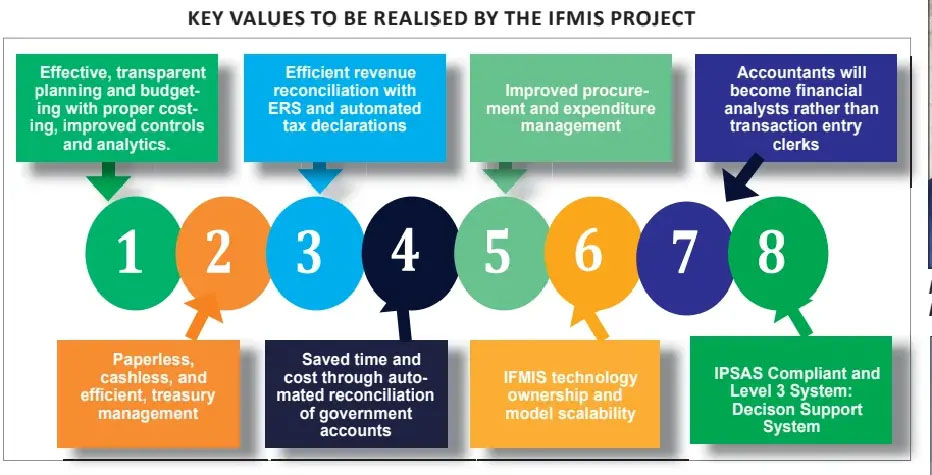
Government is also implementing the Integrated Financial Management Information System (IFMIS), which is expected to improve the management of public expenditure and strengthen controls over financial commitments.
Implementation began in 2024 and is expected to continue until 2028. Of the system’s 17 modules, 12 had been completed by May 2026.
The planning and budgeting modules were among the first to become operational, with the budget module being used in the preparation of the 2026/27 financial year budget.
The report cautions, however, that the effectiveness of the system is yet to be fully tested, as implementation remains at an early stage. Budget execution was still transitioning from the legacy system to IFMIS.
Government is also working towards adopting accrual accounting under the International Public Sector Accounting Standards, with the aim of improving the recording and management of public assets, liabilities and obligations.