

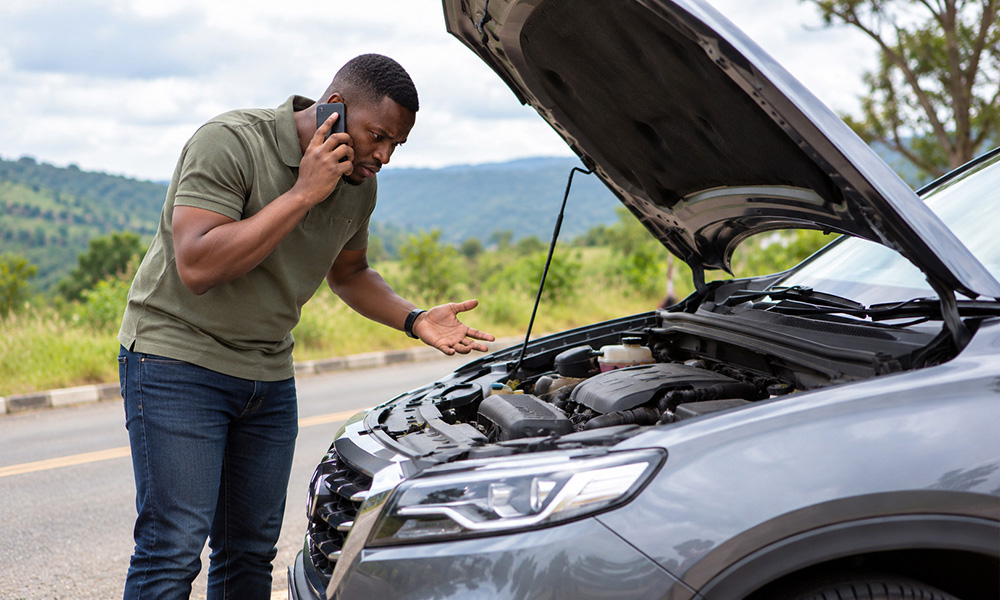
At some point, a vehicle will develop mechanical faults that may compel the driver to pull over to the side of the road.
The driver may suspect something that they believe can be fixed on the spur of the moment, or the vehicle may suddenly break down, requiring special mechanical attention.
In such circumstances, the driver may have to seek assistance while the vehicle is in the vicinity of traffic, potentially posing a hazard to other cars.
This may be unavoidable, given the condition and roadworthiness of the vehicle.
That said, it is imperative that the driver of a broken-down vehicle, together with their passengers, remains safe and takes precautions to ensure that the stalled vehicle does not pose a danger to them or other road users.
However, the situation often turns out to be one in which people pay close attention to the broken-down vehicle while exposing themselves to the risk of opportunistic accidents.
Move your vehicle to the side of the road
Depending on the size of the stalled vehicle, it is advisable to keep the roadway as clear as possible to allow traffic to flow and avoid obstruction.
However, for large vehicles that cannot be pushed off the lanes, it is imperative that towing assistance be arranged as quickly as possible to avoid traffic congestion and possible collisions involving motorists who may not have noticed the hazard in time.
A number of stalled vehicles are left unattended on the road for hours or even days, and some become almost completely invisible at night. This situation cannot be entirely separated from the negligence of drivers whose vehicles develop mechanical faults and are subsequently left in hazardous positions on the road.
Instal a reflective warning triangle
Oncoming traffic must be warned of the hazard so that drivers can reduce their speed, alert other motorists and find an alternative route around the stalled vehicle without colliding with oncoming traffic in the correct lane.
The warning triangle is best placed on the side of the affected lane rather than in the middle of the road, where it may be run over by vehicles. The appropriate distance from the stalled vehicle varies from country to country and depends on the nature of the road.
A distance of 45 metres would be ideal on a straight stretch of road, while placing the triangle between 50 and 200 metres away from the stalled vehicle would better serve motorists on a curve, a cambered road or a gravel road.
Be visible, wear reflective clothing near your broken-down vehicle
Many motorists become so preoccupied and anxious about their stalled vehicles that they pay little attention to their own safety. Drivers and their passengers may crowd around the vehicle, talking on their mobile phones without paying attention to the imminent danger of being struck by speeding traffic.
It is important to stay clear of the traffic lanes and wear a reflective vest to ensure that you are visible and identifiable from as far away as possible while using your mobile phone to seek assistance.















Leave a comment