

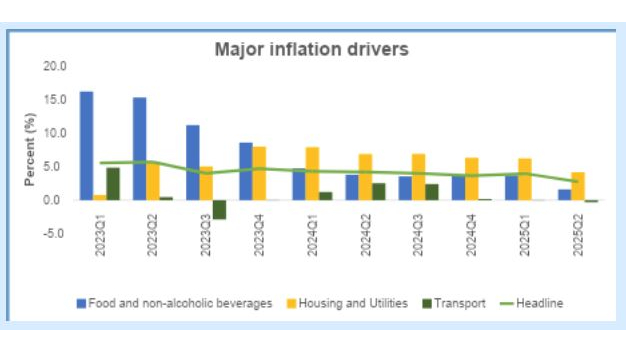
MBABANE – The domestic economy experienced nuanced quarter-on-quarter growth, with real gross domestic product (GDP) expanding by a marginal 0.5 per cent in the first quarter of the financial year.
On the contrary, a seasonally adjusted year-on-year comparison showed a 0.3 percent contraction, on account of poor performance of the primary sector and secondary sector.
The decline in the primary sector was driven by reduced output in the ‘mining and quarrying’ subsector, as well as the ‘forestry’ subsector.
This is contained in the Ministry of Economic Planning and Development Second Quarter Performance Report, covering the months of July, August and September.
The report reflects that the mining and quarrying subsector experienced a combination of operational efficiency and demand issues from destination markets in the coal industry.
Meanwhile, heightened external competition dampened local performance in the forestry subsector, as detailed in the report.
The report depicts that subdued activity in the secondary sector stemmed mainly from poor performance of the ‘manufacturing’ subsector.
“Unfavourable market dynamics also placed downward pressure on production in the subsector. On the contrary, increased construction activity owing to ongoing and new projects, such as the Construction of the International Convention Centre (ICC), Lower Usuthu Irrigation Project (LUSIP II) and MR14 and MR21 (110kms) road, cushioned the overall decline in the secondary sector,” reads the report.
*…
Global growth prospects improved
MBABANE – Global growth prospects have improved from the economic trajectory projected in April 2025.
The report reflects that this is due to robust front-loading in international trade before the kick-in of US tariff increases, lower average effective tariff rates for most countries than previously announced by the USA, improvement in global financial conditions as well as fiscal expansions in some jurisdictions, in the review period (IMF, WEO Update, July 2025).
Global growth projections have therefore been revised upwards to 3.0 per cent in 2025 and 3.1 per cent in 2026, compared to 2.8 percent and 3.0 per cent in the previous forecasts.
Growth in Sub-Saharan Africa (SSA) is projected to be relatively stable at 4.0 per cent in 2025 and pick up to 4.3 per cent in 2026. These projections reflect upward revisions from earlier projections of 3.8 percent and 4.2 per cent in 2025 and 2026 respectively, resulting from a positive global economic outlook.
*…
E21.4bn extended to private sector
MBABANE – In the first seven months of the year, total credit extended to the private sector was recorded at E21.463 billion, which reflected an 8.1 per cent growth compared to the same period in 2024.
This was mainly attributable to a rise in credit extended to businesses, households and other sectors, which grew by 14.3 per cent, 0.6 per cent and 9.4 per cent, respectively, as reflected in the report.
It depicts that the increase in credit to businesses was observed in sectors such as agriculture, mining and quarrying, manufacturing, construction, distribution & tourism as well as other sectors which comprise of non-profit institutions serving households (NPISH).
“Similarly, the country’s financial buffers, as measured by the gross official reserves, increased by 12.2 per cent compared to the same period in 2024 and amounted to E11.949 billion. This increase was on account of an inflow of the Southern African Customs Union (SACU) receipts at the beginning of July 2025. At this level, the reserves were sufficient to cover 2.9 months of imports, falling short of the internationally recommended threshold of 3 months,” reads the report.
The Central Bank of Eswatini maintained an accommodative monetary policy stance between the month of June and September 2025. In this period, the discount rate and prime lending rates were maintained at 6.75 per cent and 10.25 per cent, respectively, following the cuts effected in May.
*Full article available in our publication.

















Leave a comment