

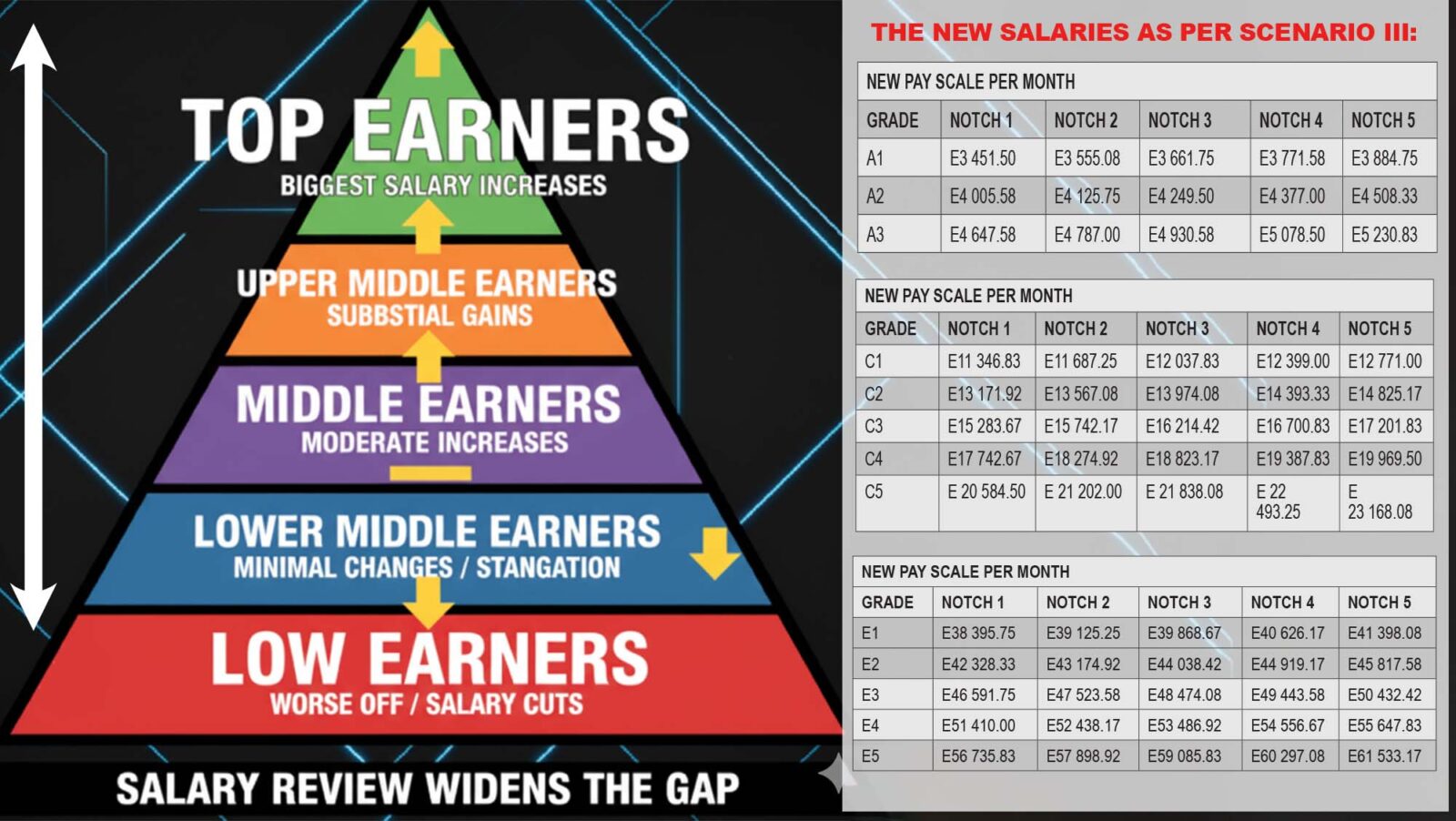
MBABANE – Low earning civil servants say the salary review was nothing but an illusion as it has widened the gap between the haves and have-nots.
The salary review, effected nine years after the last one, is said to have widened the remuneration gap among civil servants, similar to the 2016 outcome. The review, conducted through Scenario III of the Salary Review Report and implemented retrospectively from April 2025, highlights a wide earnings gap within the public service.
The new salary structure places the highest earning officials far above the lowest paid workers in both monthly pay and backpay allocations.
The pay decrease among civil servants was noted in Grade B1, which includes assistant records officers. Their old pay was E5 569.67, while the new pay scale is E5 392.50, a decrease of E177.
In the 2025 revised salaries, low-paid civil servants such as gardeners, domestic helpers, dishwashers, waiters and cleaners received a slight increase in their new pay scale. Positioned at Grade A1, Notch 1, these professions saw an old pay of E3 183.08 increase to E3 451.50, an increase of E268.
Other low-paid grades showing a minimal difference from the old pay scale include executive officers and shorthand typists under Grade B4. Their old pay scale was E8 407.83 and they will now earn E8 427.42, a modest increase of E19.59.
Contrary to the low earners, public service workers in Grades C to F transitioned directly from their current notch to Notch 1 of the new structure, as per the agreement reached in the Joint Negotiation Forum (JNF). These grades will also receive revised housing allowances from July 2026.
The salary review shows the highest increases among senior managers, particularly in Grades D, E and F. One of the most notable changes involves head teachers.
Those placed under Grades D4 and D5 transitioned to Notch 1 of the new scale, where salaries rose from E26 845.92 to E34 896.08, an E8 050.33 increase. Grade E officials saw substantial gains. Workers in Grade E1 rose from E22 373.75 to E38 395.75, while those in Grade E5 moved from E44 457.33 to E56 735.83 at Notch 1. The increases across Grades E1 to E5 range from several thousand to more than E10 000 per month.
At the highest band, Grades F1 to F5 show the largest monthly salaries in the public service. For instance, Grade F1 salaries move from E39 753.83 to E62 675.17 and Grade F5 rises from E59 054.50 to E93 315.83 at Notch 1. These figures illustrate the widening gap between lower-level civil servants and top public officials under the new structure.
It is worth noting that the International Monetary Fund (IMF) states that income inequality in the country is among the highest in the region (Gini coefficient of 54.6 in 2016), contributing to a poverty rate of 59 per cent (2023).
The country does not have social safety nets in place to cushion all the vulnerable groups, except the elderly and disabled. Additionally, poverty affects 52 per cent of the population, underscoring the persistent challenges of inequality and economic exclusion.
*…
Retail, trade workers get 6.5 – 34% salary increase
BY SIBUSISO ZWANE
MANZINI – Workers from the retail industry, hairdressing salons, wholesale and distributive trade will receive salary adjustments ranging from 6.5 per cent to about 34 per cent for the 2025/26 financial year.
These developments were confirmed by the Swaziland Commercial and Allied Workers Union (SCAWU) Secretary General Phila Mthethwa, who said workers in these industries will now receive the same salary, regardless of whether they work in rural or urban areas.
The union representative emphasised that, until now, workers in urban areas were paid more than those in rural regions. He mentioned that this year’s Wages Council has merged the categories of workers from rural areas, meaning they will earn the same salary as their counterparts in urban areas.
Mthethwa noted that they initially demanded a 15 per cent cost-of-living adjustment (CoLA), but during discussions aimed at merging pay scales, they had to reconsider their demand.
This was due to employers arguing that the salary increases for rural workers would be too significant for them to accommodate.
*…
It’s a generational curse – NAPSAWU
MBABANE – The National Public Services and Allied Workers Union (NAPSAWU) President, Winile Ndlovu, says this is a generational curse.
Ndlovu said their efforts to correct this have fallen through again as they have been trying to put a stop to it since 2016. She said for the longest time, high earning civil servants have been the ones benefitting more from salary reviews and it was only once that then Prime Minister, Sibusiso Barnabas Dlamini, heard the cries of Public Sector Unions (PSUs) and implemented a salary review that gave a high salary increment to low earners and low increment to high earners. Ndlovu said as it was, the country was reverting back to the norm that high earners get the highest increment, making the low earners worse off.
She said it was unbelievable that someone earning as little as E3 500 could not benefit from the salary review simply because the consultant found that they were already earning higher than their regional counterparts.
“The sad part is that most of the low earners can’t afford to see their children beyond tertiary and some end up working for the high earners. Some are so stressed that the only excitement is drawn in making children yet that is adding to their woes,” she said.
*Full article available in our publication


















Leave a comment