

MBABANE – What is the whole purpose of attaining a high school education?
The answer is definitely ‘for one to enter university’ and prepare for their preferred career. However, the latest statistics show that nearly 13 000 candidates who sat for the Eswatini General Certificate of Secondary Education (EGCSE) will not be allowed into the University of Eswatini (UNESWA).
This is because a critical university gateway subject, English, has been failed by 64.6 per cent of Eswatini’s 2025 examination candidates, new official data from the Eswatini Examinations Council (ECESWA) reveals. Of the 19 721 candidates who sat for the examination, only 5 308 obtained A* to C, meaning they meet the entry requirements. However, the remaining 12 751 did not qualify.
According to the latest prospectus, a prospective student seeking enrolment for a degree programme should include English not only as a pass, but at least a credit. However, this is not to say that they have failed as they may be able to enter other tertiary institutions and continue with their education.
UNESWA is the barometer of Eswatini’s tertiary education. It offers programmes up to Doctor of Philosophy (PhDs).
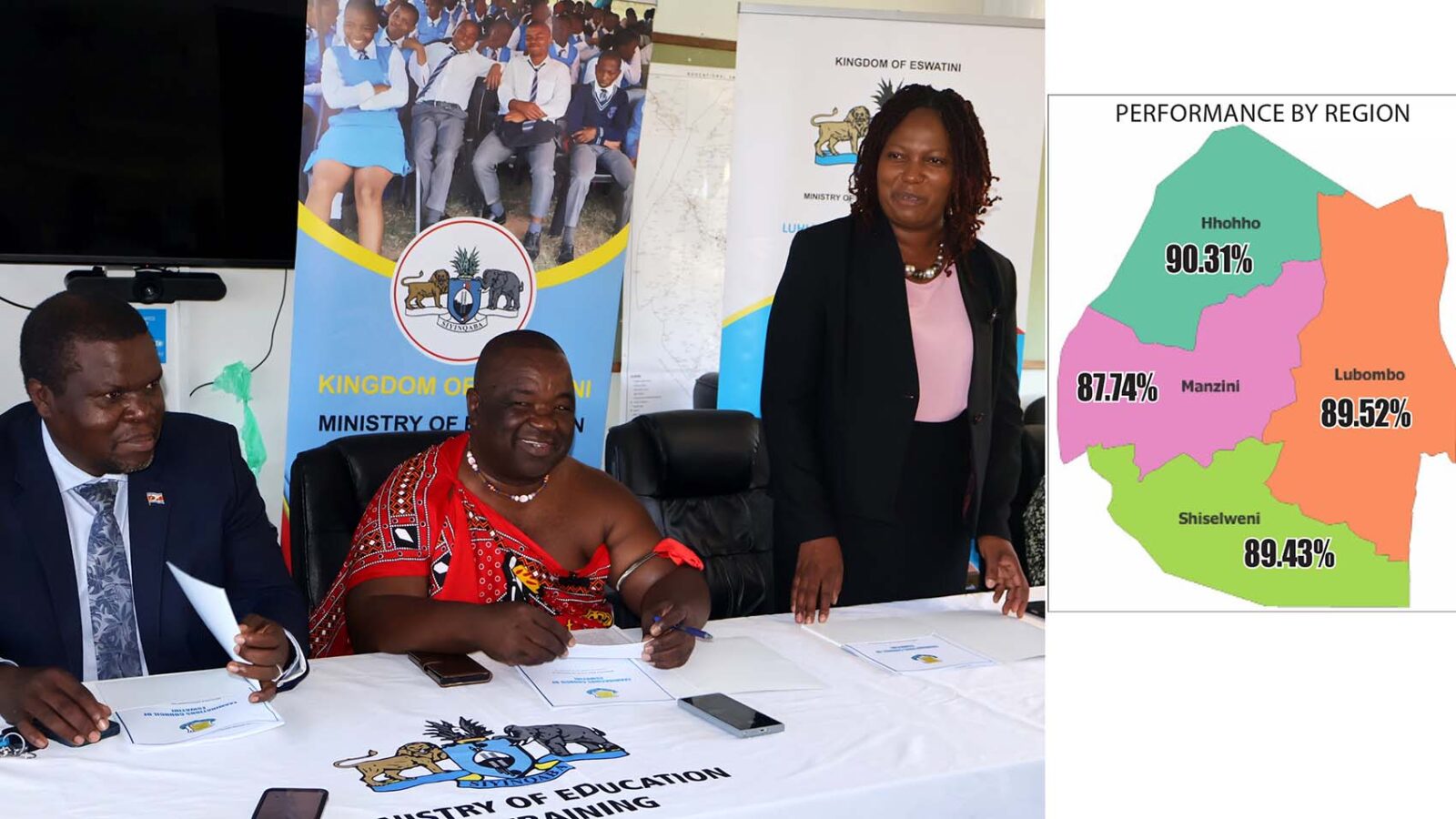
The Ministry of Education and Training, in collaboration with ECESWA, presented part of the results yesterday during a press briefing. This took place at the Ministry of Education and Training Sixth Flour Boardroom.
Meanwhile, for the first time in Eswatini’s history, two distinct groups of Form V pupils, one on a new, accelerated track and the other on the traditional path sat for the exact same national leaving certificate.
This 2025 examination served as the first major public test of the Ministry of Education’s controversial four-year high school pilot programme launched in 2022. The Minister for Education and Training, Owen Nxumalo, revealed this yesterday during the press briefing.
Interestingly, the national pass rate for the EGCSE has shown a steady improvement, climbing to 89.38 per cent in 2025, according to official results released yesterday.
The minister stated that there has been an increase of 0.15 percentage points from the 89.23 per cent recorded in 2024, signalling continued, if gradual, progress in secondary education outcomes.
Nxumalo announced the results yesterday in a speech at a press briefing delivered after ECESWA concluded the grading and verification process.
The minister presented the 2025 EGCSE, EPCSE and IGCSE results, highlighting the performance trends amid a significant expansion in candidature.
A total of 23 157 candidates registered for the EGCSE examination in 2025. This reflects a substantial increase from the 20 207 candidates who sat for the examination in 2024, marking the second consecutive year of growth in Form V candidature.
Minister Nxumalo attributed much of this growth to the pilot four-year high school cohort and ‘out-of-school’ candidates re-entering the system.
*…
Big schools perform poorly
MBABANE – Some of Eswatini’s largest high schools are struggling to translate high enrolment numbers into strong academic outcomes, with new examination data revealing that many big schools recorded weak credit pass rates despite enrolling hundreds of candidates.
An analysis of the 2025 examination results released by the Exams Council of Eswatini (ECESWA) shows a troubling pattern: schools with large candidate populations often perform worse in terms of quality results, measured by the percentage of learners obtaining credit passes (grades A* to C).
Evelyn Baring High School, one of the country’s biggest institutions with 470 candidates, recorded a credit pass rate of just 46.60 per cent. This means more than half of its candidates failed to secure the grades required for entry into most tertiary institutions, despite the school’s size and long-established status.
A similar trend is evident at Manzini Central High School, which enrolled 236 candidates, but achieved a credit pass rate of only 30.50 per cent. In effect, nearly seven out of every 10 learners at the school did not obtain credits, raising questions about classroom congestion, teacher-learner ratios and academic support structures.
*…
Pre-vocational certificate good for university entry
MBABANE – In a significant policy shift, the Eswatini Prevocational Certificate of Secondary Education (EPCSE) has been officially declared equivalent to the mainstream Eswatini General Certificate of Secondary Education (EGCSE) for entry into tertiary institutions.
Minister for Education and Training Owen Nxumalo confirmed the parity yesterday while releasing the 2025 national examination results.
He clarified that the accreditation agreement with Cambridge now fully recognises the vocational qualification as being on equal footing with its academic counterpart.
“You will recall that the EPCSE programme is now equivalent with the EGCSE programme,” Minister Nxumalo stated. “He stated that the EPCSE graduates compete equally with EGCSE graduates for entry into tertiary institutions.
He highlighted that this landmark equivalence aims to dismantle longstanding barriers for vocational students and elevate technical education.
*Full article available on Pressreader*














Leave a comment