

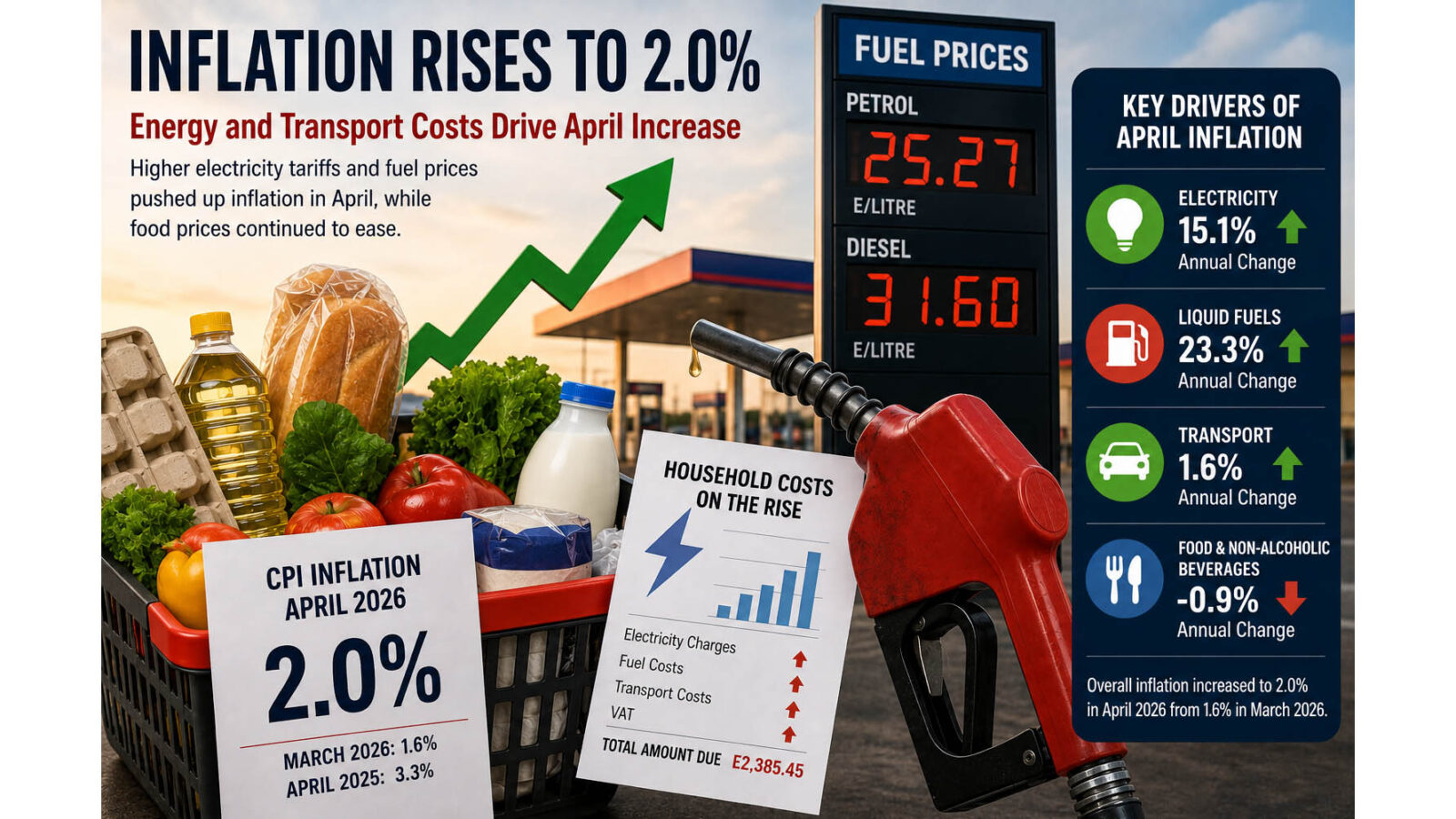
MBABANE – Eswatini’s inflation rate edged higher to 2.0 per cent in April 2026 from 1.6 per cent in March, signalling renewed price pressures in key sectors of the economy despite continued easing in food prices.
The latest Consumer Price Index (CPI) report released by the Central Statistical Office (CSO) shows that the increase was largely driven by sharp rises in electricity tariffs, liquid fuels and transport-related costs.
The April inflation figure marked the first notable upward movement in months, with month-on-month inflation surging to 1.2 per cent from negative 0.1 per cent in March.
Economists are likely to closely monitor the latest developments as they could influence the Central Bank of Eswatini’s future monetary policy stance, particularly after the country enjoyed a prolonged period of moderating inflation.
A detailed analysis of CPI, annual and monthly changes for detailed groups in the report shows that the latest inflation increase was overwhelmingly energy-driven, with electricity, liquid fuels and transport costs exerting the strongest upward pressure on household expenses.
The housing, water, electricity, gas and other fuels category, which carries the heaviest weighting in the CPI basket at 27.69 per cent, recorded annual inflation of 4.6 per cent and a massive monthly increase of 3.9 per cent.
The category alone contributed 1.3 percentage points to the overall headline inflation rate, making it the single largest contributor.
Within this category, electricity prices jumped by 15.1 per cent year-on-year and by the same margin month-on-month.
This follows the implementation of higher electricity tariffs and rising energy costs across the Southern African region.
Even more dramatic was the rise in liquid fuels, which soared by 23.3 per cent annually and 30.6 per cent on a monthly basis.
This indicates that households faced significantly higher costs for paraffin and other household fuel products during April.
Water supply costs also increased by 4.0 per cent both annually and monthly.
Transport costs also emerged as a major inflationary pressure point. The transport category recorded annual inflation of 1.6 per cent and monthly inflation of 2.4 per cent. According to the report, the increase was mainly driven by rising fuel and lubricant prices.
A closer examination of the transport sub-categories shows that fuels and lubricants for personal transport equipment rose by 8.8 per cent year-on-year and by a steep 14.9 per cent month-on-month.
These increases reflect the impact of global oil price volatility and regional fuel price adjustments filtering into the domestic market.
The operation of personal transport equipment recorded annual inflation of 6.0 per cent and monthly inflation of 9.2 per cent.
Passenger air transport also registered notable inflation of 11.7 per cent annually.
Interestingly, while fuel and energy costs surged, food prices continued to soften significantly, helping contain the broader inflation increase.
Food and non-alcoholic beverages, which account for over 20 per cent of the CPI basket, recorded annual deflation of negative 0.9 per cent and monthly deflation of negative 0.8 per cent.
*Full article available on Pressreader*



















Leave a comment