MBABANE – Eswatini’s stock market demonstrated remarkable resilience during the second quarter of 2026, with the value of companies listed on the Eswatini Stock Exchange (ESE) surpassing the E7 billion mark.
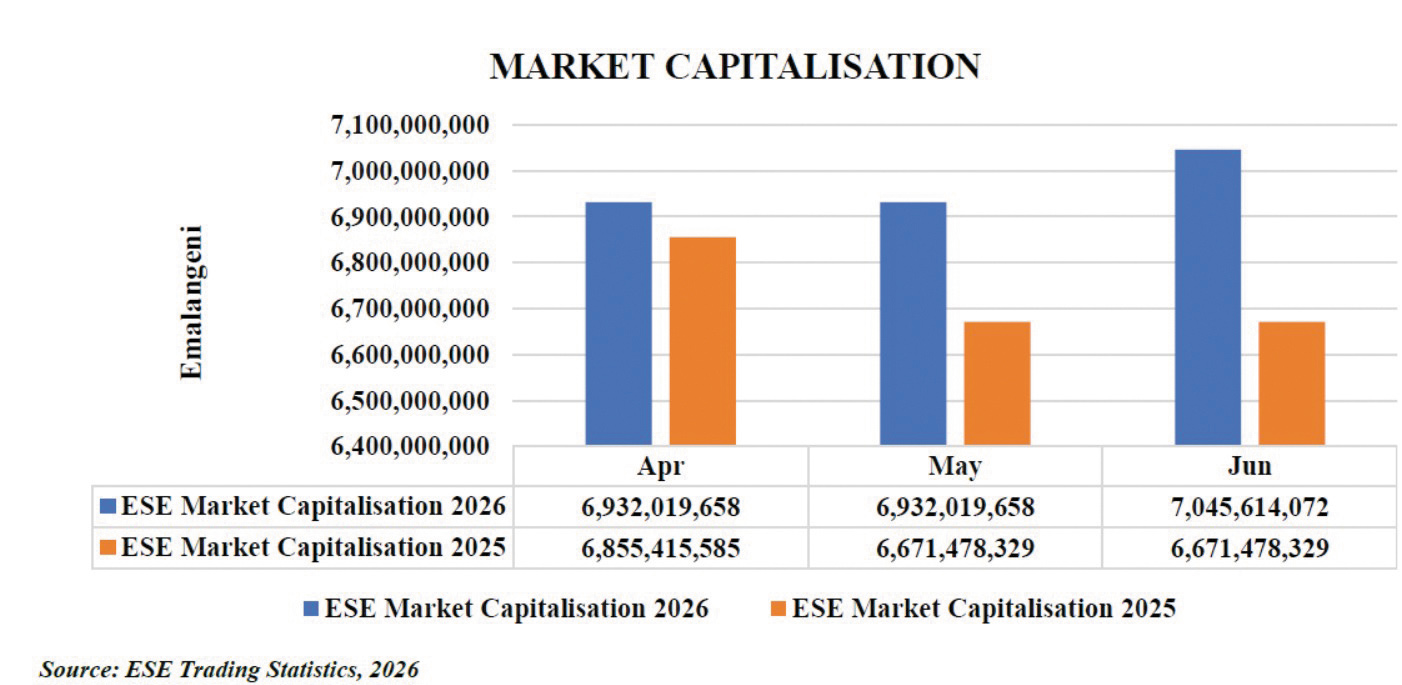
This was despite a dramatic slowdown in trading activity that underlined the persistent challenge of attracting active investors to the country’s capital market.The latest ESE Second Quarter Report shows that while investors who remained invested in listed companies continued to enjoy capital gains, actual buying and selling of shares declined sharply, creating an unusual paradox of a market becoming more valuable even as trading activity weakened considerably. Market capitalisation – the combined value of all companies listed on the exchange – increased by 1.64 per cent during the quarter to E7.05 billion from E6.93 billion recorded at the end of March. Compared to the same period last year, the market has grown by 5.61 per cent, adding more than E374 million in shareholder value over the 12-month period.
The milestone reinforces the growing importance of the local bourse as a platform for capital formation and wealth creation, even though the market remains relatively small by regional standards.
The growth was primarily driven by improving valuations of two heavyweight counters – Nedbank Eswatini and Royal Eswatini Sugar Corporation (RESCorp) – whose share price gains carried much of the market’s upward momentum. Nedbank’s share price rose from 1 650 cents to 1 720 cents during the quarter, while RESCorp climbed from 1 700 cents to 1 800 cents, collectively accounting for most of the increase in market capitalisation.
The improvement also lifted the ESE All Share Index from 493.16 points at the end of the first quarter to 501.25 points by the end of June, reflecting stronger overall performance among listed equities. On a year-on-year basis, the benchmark index rose by 5.44 per cent from 475.38 points, signalling continued appreciation in the value of local listed companies.
Crossing the E7 billion threshold represents more than just another statistical milestone. It demonstrates that listed companies continue to build shareholder wealth despite an operating environment characterised by subdued economic activity, cautious investors and relatively few new listings. For long-term investors, the figures suggest that patient investment in quality companies continues to generate returns, particularly in sectors such as banking and sugar, which remain the backbone of the local equity market.
Yet beneath the encouraging headline numbers lies a market battling one of its oldest challenges – liquidity.
While company valuations strengthened, trading activity deteriorated sharply. According to the report, only E271 086 worth of shares changed hands during the entire second quarter, with just 120 037 shares traded between April and June. This represented an 81.2 per cent decline from the E1.44 million traded during the first quarter of the year. In June last year, investors traded shares worth E16.56 million. This June, trading value stood at just E110 747, representing a decline of more than 99 per cent.
Such figures highlight the distinction between market value and market activity. A stock exchange may record increasing company valuations simply because share prices appreciate. However, if investors are reluctant to buy and sell shares, liquidity suffers.
Low liquidity has significant implications for the development of the capital market. Investors generally prefer markets where they can easily purchase or dispose of investments without substantially affecting prices. Thin trading makes it difficult to establish accurate market prices while discouraging both local and international investors from participating.
The ESE continues pursuing strategies aimed at broadening the market.
The exchange says it is actively engaging stakeholders to encourage more domestic and foreign companies to list while simultaneously introducing new investment products capable of attracting different categories of investors. Among the products being explored are real estate investment trusts (REITs), exchange traded funds (etfs) and green bonds.
Such instruments have become increasingly popular globally because they provide investors with diversified investment opportunities while helping deepen capital markets.
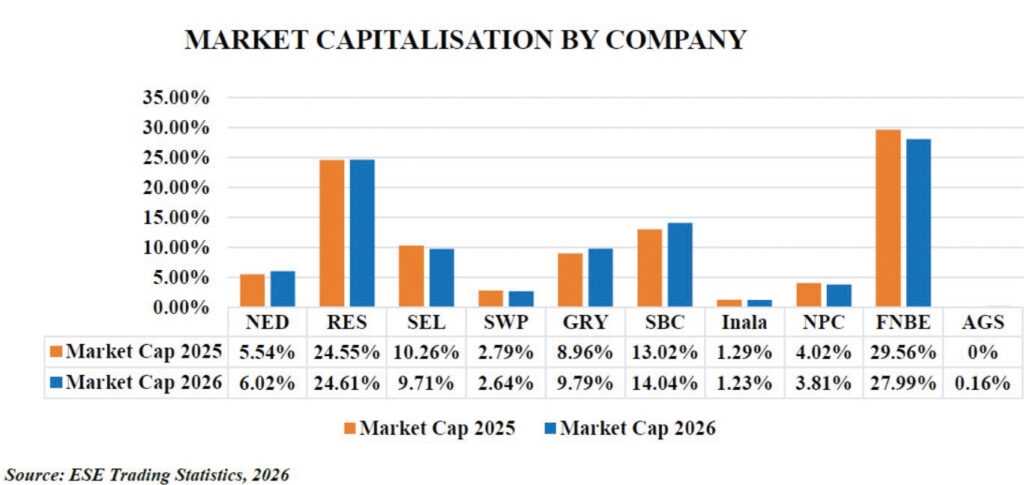
First National Bank Eswatini continues to dominate the exchange, accounting for nearly 28 per cent of total market capitalisation with a market value approaching E2 billion.
Royal Eswatini Sugar Corporation follows with approximately E1.73 billion, representing almost one-quarter of the market. Together, the two companies account for more than half of the exchange’s total value.
SBC Limited contributes just over 14 per cent of total market capitalisation, while Greystone Partners and Swazi Empowerment each account for close to 10 per cent. Nedbank Eswatini represents just over six per cent of the market, with the remaining companies—including Swaziland Property Investments (SWAPROP), Nkonyeni Pre-Cast, Inala Capital and AGSPAC—making up the balance.
This concentration means movements in only a handful of counters can significantly influence the overall performance of the exchange.
Indeed, that is exactly what occurred during the second quarter.
The appreciation recorded by Nedbank and RESCorp was sufficient to lift the broader market despite relatively limited movement in most other counters. Looking beyond quarterly performance, several companies delivered notable gains for long-term shareholders over the past year. Greystone Partners emerged as the strongest performer after its share price increased by 15.38 per cent, rising from 260 cents to 300 cents. Nedbank Eswatini followed closely with annual gains of 14.67 per cent, while SBC Limited appreciated by 13.89 per cent.
Royal Eswatini Sugar Corporation delivered a respectable 5.88 per cent increase. Meanwhile, the share prices of Swazi Empowerment, SWAPROP, Inala Capital, Nkonyeni Pre-Cast and First National Bank Eswatini remained unchanged during the year.
The performance of banking stocks reflects continued investor confidence in financial institutions, many of which have recently reported healthy earnings growth, resilient balance sheets and sustained dividend payments despite broader economic headwinds.
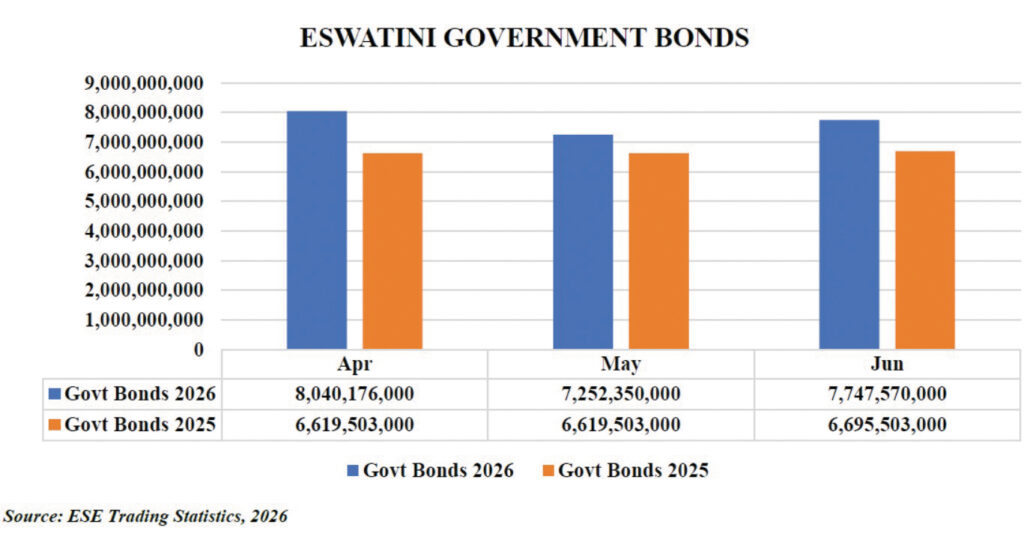
The sugar sector’s contribution equally reflects confidence in one of Eswatini’s most important export industries. While equities experienced weak trading volumes, the exchange’s debt market painted a different picture.