
MBABANE – The investment arm of the Public Service Pensions Fund (PSPF) delivered a strong financial performance during the fourth quarter of the 2025/26 financial year.
The fund’s investment income surpassed expectations, strengthening the fund’s overall financial position.
According to the Ministry of Public Service First Quarter Report for the 2026/27 financial year, which reviews the fund’s performance for the final quarter ended March 31, 2026, investment income reached E950 million during the quarter.
This represented an 18 per cent increase compared to the E803 million recorded during the previous quarter, reflecting improved returns from both domestic and South African investment portfolios.
The strong quarterly performance lifted PSPF’s total investment income for the year to E3.4 billion, significantly exceeding the budgeted target of E2.1 billion.
This resulted in a favourable variance of 62 per cent against the annual budget.
The fund attributed the improved performance mainly to higher realised gains from South African and domestic portfolios, supported by favourable market conditions and improved asset returns.
The financial year of the fund runs for a 12-month period from April 1 to March 31, with the report focusing on activities and performance for the fourth quarter covering January 1 to March 31, 2026.
Despite challenges experienced during the quarter, PSPF maintained a strong overall financial position, generating a cumulative surplus of E5.412 billion for the financial year.
This exceeded the full-year budgeted surplus of E1.571 billion by a significant margin, placing the fund well ahead of its financial targets.
However, the fund recorded a net surplus of only E4.8 million for the quarter ended March 31, 2026.
The quarterly surplus was E126.1 million below the budgeted surplus of E130.9 million.
PSPF stated that the strong annual performance was driven by effective investment strategies, prudent cost management and favourable market conditions.
“The fund continues to demonstrate resilience through disciplined investment management and effective control of operational costs,” the report noted.
The strong investment performance also resulted in an increase in investment-related costs.
Investment fees amounted to E45 million during the fourth quarter, rising from E43 million recorded in the previous quarter.
For the full financial year, total investment fees reached E168 million, slightly exceeding the budgeted E162 million.
PSPF explained that the increase was mainly linked to higher-than-budgeted investment income achieved during the year.
This was because investment fees are largely performance-based and linked to the value of assets under management.
Despite the increase, the fund maintained that the additional costs were associated with stronger investment returns.
Domestic exposure rises above regulatory requirement
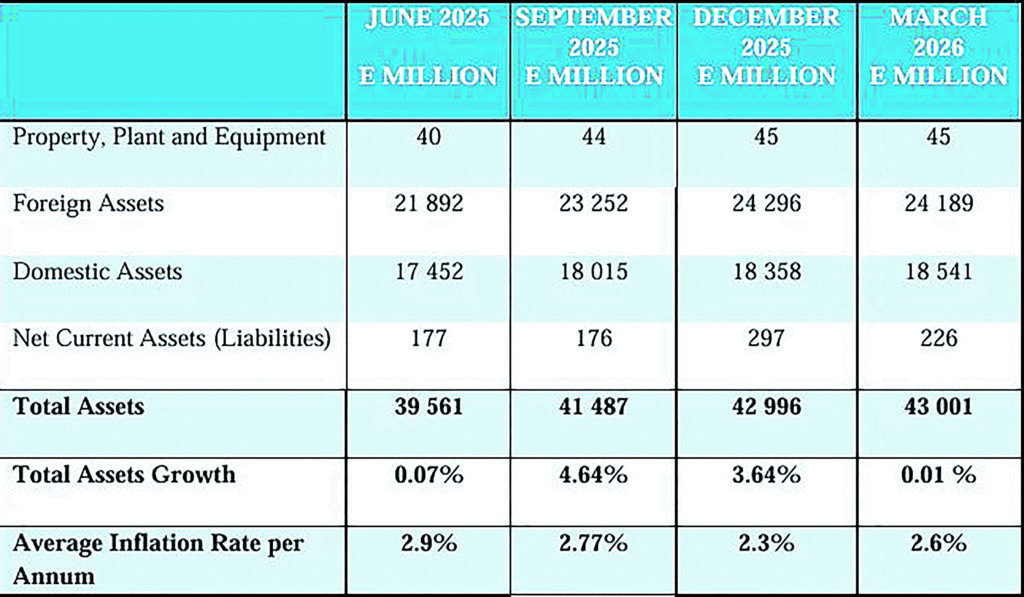
MBABANE – PSPF continued to increase its exposure to domestic investments, with 43 per cent of its total assets invested within Eswatini as at March 31, 2026.
This exceeded the Financial Services Regulatory Authority (FSRA) statutory minimum requirement of 30 per cent.
The fund said the allocation was aligned with its strategic objective of increasing domestic exposure to 50 per cent.
The strategy is aimed at supporting economic growth, job creation, local development, risk diversification and enhancing portfolio returns.
“The fund remains committed to balancing its fiduciary responsibility to members with its role in supporting national economic development,” the report stated.
The increased domestic allocation positions PSPF as a key institutional investor in Eswatini’s economy.
On the operational side, PSPF recorded savings through effective cost management.
Administration expenses amounted to E66 million during the fourth quarter, slightly above the budgeted E56 million.
However, on an annual basis, administration expenditure totalled E208 million against a budget of E225 million.
This represented a cost saving of approximately 7 per cent.
The favourable variance was attributed to deferred operational expenditure and under-utilisation of consultancy services.
The fund said this reflected prudent expenditure management and continued efforts to improve operational efficiency.