

MBABANE – Government is creating jobs, yet businesses are cutting them, with official reports recording 2 248 employment opportunities against 6 165 workers retrenched or laid off.
Three ministries’ first quarter reports of the 2026/27 financial year state that government authorised recruitment into 1 692 public service positions and supported the creation and sustenance of another 556 private-sector jobs during the past three months.
Over the same period, 599 workers were retrenched and 5 566 employees were laid off.
These statistics are according to the latest reports from the ministries of Public Service, Commerce and Labour.
Taken together, the reports show government expanding recruitment and promoting investment, while the Ministry of Labour recorded an increase in retrenchments and lay-offs in the private sector.
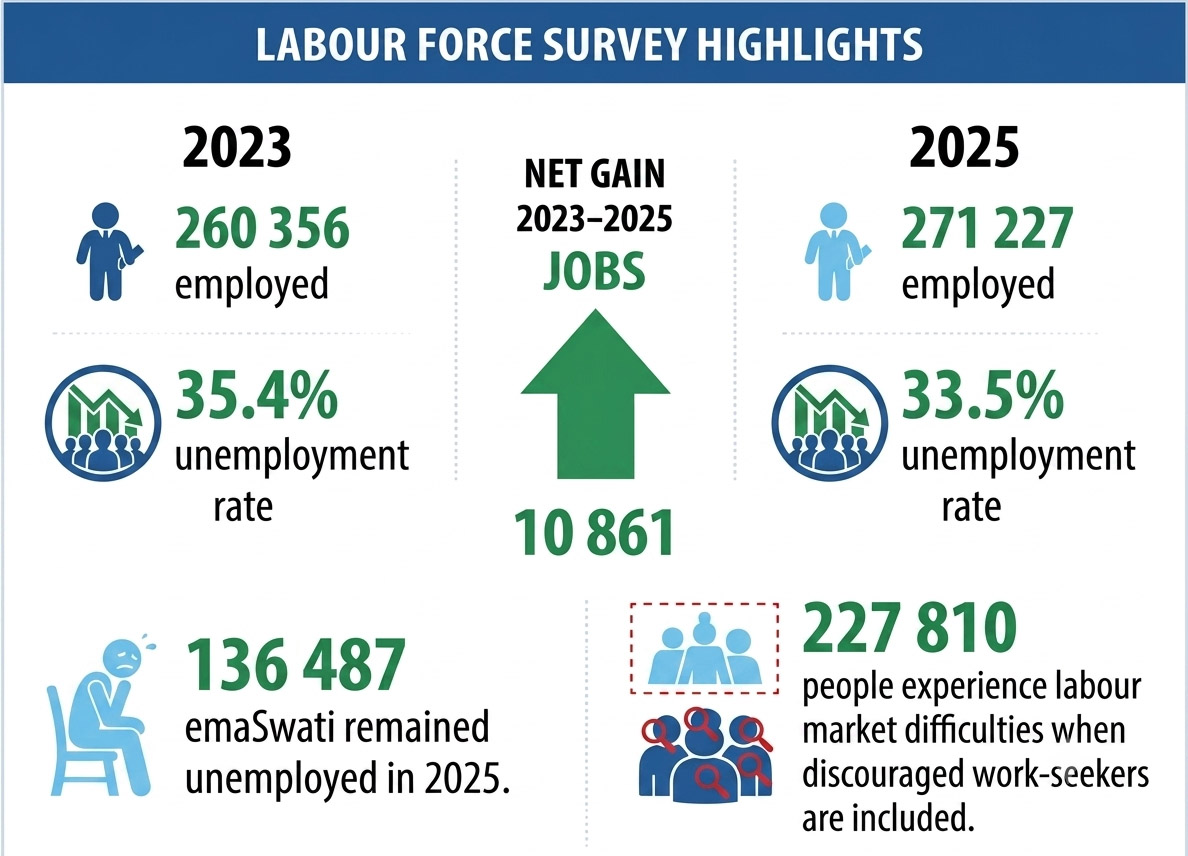
The developments come only weeks after the release of the 2025 Integrated Labour Force Survey, which recorded a net increase of 10 861 jobs between 2023 and 2025.
Employment rose from 260 356 people in 2023 to 271 227 in 2025, while the unemployment rate declined from 35.4 per cent to 33.5 per cent.
Despite that improvement, the survey also found that 136 487 emaSwati remained unemployed in 2025. When discouraged work-seekers were included, the number of people experiencing labour market difficulties increased to 227 810.
The Ministry of Public Service reported issuing recruitment authorities for 1 692 positions across government ministries and departments. The approvals include vacancies in education, health, agriculture, justice and other essential public services.
A review of the report shows that the recruitment authorities comprise both permanent and temporary appointments.
At least 460 positions, representing about 27 per cent of the approved recruitment, are temporary, seasonal or fixed-term engagements.
These include 200 temporary officers for the National Business Inspection Exercise, 72 seasonal malaria spray operators, 52 data collectors and supervisors, 32 enumerators, 27 clerical officers for the Judiciary, 26 external moderators, 24 examination invigilators, 16 pupil crown counsels, 10 temporary health employees and one extra clerical officer for the Government Press Office.
The remaining approvals relate largely to filling permanent vacancies and critical posts within government.
The Ministry of Commerce, Industry and Trade, on the other hand, reported that enterprise development programmes created and sustained more than 69 jobs, while businesses supported through the Small Enterprises Development Company (SEDCO) incubation programme created 507 jobs, bringing the total number of immediate jobs reported through the ministry’s programmes to 576.
From the 507, it was reported that within the incubation programme, four businesses vacated due to financial constraints and business failure, resulting in the loss of approximately 20 jobs. This means that the ministry created 556 jobs.
The report also distinguishes between employment already created and jobs expected to arise from future investment projects.
According to the ministry, five investment projects valued at E7.4 billion have progressed from planning to implementation and are projected to create about 4 850 jobs once operational.
In addition, the ministry reported an industrial investment pipeline valued at approximately E39 billion, with the potential to generate more than 2 000 jobs.
The Ministry of Labour reported a different trend within the private sector.
During the quarter, 16 redundancy notifications affecting 599 employees were submitted to the ministry. During the corresponding quarter in 2025, 12 redundancy notifications affecting 321 employees were recorded.
The ministry said the number of employees affected by retrenchments increased by 86.6 per cent compared with the same period last year. The report also recorded a sharp increase in layoffs.
According to the ministry, 5 566 employees from seven companies were laid off during the quarter, compared with 970 employees from four companies during the corresponding period in 2025.
In addition, the ministry approved two short-time working arrangements affecting 588 employees, compared with one arrangement affecting 63 employees during the same period last year.
The reports, therefore, record 2 248 immediate employment opportunities through public service recruitment authorities and enterprise development programmes during the quarter, compared with 6 165 workers affected by retrenchments and lay-offs over the same period.
The Ministry of Public Service figures represent recruitment authorities rather than completed appointments, while the Ministry of Commerce, Industry and Trade report includes jobs already created and sustained through enterprise support programmes.
The Ministry of Labour report distinguishes between retrenchments, where employment is terminated and lay-offs, where employees may return to work when business conditions improve.
The reports also illustrate the different roles played by the public and private sectors in employment creation.
Government recruitment is concentrated in the delivery of public services, while the Commerce Ministry’s strategy focuses on enterprise development and attracting private investment expected to generate employment over time.
The Labour Ministry’s report indicates that job losses were concentrated in three sectors. The hospitality industry accounted for 35.39 per cent of all retrenchments reported during the quarter.
The building and construction sector accounted for 19.53 per cent, with the ministry attributing many of the job losses to the completion of construction projects.
The security sector represented 17.2 per cent of retrenchments, mainly because fixed-term contracts and service agreements had expired.


















Leave a comment