

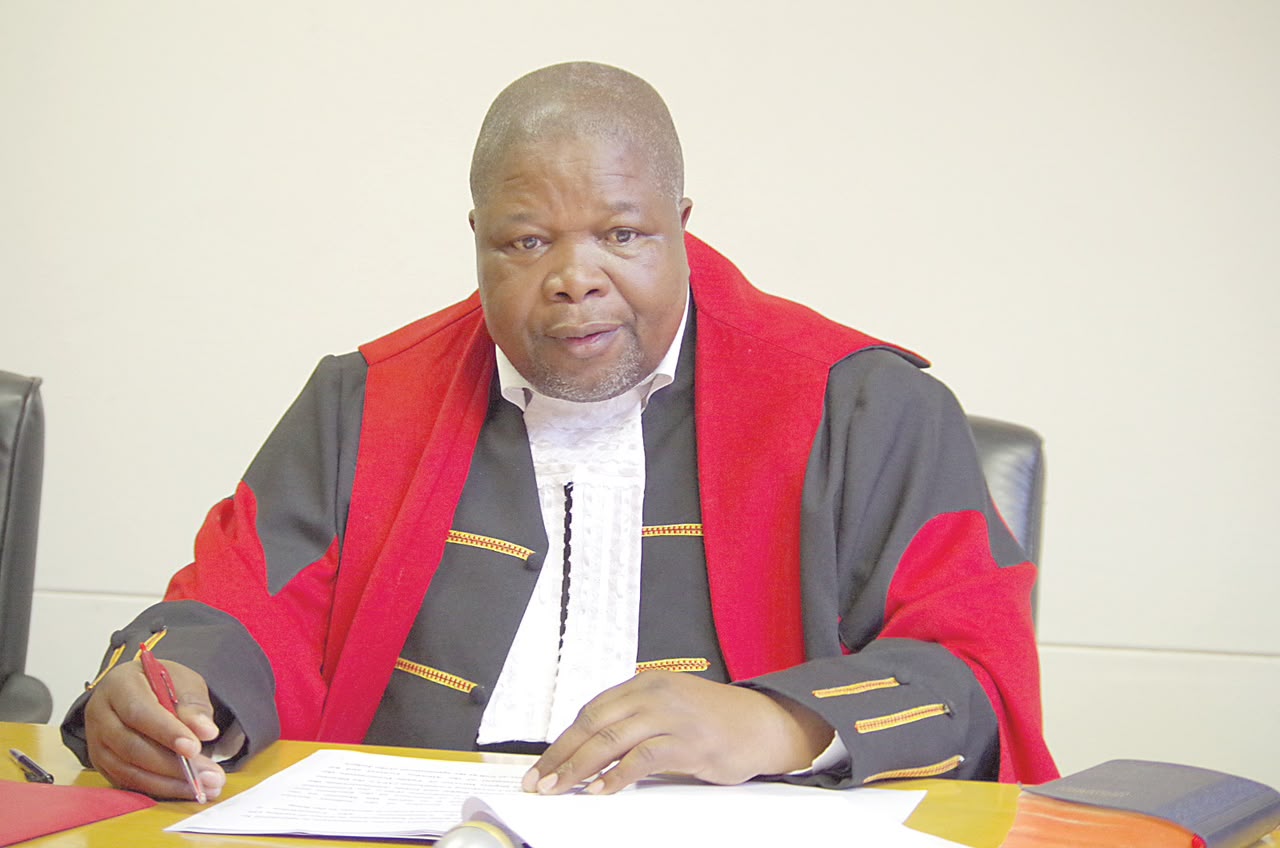
MBABANE – The late Chief Justice Bheki Maphalala has been remembered for a judgment that affirmed police officers’ constitutional rights.
The Royal Eswatini Police Staff Association (REPOSA) said Maphalala’s contribution to its landmark case against the National Commissioner of Police would remain one of the important parts of his legacy.
Maphalala died while receiving treatment at a hospital in South Africa following an illness. He was the first liSwati to serve as Chief Justice of Eswatini.
In its tribute to the late Chief Justice, REPOSA said his judgment in its case had changed the position of police officers who were seeking the implementation of Phase II of Circular No. 2 of 2014.
The association said the judgment did more than resolve a dispute over salaries and conditions of service.
REPOSA affirmed that police officers, despite being members of a disciplined service, remained citizens who were entitled to constitutional rights.
The dispute over Phase II eventually reached the Supreme Court after REPOSA challenged the position taken by the National Commissioner of Police and other authorities.
Maphalala presided over the matter together with Justices Phesheya Dlamini, Stanley Matsebula, Mbutfo Mamba and J.M. Van Der Walt.
The Full Bench delivered its judgment on November 29, 2024.
The court allowed REPOSA’s appeal and ordered that the intended disciplinary proceedings arising from the delivery of the petition concerning the officers’ terms of service were unlawful and should not proceed.
It further declared Circular No. 2 of 2014 binding and directed government to comply with and honour its commitment and undertaking contained in the circular within a reasonable time.
The circular had provided for the restructuring of the Royal Eswatini Police Service and His Majesty’s Correctional Services.
According to reports on the judgment at the time, Phase I of the restructuring had been implemented, while Phase II, which was expected to benefit junior officers, had not been implemented.
The dispute therefore centred on the failure to implement the second phase and the subsequent attempts by police officers to raise the matter through their staff association.
The Supreme Court’s decision went beyond the question of the implementation of the circular.
It examined the constitutional rights of the police officers and whether disciplinary provisions could be used to restrict those rights.
In its judgment, the court held that the march by police officers to deliver their petition was peaceful and did not amount to a prohibited demonstration under the Police Service Act.
The court also considered the officers’ rights to freedom of expression, peaceful assembly and association, as well as workers’ rights.
It rejected the argument that disciplinary provisions could automatically override constitutional rights.
The judgment stated that limitations on constitutional rights had to be reasonable and justifiable in a democratic society. ([Jibu Docs][3])
The court further found that the National Commissioner of Police had acted beyond his powers in interfering, or purporting to interfere, in the affairs of the Police Service Staff Association.
That finding was significant for REPOSA because the dispute was not only about the implementation of a salary-related circular, but also about whether police officers could collectively raise concerns about their conditions of service without facing disciplinary consequences.
The judgment also dealt with the principle that legislation should not be interpreted as interfering with fundamental rights unless Parliament had made that intention clear.
The court applied this principle when considering the relationship between the Police Service Act and the constitutional rights relied upon by the officers.
The Supreme Court found that the High Court had misdirected itself by treating Section 39(3) of the Constitution as automatically overriding the rights to freedom of expression, peaceful assembly and workers’ rights.
In a statement, the association said Maphalala and the other members of the Full Bench had recognised police officers as citizens first, rather than viewing them only through the lens of their membership of a disciplined service.
REPOSA said the judgment affirmed the officers’ freedom of association, freedom of expression and right to participate in collective bargaining.
The association particularly highlighted the finding that these rights could not simply be interfered with by the National Commissioner of Police under the guise of providing what it described as ‘assistance’.
According to REPOSA, this was important because staff associations depend on their members being able to organise and raise issues affecting their welfare.
The association said Maphalala’s judgment therefore provided a legal basis for police officers to exercise their rights while remaining committed to their responsibilities as members of the police service.
Maphalala was appointed to the Supreme Court in 2011 before becoming Chief Justice in November 2015. He succeeded Michael Ramodibedi after serving as Acting Chief Justice.
During his tenure, he headed the Judiciary, served as president of the Supreme Court and chaired the Judicial Service Commission.
Recent Times reports have also highlighted the reaction to his death from his family and the legal fraternity.
A report from Lawuba described the shock among residents and family members following the death of the country’s first liSwati Chief Justice.
The death has also attracted regional judicial tributes, with the Judiciary of Namibia mourning the passing of Eswatini’s Chief Justice.
The Prime Minister, Russell Dlamini, has also appealed to members of the public not to politicise the Chief Justice’s death and urged respect for the bereaved family.
For REPOSA, however, Maphalala’s legacy is particularly linked to what it regards as a demonstration of the Judiciary’s role in protecting constitutional rights.
The association said the late Chief Justice did not simply hand it a legal victory.
According to REPOSA, the CJ helped establish that police officers could seek to have their labour and constitutional rights recognised without those rights being treated as incompatible with the disciplined nature of the police service.
The association said Maphalala looked at police officers who were pursuing their rights and recognised them as citizens entitled to dignity and constitutional protection.
It further said he demonstrated that the law could serve as a shield for people exercising their rights rather than being used against them.
The judgment itself, however, was delivered by a five-member Full Bench, meaning the decision was not that of Maphalala alone.
REPOSA acknowledged the contribution of the other members of the Bench, while specifically remembering Maphalala because he presided over the matter and was the country’s Chief Justice at the time.
The Supreme Court’s order remains particularly significant because it dealt with both aspects of the dispute – the disciplinary proceedings against officers and the Government’s obligation concerning Circular No. 2 of 2014.
The court ordered that the disciplinary proceedings should not proceed and that the Government should comply with the circular within a reasonable time.
REPOSA said it would honour Maphalala’s memory by exercising the rights affirmed by the judgment responsibly.
The association said it would continue to promote professionalism and dedication to public service while exercising its rights as a staff association.


















Leave a comment