

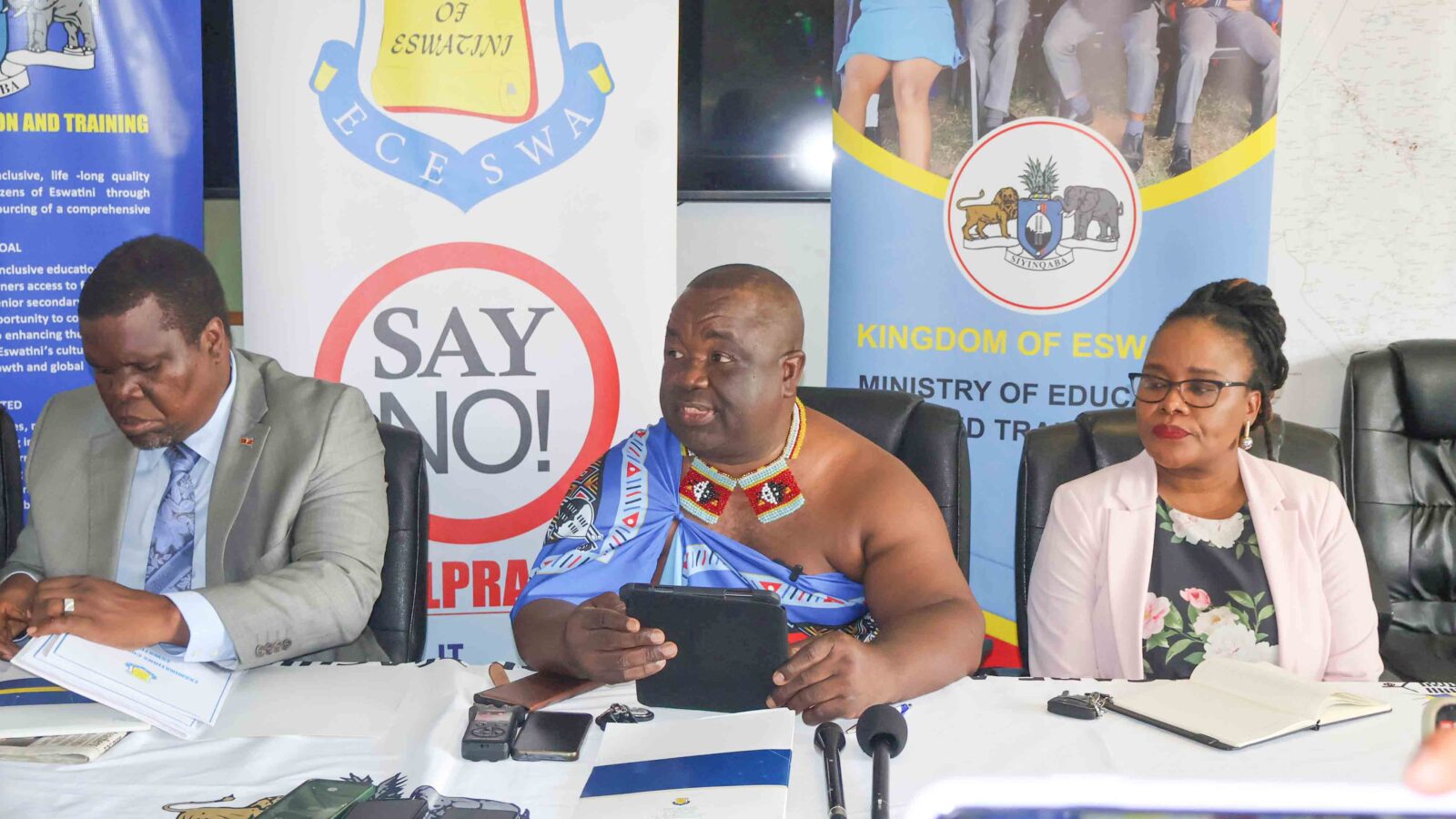
MBABANE – Grade VII examination results have recorded an upturn, with a national pass rate of 87.30 per cent; however, 4 100 pupils will be repeating the grade next year.
The increase in the pass rate follows the release of the country’s first-ever Competency-Based Education (CBE) syllabus examination results.
Candidates who achieved Sufficient and above in 2025 stood at 87.30 per cent, compared to the national pass rate of 83.15 per cent recorded in 2024.
Minister for Education and Training Owen Nxumalo said the increase in the number of registered candidates for the Eswatini Primary School Assessment (EPSA) also contributed to the improved pass rate. A total of 32 452 candidates registered for the assessment in 2025, compared to 29 635 entries in 2024.
The 2025 candidature increased by 9.51 per cent when compared with 2024.
The minister further stated that of the 32 452 candidates registered in 2025, 32 300 were assessed. In 2024, 29 478 candidates sat for the assessment, with 157 absentees recorded. In 2025, 152 candidates were absent.
The high pass rate comes against the backdrop of an announcement that 4 100 pupils were graded Insufficient under the 2025 CBE examination.
This means all affected learners are eligible to repeat Grade VII next year, in line with Circular No.3 of 2025. The circular directs schools to retain learners graded Insufficient in their final Grade VII examination results, using a four-pronged intervention approach.
Worth noting is that in 2024, Grade VII failures stood at 2 716, compared to 2 295 in 2023.
Meanwhile, of the 32 452 candidates registered in 2025, 32 300 were assessed. In 2024, 29 478 candidates sat for the assessment while 157 candidates were absent. In 2025, 152 absentees were recorded.
The Shiselweni Region emerged as the top performer, attaining 91 per cent Sufficient and above, followed by the Manzini Region at 90 per cent. Hhohho Region achieved 85 per cent, while Lubombo Region recorded 83 per cent Sufficient and above.
Nxumalo further revealed that candidates who achieved Excellent grading in the EPSA this year totalled 1 181, comprising 413 males and 768 females.
*…
Grade VII exams renamed EPSA from EPC
MBABANE – The Minister for Education and Training, Owen Nxumalo, has announced that Grade VII examinations will no longer be referred to as the Eswatini Primary Certificate (EPC), but as the Eswatini Primary School Assessment (EPSA).
The minister made the announcement yesterday when delivering the 2025 Grade VII examination results.
According to Nxumalo, the change aligns with the principles of the Competency-Based Education (CBE) curriculum, which positions the Grade VII assessment as a diagnostic tool rather than a pass-or-fail examination.
In a press statement issued after the results briefing, the Examination Council of Eswatini (ECESWA) said the main purpose of diagnostic assessment is to identify learners’ strengths, weaknesses, prior knowledge and misconceptions, enabling teachers to develop tailored learning plans and targeted interventions.
Nxumalo further stated that stakeholders are advised that EPSA results will now be presented using a revised five-point performance descriptor system, replacing the previously communicated six-point indicator framework.
*…
E50 000 fine for malpractice, 18 cases concluded
MBABANE – The Ministry of Education and Training has confirmed that investigations into all 18 cases of examination malpractice recorded this year have been concluded.
Minister for Education and Training Owen Nxumalo said all schools will receive EPSA results, as there are no outstanding investigations.
He reminded offenders that the ECESWA Act provides for penalties of up to E50 000 or imprisonment for up to five years for those found guilty of malpractice. “It is disheartening that in some centres, teachers and invigilators continue to be involved in malpractice. The sad reality is that even when malpractice is orchestrated by adults, it is learners who suffer the harshest consequences,” said Nxumalo.
The ECESWA Act of 2023 criminalises malpractice, requiring ECESWA to report implicated adults to the police. “At this moment, allow me to congratulate candidates for working hard in preparation for the assessments. To those who did not make it, please do not lose hope, but continue working hard,” he added.
*…
We are not surprised by results – SNAT
MBABANE – The Swaziland National Association of Teachers (SNAT) Secretary General, Lot Vilakati, says they are not surprised by the high number of learners who were graded Insufficient.
According to the Eswatini Primary School Assessment (EPSA) results, 4 100 pupils obtained the Insufficient grade and are set to repeat.
Vilakati stated that when the Competency-Based Education (CBE) was rolled out in 2019, they warned government that it should ensure that all resources were availed, including an adequate number of teachers.
Vilakati said these are pupils who had failed Grade I but were not made to repeat the class to master the concept of earning, but instead, they were pushed to the next class.
He said a majority of the pupils did not know the basics, including reading and writing, hence it came as no surprise to them that they were graded Insufficient.
“It is going to be detrimental for their future if they are going to be pushed to the next class because they have not mastered the concept of learning. The sad part is that we can’t track back to establish which class the child was left behind,” he said.
Vilakati highlighted that government issued a circular of normal progression for pupils under the programme, but it was now surprising that the pupils would be repeating.
“We did say that the pupils who have not done well should repeat, but government was adamant that they should progress to the next class, and the results are now showing,” he said.
Sitsatsaweni, Tholulwazi bottom again
MBABANE – Sitsatsaweni Primary School has once again recorded a high number of learners graded Insufficient.
The school recorded 57 Insufficient grades, while Tholulwazi Primary School recorded 65 Insufficient grades.
Other low-performing schools included Gijimani Primary School, Princess Monile Primary School, Good Shepherd Catholic Primary School, St Paul’s Catholic Primary School and Bekezela Primary School, all recording insufficiency rates above 50 per cent.
In 2024, Sitsatsaweni Primary School in the Lubombo Region recorded the highest number of failures, with only 55 of 164 candidates passing, resulting in a pass rate of 33.54 per cent.
Other schools with high failure numbers in 2024 included Engeveni, Tholulwazi, Shewula, Enkamanzi, Mahlabatsini, Maloma, Jerusalem, Malibeni and Zandondo primary schools.
*Full article available in our publication












Leave a comment