

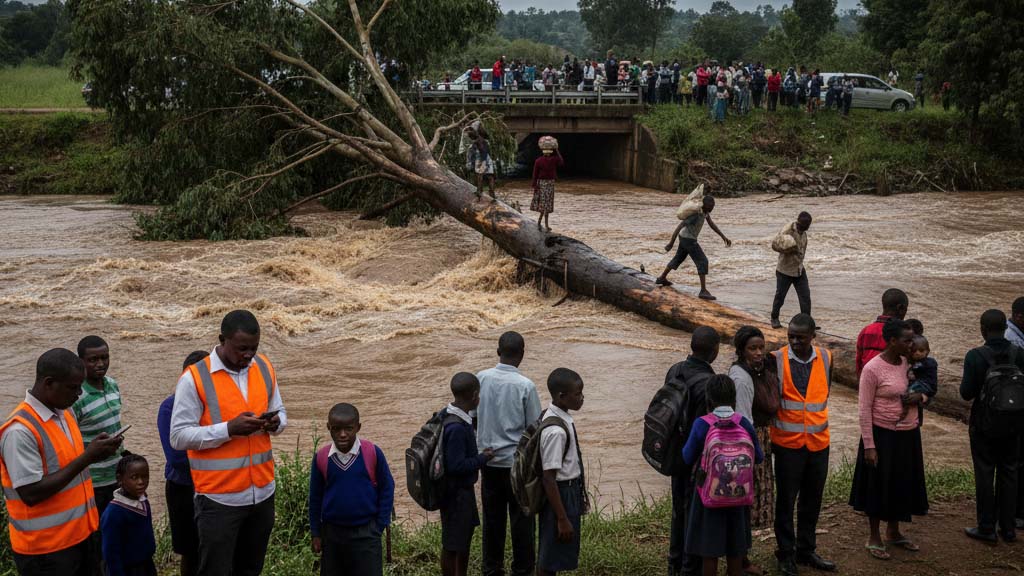
For most of the year, the river that runs through Pine Valley is an unremarkable presence. It flows gently, winding quietly shaping the landscape and the routines of those who live alongside it. Children cross the bridge on their way to school and workers use it to reach town.
The recent rains, however, have left the community stranded on either side of the river. As a new resident you can only imagine my shock waking up to an uncrossable flooded river that not only runs up to a metre above the bridge level, but also slowly creeps up the road as well.
The crossing became uncrossable. On either side of the river, people gathered some hoping the water would subside, others realising that for the day and possibly longer, movement had come to a standstill.
For Pine Valley residents, the bridge is more than infrastructure. It is a lifeline, even in its current dilapidated and quite frankly dangerous state. When it disappears beneath muddy, fast-moving water, Pine Valley is effectively cut in two.
Now, I have been slowly learning about the political and financial constraints that are keeping the much-needed bridge renovation at a standstill, but I will not go into that today.
In this economy and tenuous work environment, emaSwati simply cannot afford to miss even a single day of work. Standing on the wrong side of the riverbank, it is quite common to see workers checking their phones anxiously, calculating how absence might affect their already fragile employment. Parents worry about children stranded away from home, while the elderly and sick face the frightening reality of being cut off from clinics and pharmacies.
What makes the situation particularly painful is how familiar it feels. Flooding at Pine Valley is not new. Residents speak openly about how the bridge becomes dangerous during periods of heavy rain, a problem they say has been raised repeatedly over the years. Yet, the structure remains largely unchanged, vulnerable to the same seasonal patterns that are becoming more intense with time.
This incident is not simply about bad weather. It is about infrastructure that has failed to keep pace with the environmental reality. Climate change has altered rainfall patterns across Eswatini, bringing heavier downpours over shorter periods.
The social cost of this failure is immense. When access is cut, the poorest are hit the hardest. Missing a day of work can mean losing income that was already stretched thin. Informal traders cannot move goods and casual labourers risk being replaced.
Learners lose valuable teaching time, widening educational gaps that already disadvantage rural communities. For households dependent on daily movement to survive, isolation becomes yet another layer of inequality.
There is also an emotional toll. Being stranded and watching loved ones cross the flooded river out of sheer necessity, risking life and limb in the process is quite a harrowing experience to say the least.
Recently, crafty community members felled a large eucalyptus tree and created a makeshift bridge. Seeing desperate breadwinners stumble across this dangerous narrow ‘bridge’, to bring food and supplies to their families, is heart wrenching.
Parents worry about children, caregivers worry about patients and families worry about emergencies that may arise while help is unreachable. In moments like these, the fragility of daily life becomes impossible to ignore.
Environmental experts have long warned that infrastructure planning must take climate realities into account.
Building bridges that cannot withstand predictable flooding is no longer sustainable. Each time water washes over the Pine Valley bridge, it signals not only environmental stress but planning gaps.
Short-term fixes and temporary repairs may restore access for a while, but they do not address the underlying vulnerability.
Communities like Pine Valley are often expected to adapt quietly. People learn to wait, to plan around floods and to accept disruption as normal. However, resilience should not mean enduring preventable hardship. It should mean systems designed to protect people, especially as environmental risks grow.
The flooding also raises questions about disaster preparedness and response. When communities are cut off, who coordinates assistance? How quickly are risks assessed, and how are vulnerable residents supported? These are not abstract policy concerns; they are questions that matter most when water rises and time becomes critical.
As the rains subside and the river eventually recedes, the bridge slowly re-emerges. Movement resumes and learners can return to school, workers to their jobs and life continues as though nothing has happened. But the memory remains. So does the certainty that it will happen again.
Certainly, with the weather warnings circulating across the different media platforms, we need to brace ourselves for the inevitable lockdown that will ensue.
No one can say how long the water will take to recede and some residents attempt to find alternative routes, only to discover that detours are long, costly or equally unsafe. Crossing the flooded bridge is often simply not an option; the current is strong enough to sweep away vehicles and pedestrians alike.
Each year, lives are lost in similar situations across the country, making the decision to wait a matter of survival rather than inconvenience.
Pine Valley’s flooded river may be a local story, but it reflects a national challenge. Across Eswatini, communities are grappling with the effects of climate change on infrastructure that was never designed for today’s extremes. Each flooded bridge is a warning that adaptation is no longer optional.
Development cannot be measured only by what is built, but by whether it endures. A bridge that disappears every rainy season fails the very people it is meant to serve.
Until climate-resilient infrastructure becomes a priority rather than an afterthought, communities like Pine Valley will continue to live with uncertainty -waiting on riverbanks, hoping the water goes down before the cost becomes too high.

















Leave a comment