

In the Ministry of Public Works and Transport, the only thing that works is the air conditioning in the minister’s office.
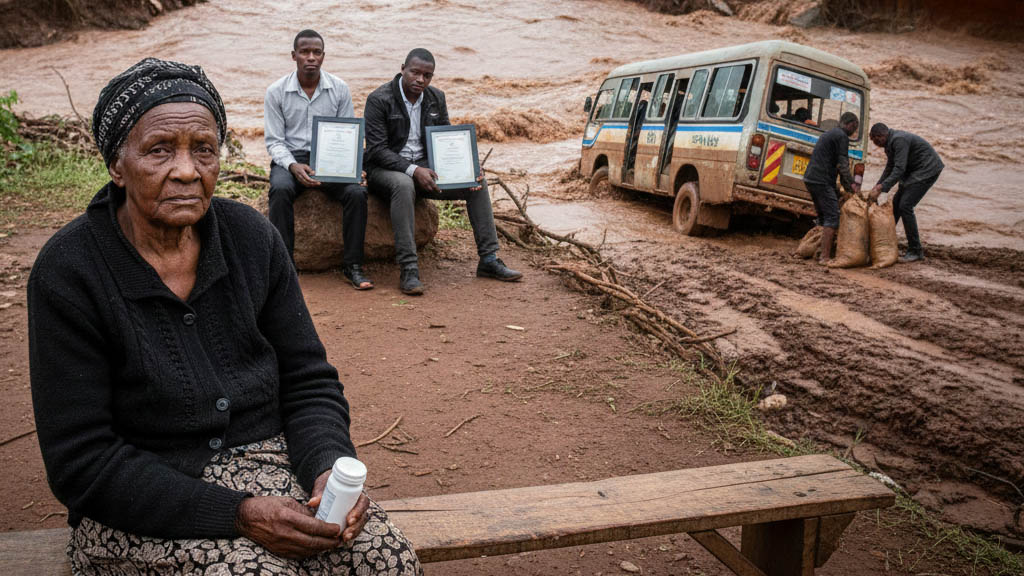
Imagine, for a moment, the quiet desperation of Gogo Simelane. She is 74 years old, a matriarch who has given her life to this soil, yet her body is now a battlefield of diabetes and hypertension.
She sits on a wooden bench in the humid air of northern Hhohho, clutching an empty plastic pill bottle as if it were a rosary. The Mzimnene River is swollen and angry, having long since swallowed the bridge and the road to Pigg’s Peak Government Hospital has dissolved into a chocolate-coloured slurry that even a mountain goat would think twice about navigating.
For this granny and hundreds of families like hers at Ludlawini and Machobeni, the national road network is no longer a path to progress; it is the wall of a prison. These communities have been effectively severed from the rest of the country, turned into involuntary islands by a ministry that seems to believe infrastructure is an optional luxury. Civilisation – clinics, shops and safety – lies just a few kilometres away, yet it might as well be on the moon.
In this watery isolation, the economic cruelty of our times hits hardest. Gogo Simelane has two children at home, both university graduates with degrees that promised a better life.
In any functioning economy, they would be the ones paying for a private 4×4 to get their mother to a doctor. Instead, they sit in the shadows of a 35.7 per cent national unemployment rate, their education a hollow mockery of their current reality.
Minister for Public Works and Transport Chief Ndlaluhlaza Ndwandwe, sir, this muddy mess is the face of your ministry’s inaction. It is not just about asphalt and gravel; it is about the fact that gogo Simelane might die due to failure to access an E80 bottle of Metformin because your ministry cannot build a bridge.
The catastrophe is not waiting to happen, honourable minister; it is here, it is muddy and it is charging us E70, a trip that should cost E15. While the ministry is busy assessing damage – a process that seems to take longer than the actual construction of the Great Wall of China – the people of Ludlawini are living in a state of total partition.
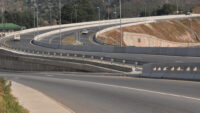
Let us move from the rural mud to the supposed jewel in our crown: The Mbabane-Manzini freeway. If you drive this stretch during a downpour, you aren’t driving a car; you are captaining a vessel. The drainage systems are so archaic and blocked that the freeway transforms into a series of mini lakes.
The highway is now a collection of puddles and craters. One moment you are cruising at 120km/h and the next, you are aquaplaning into the next life because the water has nowhere to go. It is a miracle we haven’t seen a multi-car pile-up of biblical proportions. The capital city’s main artery is decorated with potholes here and there, which just only tap into your wallet through the need to replace the suspension of your automobile.
Not long from now, public transport owners will want to be cushioned from this expenditure through a hike in fares. Guess who will feel the pinch?
When did highway maintenance become’s wait for a disaster and then put out a press release?
Our highways have better water features than the infrastructure set up in the various communities for water harvesting. Wait! Do we even have that? Anyways, that is a topic for another day. This brings us to the golden question: Where is the money? Every single time a motorist pulls up to a filling station, they are hit with a levy of over E5 per litre of fuel, with a portion specifically designated for roads.
We are paying for First-World road taxes and receiving third-world dirt tracks. It is a fiscal heist played out in broad daylight at every petrol pump in the country.
To tell a man who has just paid E1 000 to fill his tank that there are no funds available to fix the ‘ditch’ that just blew his tyre is a level of audacity that borders on the criminal.
The only thing being ‘rehabilitated’ by our fuel tax is the bank balance of those claiming lunch and overtime for staring at dilapidated road infrastructures while telling us that they are ‘assessing’.
Since the ministry is busy mobilising resources (which I assume involves a very slow-moving ox-wagon), the citizens have turned into a DIY Republic. Mdzangwini, we saw the heartbreaking spectacle of kombi operators buying sacks, filling them with soil and laying them across the mud so their customers wouldn’t have to walk kilometres.
The result? Bayanda Nxumalo, a 22-year-old conductor with a future ahead of him, ended up in a hospital bed with a fractured leg because a donga collapsed on him while he was doing the ministry’s job. This is the ‘Punchline’ that isn’t funny: Our citizens are breaking their bones to fix the roads they’ve already paid for.
In Shiselweni, residents are carrying gravel by hand. They are tired of doing the work government is supposed to do. They pay taxes, they pay the fuel levy and yet Vusi Dlamini must walk through knee-deep mud just to buy bread. From the seat of a stuck kombi at Kubuta, we can only envision our destination.
If the Ministry of Public Works and Transport were a private contractor, they’d have been sued into bankruptcy and chased out with sjamboks by bus drivers.
Even our education system is bowing to the mud. Minister Owen Nxumalo had to postpone the reopening of schools by a week because ‘assessments’ revealed that classrooms were swept away and access roads were death traps.
Contractors have been given one week to renovate. One week! You cannot fix a leaky tap in a government office in a week, yet we expect the entire national infrastructure to be renovated in seven days? This is not planning; this is panic.
It is a phased response to an emergency that started years ago. While the ministry appeals for patience, the children of Ludlawini are watching the rain and wondering if they will ever see a Form I classroom.
We give our children seven days to study for finals and we give local contractors seven days to rebuild roads.
At least the learners have a syllabus; the contractors just have a prayer to get the jobs, if they are not exported to foreign firms.
The national road network is not just a collection of paths; it is the circulatory system of our economy. Right now, Eswatini is suffering from a massive coronary. The arteries are blocked, the pulse is weak and the doctor is still assessing the patient, while the morgue is being prepped.
Chief Ndlaluhlaza, the people are not asking for a highway to the moon. They are asking for a bridge that does not disappear when it drizzles. They are asking why their fuel tax is being swallowed by a black hole. They are asking why a 22-year-old must break his leg to make a road passable.
Put down the assessment clipboard and pick up a shovel. If this total infrastructure paralysis continues, the only thing your ministry will be assessing is why the entire country has finally, inevitably, slid into the donga.
Fix the roads, Chief Ndlaluhlaza. Before the rain washes away what’s left of our patience.












Leave a comment