


MBABANE – Business operating costs are set to rise by 15 per cent following the application of Value-Added Tax (VAT) on water and wastewater services for non-domestic consumers.
This move has drawn concern from the business community, particularly water-intensive sectors.
The Eswatini Water Services Corporation (EWSC) has announced that with effect from December 17, 2025, VAT will now be applied to the supply of tap water and wastewater services for all non-domestic accounts, in line with the Value Added Tax (VAT) Amendment Schedule, Legal Notice 109 of 2025, issued by the Minister for Finance Neal Rijkenberg late last year.
The development marks a significant policy shift in the treatment of water services, a key input cost for businesses across the economy, ranging from manufacturing and hospitality to retail, agriculture and public institutions.
EWSC clarified that the supply of tap water and wastewater services for domestic consumption remains VAT-exempt, consistent with existing VAT legislation.
This means households will not be affected by the new tax application, a move government has positioned as part of its broader social protection framework.
*…
Business community raises concern
MBABANE – The Business Federation of Eswatini (BUFE) has cautioned that the new VAT application will further strain an already pressured business environment.
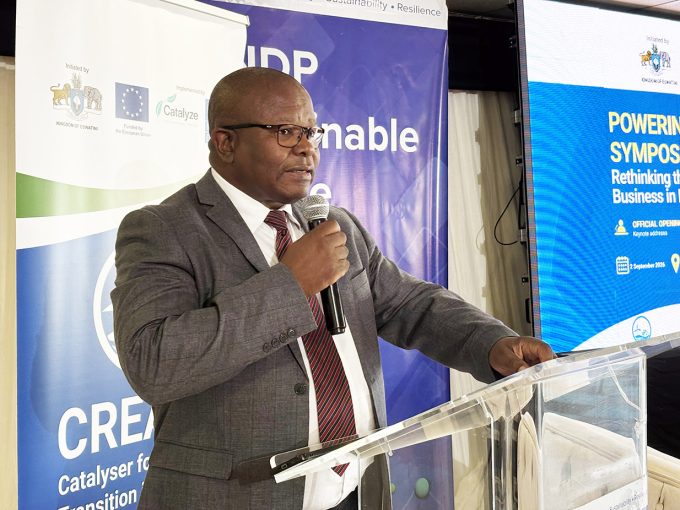
BUFE Operations Manager Mangaliso Maseko said the development would have a direct and immediate impact on operating costs, with the hospitality sector expected to be among the hardest hit.
“This will affect the business community, especially water-intensive businesses such as hotels, lodges, restaurants, food processors, laundries and manufacturing entities,” Maseko said.
He explained that the VAT application effectively pushes the cost of doing business up by about 15 per cent, at a time when many firms are already grappling with rising input costs, subdued demand and cash flow constraints.
Maseko noted that the VAT burden comes on top of existing standard water charges, which already place pressure on business finances. He said businesses currently pay additional standard charges ranging from E705 to E1 857, depending on their consumption category and service level.
“When you add VAT on top of these charges, it significantly raises monthly water bills. For businesses operating on thin margins, this is not a small adjustment – it directly eats into profitability,” he said.
He warned that sustained increases in utility costs could force some businesses to either pass the costs on to consumers through higher prices or cut back on operations, employment and investment.
According to BUFE, small and medium enterprises (SMEs) are likely to be the most vulnerable to the new cost structure, given their limited pricing power and weaker financial buffers.
Maseko pointed out that many SMEs are already facing serious cash flow challenges, largely due to late payments from government and other institutions.
“Some SMEs are struggling to stay afloat because invoices are not being settled on time. Adding higher utility bills into that mix worsens the situation and increases the risk of business failure,” he said.
*Full article available on Pressreader*


















Leave a comment