Home Business How Middle East war could hit every liSwati’s pocket
Business

How Middle East war could hit every liSwati’s pocket

Share
The eruption of war in the Middle East has sent a historic shockwave through global commodity markets that is now threatening to reach the doorsteps of every Eswatini household.
Share

MBABANE – The eruption of war in the Middle East has sent a historic shockwave through global commodity markets that is now threatening to reach the doorsteps of every Eswatini household.

A loaf of bread in Mbabane, a bag of maize meal in Manzini or cooking oil in a rural homestead—these everyday essentials for emaSwati are directly tied to a war unfolding thousands of kilometres away in the Middle East.

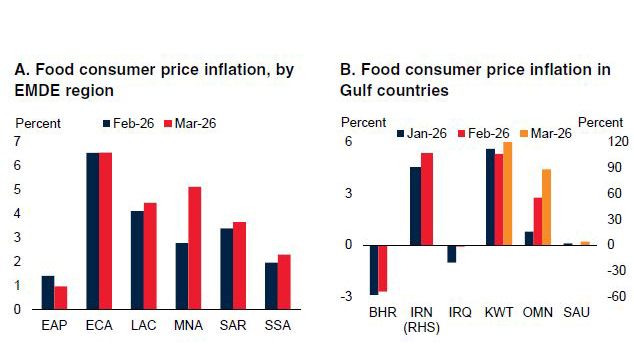
A new World Bank Commodity Markets Outlook (April 2026) Report paints a sobering picture: The conflict is not just a geopolitical crisis, but a global economic shock that is set to push up the cost of fuel, fertiliser and ultimately, food.

For a small, import-dependent economy like Eswatini, the implications are direct and far-reaching—touching everything from transport costs to supermarket prices.

At the centre of the unfolding crisis is a disruption to global energy markets. The report highlights that the war has severely affected trade through the Strait of Hormuz, one of the world’s most critical shipping routes for oil and gas.

Before the conflict, the Strait handled a significant share of global energy trade. Its disruption has triggered what the World Bank describes as the largest oil supply shock on record, with global supply falling sharply in March 2026.

Surged

Oil prices responded immediately. Brent crude surged dramatically, with global energy prices now projected to rise by 24 per cent in 2026.

For Eswatini, which imports all of its fuel, this translates into higher costs across the economy. Fuel is not just a commodity—it is a foundational input in transport, manufacturing, agriculture and retail.

When fuel prices rise:

  • Transport costs increase
  • Production becomes more expensive
  • Distribution costs escalate

These increases ultimately filter through to consumers in the form of higher prices for goods and services.

*Full article available on Pressreader*  

Share
Written by
Nhlanganiso Mkhonta

Nhlanganiso Mkhonta serves as Business Editor at the Times of Eswatini. He reports on business, economics, finance, investment, entrepreneurship and public policy, producing insightful coverage and analysis of the issues driving Eswatini’s economy and the wider African business environment.

Leave a comment

Leave a Reply

Your email address will not be published. Required fields are marked *

Don't Miss

Swazipharm blames ministry delays, commits to compliance

LOBAMBA – After being implicated in the delivery of medical drugs that were later recalled, prominent pharmaceutical supplier Swazipharm has reaffirmed its commitment...

DNA plan could swallow E126m of Home Affairs budget

MBABANE – Making DNA testing compulsory before issuing birth certificates could cost taxpayers about E126 million annually, enough to fund free Grade I...

Maloma Colliery calls for calm as wage talks continue

MBABANE - Maloma Colliery Ltd has offered employees a cumulative nine per cent salary increase over two years, but wage negotiations have reached...

Shembe forgives Zulu King after video fallout

MBABANE – Members of the Nazareth Baptist Church in Eswatini have rallied behind His Holiness Unyazi Lwezulu Shembe after he publicly forgave Zulu...

Family sues EEC over E6m for Mpolonjeni child electrocution

MBABANE - The Eswatini Electricity Company (EEC) is facing lawsuit of more than E6 million following an electrocution incident that allegedly claimed the...

Related Articles

FNB takes SME support directly to regions

MBABANE – FNB Eswatini is expanding its support for the country's small...

FDI inflows plunge to E810m in 2025

MBABANE – Eswatini attracted approximately E810 million (US$45 million) in foreign direct...

EIPA defers 2nd Investment conference

MBABANE – Government has postponed the highly anticipated second edition of the...

Tribunal clarifies insurance tax rules in landmark ruling

MBABANE – The Revenue Appeals Tribunal Eswatini (RATE) has delivered yet another...