
Home Business How Middle East war could hit every liSwati’s pocket
Business

How Middle East war could hit every liSwati’s pocket

Share
The eruption of war in the Middle East has sent a historic shockwave through global commodity markets that is now threatening to reach the doorsteps of every Eswatini household.
Share

MBABANE – The eruption of war in the Middle East has sent a historic shockwave through global commodity markets that is now threatening to reach the doorsteps of every Eswatini household.

A loaf of bread in Mbabane, a bag of maize meal in Manzini or cooking oil in a rural homestead—these everyday essentials for emaSwati are directly tied to a war unfolding thousands of kilometres away in the Middle East.

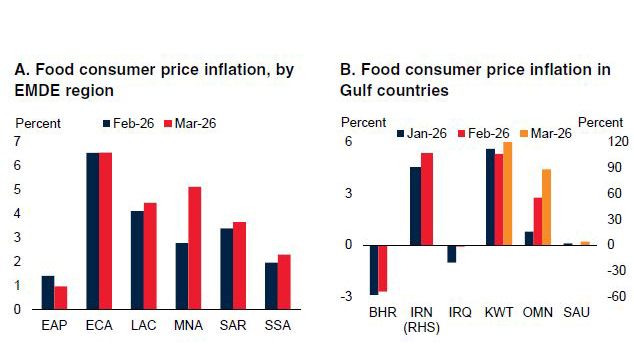
A new World Bank Commodity Markets Outlook (April 2026) Report paints a sobering picture: The conflict is not just a geopolitical crisis, but a global economic shock that is set to push up the cost of fuel, fertiliser and ultimately, food.

For a small, import-dependent economy like Eswatini, the implications are direct and far-reaching—touching everything from transport costs to supermarket prices.

At the centre of the unfolding crisis is a disruption to global energy markets. The report highlights that the war has severely affected trade through the Strait of Hormuz, one of the world’s most critical shipping routes for oil and gas.

Before the conflict, the Strait handled a significant share of global energy trade. Its disruption has triggered what the World Bank describes as the largest oil supply shock on record, with global supply falling sharply in March 2026.

Surged

Oil prices responded immediately. Brent crude surged dramatically, with global energy prices now projected to rise by 24 per cent in 2026.

For Eswatini, which imports all of its fuel, this translates into higher costs across the economy. Fuel is not just a commodity—it is a foundational input in transport, manufacturing, agriculture and retail.

When fuel prices rise:

  • Transport costs increase
  • Production becomes more expensive
  • Distribution costs escalate

These increases ultimately filter through to consumers in the form of higher prices for goods and services.

*Full article available on Pressreader*  

Share
Written by
Nhlanganiso Mkhonta

Nhlanganiso Mkhonta serves as Business Editor at the Times of Eswatini. He reports on business, economics, finance, investment, entrepreneurship and public policy, producing insightful coverage and analysis of the issues driving Eswatini’s economy and the wider African business environment.

Leave a comment

Leave a Reply

Your email address will not be published. Required fields are marked *

Don't Miss

Customary marriages declared in community of property

MBABANE – The High Court has declared the long-standing practice of treating marriages under Eswatini Law and Custom as being out of community...

Inyatsi Construction building foundations of First World future

For more than four decades, Eswatini has witnessed one of the most significant periods of infrastructure development in its history. Under the leadership...

No more USA Visa processing in Eswatini

MBABANE – In a move that will significantly alter travel logistics for Eswatini nationals, the United States Embassy in Mbabane will cease accepting...

King moves to save Ncangosini residents from eviction

KONTSHINGILA – Hundreds of residents living on a privately owned farm at Ncangosini, Kontshingila, are set to be spared from eviction after an...

Each MP set for E1m handshake

MBABANE – When the 12th Parliament assumed office in 2023, an ordinary Member of Parliament (MP) was earning a basic monthly salary of...

Related Articles

Eswatini among southern Africa’s fastest-growing economies

MBABANE – Eswatini is expected to remain among Southern Africa’s strongest-performing economies...

ERS coming for high-net-worth individuals

MBABANE – Eswatini Revenue Service (ERS) is seeking to ensure wealthy individuals...

SA economic woes cast shadow on Eswatini 

MBABANE – Eswatini remains one of Southern Africa’s stronger fiscal performers, although...

SADC banks resilient despite global economic pressures

EZULWINI – Regional banking systems have remained sound and well-capitalised despite mounting...