

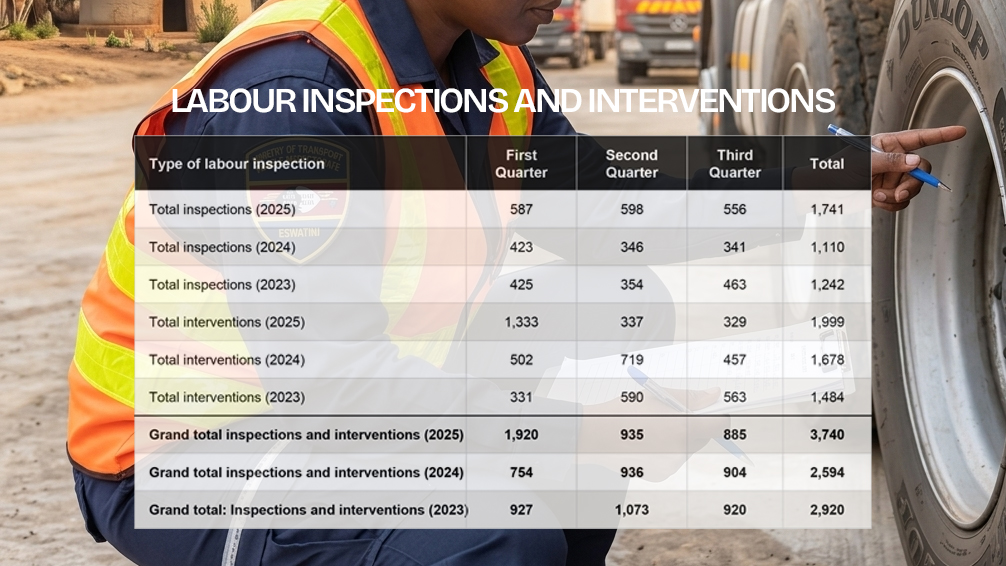
MBABANE – There is a shortage of inspectors as only 19 inspectors are responsible for monitoring more than 50 000 companies nationwide.
This was said by the Ministry of Labour and Social Security which has led to stakeholders calling upon the portfolio being accorded an improved budget allocation.
The stakeholders, which include representatives of employees and employers, said the shortage of personnel under the General Inspectorate Unit is crippling the Ministry of Labour and Social Security’s ability to effectively enforce labour laws and ensure compliance in workplaces.
As per the Ministry of Labour and Social Security’s Annual Report for the period April 1, 2025 to December 31, 2025, this department is responsible for ensuring compliance with statutory basic minimum terms and conditions of employment as established through the Employment Act No. 5 of 1980, the Wages Act No. 16 of 1964, the Workmen’s Compensation Act No. 7 of 1983, the Industrial Relations Act No. 1 of 2000 (as amended), the Regulations of Wages Orders set by the 18 wages councils for various sectors of the economy, among other pieces of legislation.
This, it is said, is done through conducting labour inspections in the various workplaces liable for inspection.
The ministry explains that the labour inspection process entails inspecting employees’ personal files to verify the availability of written particulars of employment, perusing them to establish if the written particulars of employment are in line with the labour standards, inspecting employment registers, wages registers, inspecting annual leave forms, workmen’s compensation policies, pay slips, the work environment, etc.
The inspector also conducts interviews with the employer, the workers or their representatives or shop stewards, in cases where there is a recognised trade union, staff association or workers committee.
Meanwhile, Labour Commissioner Kingdom Mamba said the Labour Department is currently understaffed and faces limited transport resources, with only four operational vehicles available despite the ministry having seven stations across the country.
He said this on Thursday before the Public Accounts Committee (PAC). Mamba added that the ministry relies heavily on members of the public reporting labour law violations because inspectors cannot cover every workplace due to limited resources. He also said government recently hired a legal officer to assist in taking non-compliant employers to court.
In response to his assertions, stakeholders said the shortage of labour inspectors is undermining workers’ rights, compromising workplace safety and threatening the country’s ability to meet international labour standards required for export markets.
They further warned that the country risks damaging its international reputation as this will lead to deteriorating labour standards. They said Eswatini could struggle to comply with conventions set by the International Labour Organization (ILO), which promotes fair labour practices and decent working conditions globally.
As a result, they are calling on government to significantly increase the budget allocated to the Ministry of Labour and Social Security. They believe additional funding would enable the ministry to recruit more inspectors, improve transport capacity and strengthen workplace monitoring across the country.
The Federation of Eswatini Business Community (FESBC) Chief Executive Officer (CEO), Benjamin Simelane, said his entity appreciates all the efforts that the Ministry of Labour and Social Security does with limited resources.
However, Simelane said as stipulated in the Industrial Relations Act of Eswatini, Labour inspectors play an indispensable role in safeguarding fair and safe working environments.
He said their responsibilities include monitoring and enforcing compliance with labour laws, including standards related to salaries and wages, working hours, conditions and occupational health and safety.
*Full article available on Pressreader*


















Leave a comment