

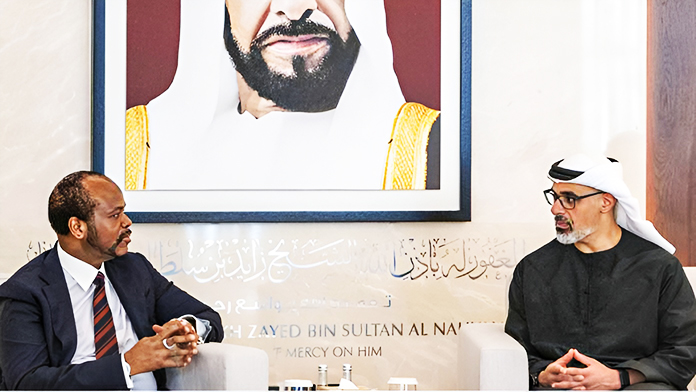
ABU DHABI, UAE – His Majesty King Mswati III, accompanied by Inkhosikati LaMashwama, Emazinyane and Libandla yesterday visited the Zayed National Museum where he was taken through the history of the United Arab Emirates (UAE).
The national museum celebrates the rich history, culture and stories of its people from ancient times to modern day UAE. His Majesty the King and Inkhosikati were taken through the vast and spacious interior of the museum, where he was informed about the UAE founding father, the late Sheikh Zayed bin Sultan AI Nahyan, whose enduring example still guides and shapes the nation and its people even today.
The King was received by the national museum director Dr Peter Muge and protocol Ahmed Obaid, who took him and the delegation through the various exhibitions which, with pictures and videos, details the birth and life of the late Sheikh, culture and development of today’s UAE.
It is said that growing up in the AI Ain’t Oasis, Sheikh Zayed learnt from listening to the community. People often gathered under the shade of Ghaf tree, which served as a place to hold majlis, where shura (collective counsel) was practiced and shared (something similar to ancient emaSwati life (imiphakatsi and tinkhundla).
The founding father Sheikh Zayed understood that people should have access to their leader. He ensured that. UAE’s system of governance was founded on the principles of majlis and shura, in which leaders are accessible for consultation.
It is said that alongside his deep Islamic faith, this experience guided the late Sheikh Zayed throughout his life. The Falcon bird is deeply embedded to the Emirati culture, something the late Sheikh learnt early in his life.
It is said that from the young age, Sheikh Zayed showed a keen interest in falconry, a practice he learnt from his elders. “He learnt falconry when it was a means of survival, through hunting expeditions. He gained a deeper understanding of the natural landscape and companionship, both with the falconers and their falcons. Fatah, a saker falcon known locally as a hurr, was one of his favourites,” some of the writings displayed at the museum describe the late Sheikh.
He would later reflect on the falconry’s leadership lessons: “Falconry is a pursuit that demands perseverance and patience, offering no reprieve. It involves embarking on an expedition without any indulgences of diversions – it allows me to travel expansive lands and deserts and encounter numerous individuals from whom I can learn about different lifestyles.”
It is said that Sheikh Zayed’s knowledge of the natural landscape, his skills of navigation and the trust the community had in him meant he was often asked to help guide people across the emirate.
It is stated that in the 1930s, Sheikh Shakhbut bin Sultan AI Nahyan, the ruler of Abu Dhabi, invited geologists to begin searching for oil in the emirate. Knowing how important this search was, Sheikh Shakhbut asked Shiekh Zayed to work closely with the geologists and to guide them. “On January 11, 1939, Sheikh Shakhbut signed a 75-year oil concession between Abu Dhabi and the British company Petroleum Development (Crucial Coast Ltd). Today, the UAE holds all rights to its oil through Abu Dhabi National Oil Company (ADNOC).
*Full article available on Pressreader*











Leave a comment