

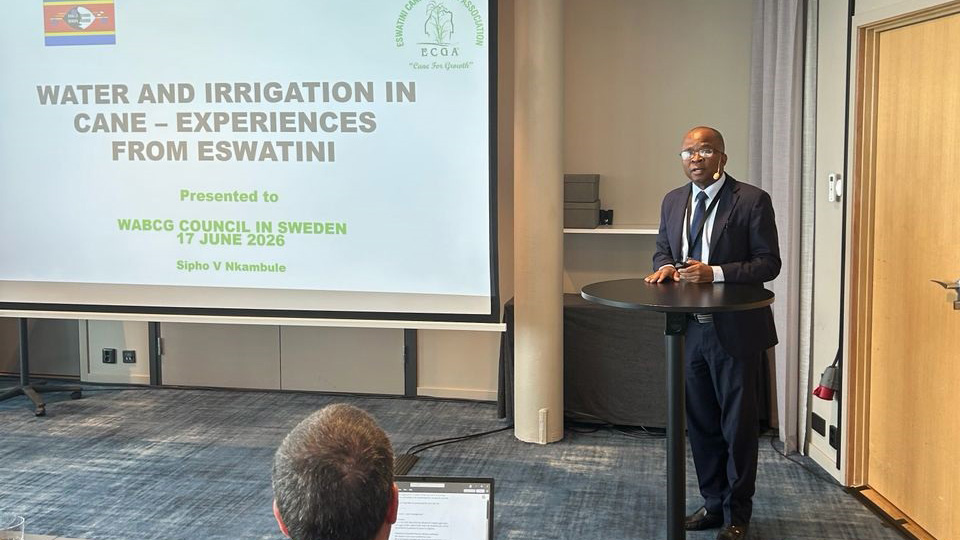
MBABANE – Eswatini’s sugar industry has taken its water management and irrigation expertise to the global stage.
Eswatini Cane Growers Association (ECGA) Chief Executive Officer Dr Sipho Nkambule presented the country’s experiences in irrigation and climate resilience during the ongoing World Association of Beet and Cane Growers (WABCG) Conference in Sweden.
Dr Nkambule addressed delegates from some of the world’s leading sugar-producing countries, highlighting how Eswatini’s sugar industry has managed to sustain production in one of Southern Africa’s most water-dependent agricultural sectors despite growing climate-related challenges, rising energy costs and increasing pressure on limited water resources.
His presentation, titled ‘Water and Irrigation in Cane – Experiences from Eswatini’, showcased the country’s extensive irrigation infrastructure, innovative water management practices and ongoing efforts to improve water-use efficiency while safeguarding the long-term sustainability of the industry.
The presentation comes at a time when water security has become a critical issue for agricultural producers worldwide as climate change continues to intensify droughts, floods and other extreme weather events.
According to figures presented by Dr Nkambule, sugarcane remains the largest consumer of water in Eswatini, accounting for approximately 80 per cent of the country’s allocated water resources.
Other agricultural activities account for 15 per cent, while domestic use represents 3 per cent, with industry and livestock each accounting for 1 per cent.
*…
… energy costs drive innovation
MBABANE – The close relationship between water and energy usage has become another key focus area for growers.
With irrigation requiring substantial electricity and fuel inputs, rising energy costs have placed additional pressure on farm profitability.
To address this challenge, the industry is investing in energy-saving technologies such as variable speed drives for irrigation pumps.
Growers are also working to optimise electricity consumption through time-of-use tariffs that encourage pumping during lower-cost periods.
Beyond efficiency measures, the industry is increasingly exploring renewable energy solutions.
Eswatini Cane Growers Association (ECGA) Chief Executive Officer Dr Sipho Nkambule revealed that growers are rolling out solar energy projects aimed at reducing both electricity costs and carbon emissions.
The recent approval of feed-in tariffs by the country’s energy regulator is expected to accelerate solar adoption by allowing producers to sell excess power back into the national grid.
The presentation also highlighted several technological innovations currently being piloted within the industry.
These include 3 yield forecasting and crop monitoring tools designed to provide growers with better information for decision-making.
*Full article available on Pressreader*
















Leave a comment