

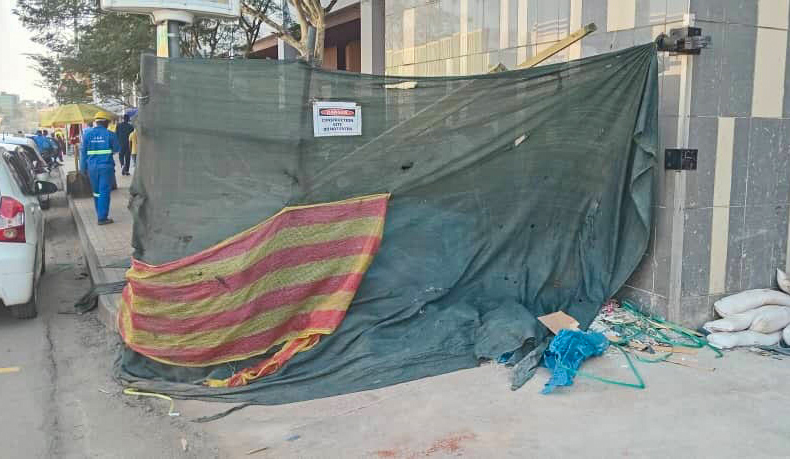
MANZINI – If the law was contravened during the execution of the Bhunu Mall project in Manzini, those responsible face a jail sentence.
This is in terms of the Registration of Architects, Engineers, Surveyors and Allied Professionals Regulations (AESAP), 2018, the Building Act of 1968, among other legislation.
The AESAP Act and Regulations are very strict on who can work on a project site. Ordinarily, the project team comprises the owner, project manager, engineers and other professionals. It has been learnt that the law provides for fines up to E100 000 or up to 10 years imprisonment.
According to AESAP law: “A person or entity that fails to comply with a provision of these Regulations commits an offence and where no penalty is provided under the respective provision of the act, such person shall be liable to a penalty not exceeding E50 000 or imprisonment for a period not exceeding five years or to both.”
It must be said that the AESAP law is read with several others, including the Standard Building Regulations, Building Act, Urban Government Act and Construction Industry Council Act, which, in the case of project managers, refers to them as ‘construction managers’.
The law suggests that nobody can wake up and claim to be a builder, architect, project manager, engineer, quantity surveyor or any other professional in the built environment.
According to the law, a person must have the right papers to work as a construction project manager, electrical engineer, architect or any other professional. Suppose a person is found to have been working at the Bhunu Mall without the right papers, the law provides a punishment.
It is provided in this legislation that: “A person shall not work as a candidate or architect, engineer, surveyor, allied professional or technologist or technician without a valid registration certificate issued by the council.”
The law does not stop at just saying one must have a certificate. It gives a clear punishment for those who choose to ignore the rules. It must be said that having a registration certificate is not the only rule.
According to the law, a professional in the built industry must also have a ‘practising licence’.
It is provided in this piece of legislation that: “A person registered as a professional architect, engineer, surveyor or allied professional shall be required to have an annual practising licence issued by the council in addition to the registration certificate for that person to practise.”
To get these important papers, a person must show his tertiary qualifications. In terms of the law, a professional cannot just bring any paper to the council as it provides strict steps for applying.
It is said that: “The application shall be accompanied by – (a) certified copies of proof of qualifications; (b) a certified copy of identity card or document; (c) proof of payment of the application fee; and (d) proof of membership of a recognised relevant professional association.”
The council shall check these tertiary papers very carefully to ascertain whether the professional went to a real and recognised school. Regarding a candidate applicant, the council shall particularly evaluate the academic qualifications of the applicant with a view to ascertaining if – (a) the qualification was obtained from a recognised learning institution; and (b) the applicant is sufficiently qualified for the registration applied for.”
The law provides that a person must also have real work experience before they can work on a big site like the Bhunu Mall. The law provides that they must work under a senior person for some years.
It is provided in the law that: “An application to sit for a professional assessment examination shall be made in the prescribed form and shall be accompanied by – (a) proof of academic qualifications of the applicant; (b) proof that the applicant has worked under the supervision of a professional for a period of at least three (3) years after obtaining academic qualifications; and (c) proof of payment of the application fee prescribed in the respective Schedule.”
After the three years of working, the person must pass a hard test. According to the law, the test checks their real knowledge.
The law provides details on how the test is done. It is provided in the law that: “The professional assessment examination that an applicant has to pass in order to be entitled to be registered as a professional architect, engineer, surveyor, allied professional or technician shall consist of – (a) a professional interview conducted by not less than two examiners appointed by the council, who shall be registered professionals of not less than 10 years’ experience.”
The law provides rules for starting a practice. It is provided in the law that “A person shall not establish an architectural, engineering, surveying or allied professional practice within Swaziland (Eswatini) unless such person – (i) is a citizen of Swaziland (Eswatini) or has been lawfully residing in Swaziland (Eswatini) for a period of at least five (5) years; and (ii) has a registration and a practising certificate issued by the council.”
It is provided in the law that: “A registered professional shall discharge the duties to their employer or client as the case may be with complete fidelity.”
It is also provided in law that they must not try to steal jobs from other professionals. It is provided in the law that: “A registered professional shall not directly or indirectly – supplant or attempt to supplant another registered professional.”
Regarding bad behaviour, it is provided in the law that: “The council shall forward all complaints to the Investigation Committee appointed in terms of section 55 of the Act for investigation.”
The investigators will look at the facts. If they find that the person did wrong, they will send the matter to the disciplinary committee. According to the law, the bad behaviour is recorded forever.
It is provided in the law that: “The council shall keep and maintain a register for recording defaults of professional misconduct committed by a registered person.” The council can even remove the person from the register.
It is provided in the law that “The council shall have power to take any action including suspension or deletion from any register a registered person, where there is re-occurrence of defaults on professional misconduct.”
Even if a person has worked for many years without papers, the law gives them a chance to fix their mistake.
It is provided in the law that: “Where an applicant has been working without registration in Eswatini for more than 15 years, that applicant may file a special application to be registered as a professional under this regulation.”
However, they must still pass the tests and pay the fees. Professionals said they would not openly talk about the Bhunu Mall incident because they may be required to assist in the ongoing investigation.
Phumlani Matse, the Information and Communications Manager in the Municipal Council of Manzini, said the local authority issued a statement expressing commitment to revealing all verified details as they become available after the investigation. “For now, we await the investigations to provide these details,” Matse said.
Chief Executive Officer of AESAP Lwazi Mthimkhulu told our sister publication, the Times of Eswatini, that they are also investigating the matter.
The project manager was KAM Corporate while the main contractor was J&E Construction. The civil/structural engineer is E.D Simelane and Associates. The CEO and founder of KAM is Reverend Alex Mngomezulu. It is said that Rev Mngomezulu’s entry into the AESAP records is predicated on his pursuit of a project management course.
However, the law mandates that the project management qualification must be in the built environment.




















Leave a comment