

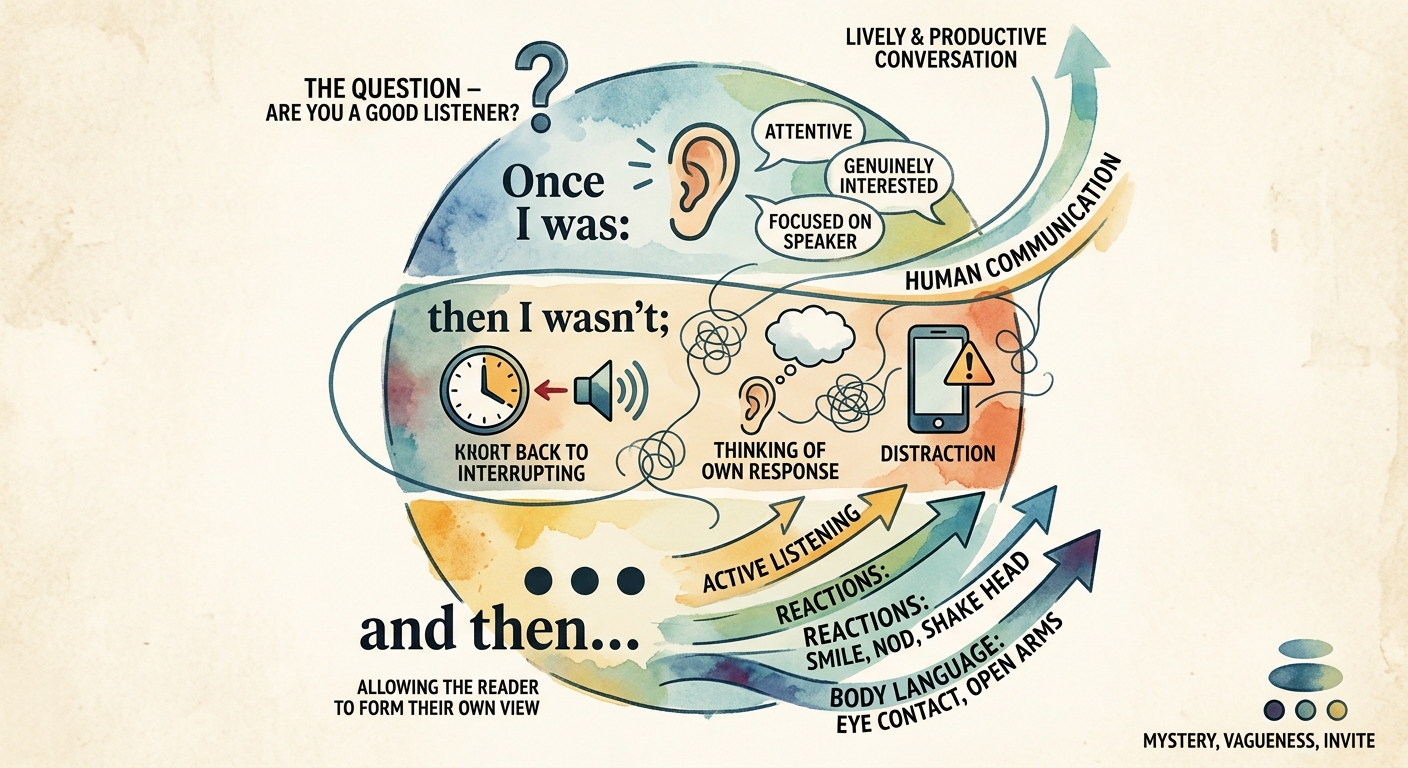
Once I was; then I wasn’t; and then … I have used the three full stops, which has become, in modern usage, a way of allowing the reader to form their own view or conclusion. Or perhaps the writer is creating an element of mystery; or is simply too lazy to finish. Well, it is the first option, though so vague that the reader is entitled to ignore the invitation; but an explanation will follow later in the article. If you care to read on or I could say listen, I will share with you the world of good listening. The title is a question – are you a good listener? It is a question that perhaps a very substantial proportion of any national population may never have asked themselves.
Vocal interaction is a vital component of human activity; and right at the top of valuable human communication is lively and ideally productive conversation, with attentive listening being as vital to it as what is delivered by the speaker. Unless someone is listening, you are wasting your time talking. Though not entirely, I would suggest. It can be useful to chat to oneself when organising a shopping list or the contents of a suitcase; or even when voicing criticism of one’s own forgetfulness in losing a vital document. Arguing aloud with oneself is a stage further, but not recommended. Not all conversations go well. Too often there is the dominant talker or the distracted listener. The mix should be shared to the extent that the participants feel comfortable. Unfortunately, there are far more lively talkers than patient, attentive listeners. Unless it is a formal occasion of speeches or academic lecturing where polite listening and other good behaviour is mandatory, there should always be a happy sharing of talking and listening, though with no specific or even implicit, allocation of talking and listening time. I started this article with a strange sentence. To put it in perspective, please allow me to slip back into a moment of reflective vanity in order to make my point.
I was told as a late teenager by a very good friend at university that I was a good listener. This guy was Norwegian and I might, of course, have been simply concentrating intensively, trying to work out what he was saying. The natural Norwegian tongue in modern humour is allegedly like German spoken underwater. Forgive me, Bjorn and the 5.7 million other citizens of that lovely country.
Then whatever happened, I moved on to many years of poor listening, mostly when trying to impress the ladies; and the three full stops in that opening sentence mean that the jury is out on where I am today. So allow me please, without further ado, to dive into what constitutes good listening. It becomes self-explanatory when I call it active listening.
There are certain features of active listening that are absolutely vital to the role of an active listener. Firstly, we should always allow the speaker to finish what they are saying and give that impression very clearly too. Then, secondly, it is vital to take a genuine interest in what the speaker is saying and thirdly, to react to it. One of the most unsettling aspects when talking in a conversation is the awareness of a listener evidently preparing what they are going to say, and positively bristling in anticipation. Then, worst of all, you may encounter the so-called listener who is always interrupting. I was once a lame participant in a conversation between four people where one person, quite well-known, never allowed another person to finish a sentence. We should always concentrate on avoiding those mistakes ourselves. That is not always easy, especially in particularly lively discussions.
There are certain important refinements to the basics of good listening.
The right body language is valuable. The first feature is reasonably sustained eye contact, avoiding uninterrupted eye contact, which can be disconcerting to the speaker. Reacting naturally and silently to what is being said includes the smile, the nod, the shake of the head, depending on the speaker’s content, of course. That is rewarding to the speaker. Furthermore, there should be no gazing at the cellphone, with conversation only interrupted by emergency calls. A sophisticated technique is where the listener takes further whatever the speaker says. Listening in a sitting or standing position with arms crossed is to be avoided.
One of the most satisfying experiences for a speaker is to be talking to someone who is clearly and genuinely interested and appears to have an open mind. The early pioneer of self-improvement, Dale Carnegie, wrote about when at an important function he happened to attract the attention of an eminent botanist. This lady proceeded to talk non-stop about her work. Carnegie wrote that: “I was really interested in what the lady was saying but couldn’t find anything sensible to say. In fact, I felt rather inferior because of that. But what came as quite a shock was when the hosts told me later that the lady, when leaving, pointed in my direction and asked the hosts – “Who is that man? I had such an interesting conversation with him.”


















Leave a comment